
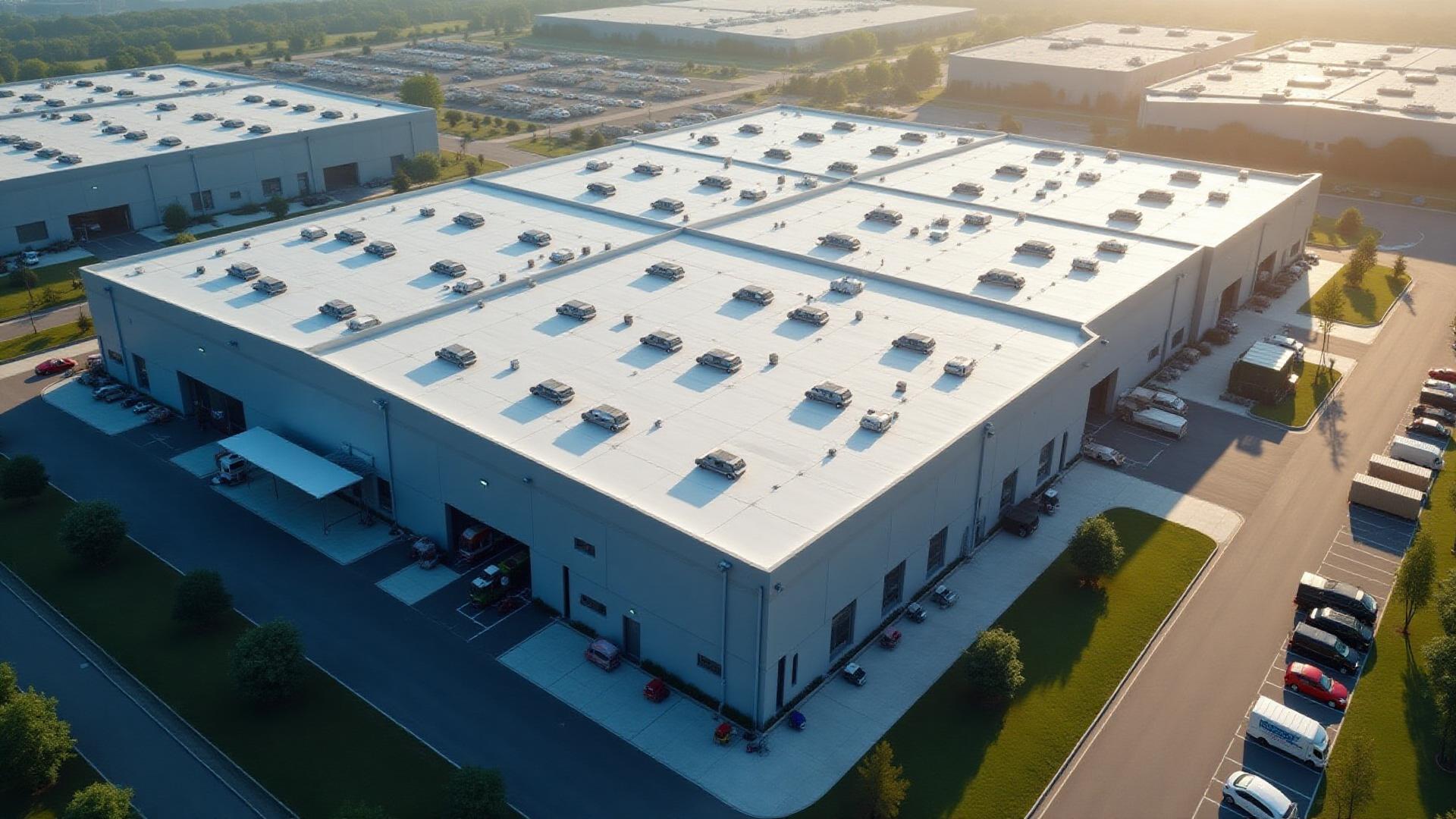
Commercial Roofing for Warehouses & Distribution Centers
Large-scale performance in Texas & Oklahoma. Minimal disruption. Maximum protection.
Understanding Warehouse Roofing Challenges
Warehouse and distribution center roofing presents unique considerations that differ significantly from office buildings, retail properties, or manufacturing facilities. The combination of massive square footage, 24/7 operations, minimal interior access points, and tight operating margins creates specific requirements for roofing system selection, installation approach, and long-term maintenance.
For facility managers and property owners in Texas and Oklahoma, these challenges compound with regional factors: intense summer heat that drives cooling costs, severe hail exposure that threatens large unprotected roof surfaces, and the reality that any operational disruption multiplies across hundreds of thousands of square feet.
Making informed roofing decisions for warehouse properties requires understanding how system choices, installation timing, and maintenance approaches affect both immediate costs and long-term facility operations.
Scale Changes Everything
A 50,000 sq ft office and a 500,000 sq ft distribution center face fundamentally different roofing economics
The Budget Reality
When you're looking at 200,000+ square feet, every dollar per square foot compounds dramatically. The difference between a $5.50/sq ft system and a $7.50/sq ft system isn't just $2 per square foot—it's $400,000 on a 200,000 sq ft building.
Many warehouse owners focus intensely on minimizing upfront cost, which often leads to selecting the most economical system that meets basic performance requirements. This makes sense when deploying capital across multiple facilities or when the building's hold period is under 15 years.
However, a system that costs $1/sq ft less initially but requires replacement 5 years sooner may actually cost more over 20 years when you factor in business disruption, logistics coordination, and compounding effects across massive square footage.
Installation Logistics at Scale
Installing 200,000+ square feet of roofing isn't just a bigger version of a 20,000 sq ft project. The logistics, sequencing, and business coordination requirements change fundamentally.
Material staging alone requires different approaches. You can't simply deliver 200,000 sq ft of membrane to a warehouse operating at full capacity. Installation typically requires carefully sequenced material deliveries, section-by-section approach, and coordination with facility operations.
Weather windows matter more at scale. A storm that delays work for three days on a small building might cause a week of delays on a large warehouse, as contractors can't simply "catch up" when dealing with such massive areas.
System Selection for Warehouse Properties
Choose the right system based on your budget, hold period, and operational requirements
EPDM (Rubber Roofing)
The traditional warehouse choice with lowest upfront cost
Budget-focused projects, shorter hold periods, minimal climate control needs
Key Benefits
- Lowest installed cost for large square footage
- Proven performance dating back to 1960s
- Available in large sheet sizes (up to 50 feet wide)
Considerations
- Black membrane absorbs heat, increasing cooling loads
- Less energy-efficient than white TPO or PVC
TPO Membrane
The modern alternative with energy efficiency benefits
Climate-controlled warehouses, sustainability goals, long-term holds
Key Benefits
- White reflective surface reduces cooling costs
- Heat-welded seams provide reliable long-term performance
- Often meets utility rebate programs
Considerations
- Slightly higher upfront cost than EPDM
- Quality varies significantly between manufacturers
Standing Seam Metal
The long-term investment for maximum protection
Long-term holds (20+ years), hail-prone areas, solar-ready facilities
Key Benefits
- 40-50+ year service life eliminates mid-life replacement
- Excellent hail resistance (Class 4)
- Superior energy performance with cool roof coatings
Considerations
- Higher upfront cost
- Requires structural capacity verification
Not sure which system is right for your warehouse?
Energy Performance in Warehouse Applications
Even modest per-square-foot savings compound significantly across massive warehouse footprints
Climate Control Savings
Many warehouses maintain 50-90°F rather than office-standard 68-72°F. While per-square-foot energy savings are smaller than heavily conditioned spaces, the massive square footage means significant absolute savings.
A white TPO roof that reduces energy costs by $0.10/sq ft annually saves $20,000 per year on a 200,000 sq ft warehouse—$400,000 over 20 years.
For refrigerated warehouses or cold storage facilities, the energy equation becomes even more compelling as reflective roofing directly reduces refrigeration loads.
Solar Reflectance Values
In North Texas summer conditions, roof surface temperatures can exceed 170°F on black membranes versus 130°F on white membranes—directly impacting HVAC loads.
Utility Rebates & Incentives
Many Texas utility companies offer rebates for cool roof installations on commercial properties. These typically range from $0.10-$0.25 per square foot, which can offset $20,000-$50,000 of installation cost on a large warehouse. Check with your local utility provider about available programs.
Hail Exposure and Risk Management
Large warehouse roofs present substantial hail exposure simply due to the square footage involved
The 2023-2024 Reality Check
Recent hail events have dramatically affected warehouse properties across Texas and Oklahoma:
- June 2023 Dallas-Fort Worth: $7-10 billion in insured losses, 95% from hail
- May 2024 North Texas: $2.3 billion in damage from softball-sized hail
- April 2023 Oklahoma: 480,000 structures damaged in a single day
Standard TPO and EPDM membranes typically survive 1-inch hail without significant damage. Golf ball-sized hail (1.75 inches, common in severe Texas and Oklahoma storms) often causes punctures requiring immediate repair or full replacement.
Class 4 Options for Warehouses
Reinforced TPO/PVC
Achieves Class 4 rating with proper substrate. Adds approximately 15-20% to project cost.
Standing Seam Metal
Inherently provides excellent hail resistance. Extended lifespan plus hail protection often makes financial sense.
Cost-Benefit Example
A 200,000 sq ft facility might pay $150,000-$200,000 premium for Class 4 system. The value comes from avoiding storm-related replacements and downtime. Ask your insurer whether your policy offers a credit.
Minimizing Business Disruption
Warehouse operations typically can't pause for roofing work—we plan around your business
Phased Installation Approach
Coordination Requirements
Successful warehouse reroofing requires close coordination between the roofing contractor and facility operations:
- Loading dock access and timing
- Forklift and equipment traffic patterns
- Material staging areas that don't interfere
- HVAC system shutdown/restart schedules
- Fire system impairment notifications
- Safety protocols for contractor/employee interaction
Typical Project Timeline
Large warehouse reroofing projects require 3-5 months total for typical facilities
Planning & Engineering
4-8 weeks
Structural evaluation, system selection, contractor selection, material ordering
Tear-Off (if required)
2-4 weeks
For 100K sq ft, tear-off typically takes 10-15 working days
New System Installation
4-8 weeks
TPO/EPDM: 3-5 weeks. Metal roofing: 6-10 weeks due to complexity
Inspection & Closeout
1-2 weeks
Final inspections, warranty documentation, facility walk-through
Seasonal Timing
Optimal windows: March-May (before peak heat) and September-November (after summer). Avoid if possible: July-August (extreme heat affects installation quality) and December-February (cold limits membrane installation). Spring hail season (April-May) creates tension between optimal temperatures and severe weather risk—many facility managers prefer fall installations.
Refrigerated & Cold Storage Facilities
Cold storage warehouses and refrigerated distribution centers face specialized roofing challenges beyond standard warehouse considerations.
Refrigerated facilities require enhanced insulation (typically R-30 to R-40 or higher) to minimize heat gain and reduce refrigeration costs. The roof becomes a critical component of the thermal envelope, not just weatherproofing.
Vapor retarder placement, detailing at penetrations, and proper sealing are critical for long-term performance. This specialized knowledge separates contractors experienced with cold storage applications from those primarily working on standard warehouse buildings.
Cold Storage Requirements
- Enhanced Insulation: R-30 to R-40+ to minimize heat gain and reduce refrigeration costs
- Vapor Retarders: Critical to prevent moisture migration that can destroy insulation and create ice formation
- Thermal Bridging Mitigation: Address metal structural elements that penetrate insulation
- Heat-Welded Seams: TPO and PVC preferred for excellent moisture resistance in constant temperature differentials
Maintenance Programs for Large Facilities
Preventive maintenance that extends roof life by 3-5 years more than pays for itself
Per Sq Ft Annually
Comprehensive maintenance program cost for large facilities
Annual Investment
For a 200,000 sq ft warehouse facility
Extended Roof Life
Defers replacement capital expenditure significantly
Key Maintenance Activities
Semi-Annual Inspections (Spring & Fall)
- Drain and gutter cleaning (critical for ponding prevention)
- Seam integrity assessment
- Penetration flashing evaluation
- Membrane surface condition documentation
- Drainage system verification
Annual Professional Assessment
- Detailed inspection by roofing professional
- Remaining service life evaluation
- Repair priorities and cost estimates
- Budget planning for eventual replacement
- Post-storm damage documentation
Frequently Asked Questions
Common questions about warehouse and distribution center roofing
Protect Your Warehouse Investment
Keep your operations running smoothly with a roof system designed for performance, durability, and minimal business disruption.
Warehouse Roofing Specialties
Dive deeper by facility type, roof system, service, or metro area. Each page covers the specific requirements, costs, and approach for that niche.
By Facility Type
Distribution Centers
Large-format TPO and PVC for 24/7 logistics operations
Cold Storage Roofing
Vapor retarders, R-30+ insulation, condensation control
Fulfillment Centers
Peak-season scheduling for e-commerce operations
Self-Storage Facilities
Standing seam metal for multi-building portfolios
Flex Industrial
Mixed office and warehouse, multi-tenant coordination
3PL Logistics
Phased reroofing around third-party logistics operations
By Roof System
Warehouse TPO Roofing
Reflective white membrane, energy savings at scale
Standing Seam Metal
40-50+ year service life, best hail resistance
Warehouse EPDM Roofing
Lowest installed cost for budget-driven portfolios
Warehouse PVC Roofing
Chemical and grease resistance for industrial uses
Warehouse Roof Coatings
Restoration at 30-40% of replacement cost
By Service
Warehouse Roof Replacement
Phased full tear-off and recover for large facilities
Warehouse Roof Repair
Targeted membrane, seam, and flashing repairs
Emergency Roof Repair
Priority dispatch for storm and leak service
Warehouse Roof Inspections
Drone, infrared, and core sampling assessments
Preventive Maintenance Plans
Semi-annual programs that extend roof life 3-5 years
Hail Damage Repair
Insurance documentation, Class 4 replacements
Leak Detection
Electronic leak detection and infrared moisture surveys
By Metro Area
DFW Warehouse Roofing
Serving the largest industrial market in Texas
Houston Warehouse Roofing
Port logistics, petrochemical, and distribution facilities
San Antonio Warehouse Roofing
I-35 / I-10 industrial corridor coverage
Oklahoma City Warehouse Roofing
Aerospace, energy, and distribution warehouses
Tulsa Warehouse Roofing
Energy corridor and manufacturing facilities
Looking for related coverage? See commercial flat roofing, Class 4 hail-resistant systems, or standing seam metal roofing.