PVC Roofing Cost in Texas: What Commercial Buildings Actually Pay and When the Premium Makes Sense
| By TriVAN Roofing | 11 min read
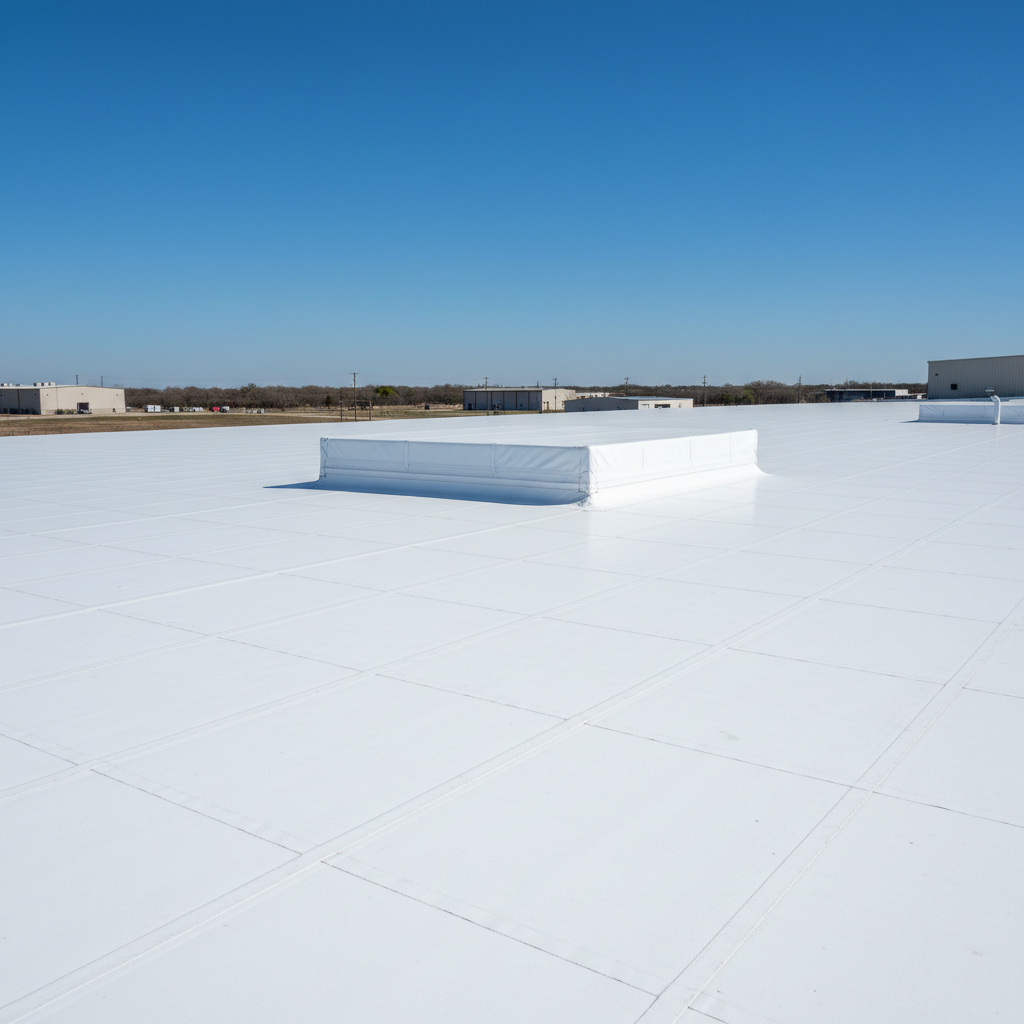
Explore actual PVC roofing costs in Texas, from $5.15 to $16.00+ per sq. ft. We break down what drives prices, from membrane thickness to factory-fabricated Duro-Last systems, and show when the premium over TPO offers a genuine long-term ROI.
Categories: Roofing Materials
PVC Roofing Cost in Texas: What Commercial Buildings Actually Pay and When the Premium Makes Sense
Let's address the number that gives many facility managers and building owners pause. A PVC roof typically costs 20% to 30% more upfront than its main competitor, TPO. For a large commercial facility in Texas, that percentage represents a significant capital expense. This often leads to a simple conclusion: PVC is too expensive. But that conclusion is incomplete. The real question isn't just "What does it cost?" but "When is that higher cost a rational, value-driven investment?"
Sometimes, it isn't. For a standard warehouse with no unusual chemical exposure, TPO’s lower upfront cost often makes it the more sensible financial choice. But for a surprising number of Texas properties, from restaurants to chemical plants to manufacturing facilities, opting for the cheaper material upfront can lead to catastrophic expenses down the road. This guide breaks down the actual installed costs for premium PVC roofing systems, clarifies what those numbers include, and provides a clear framework for deciding when the PVC premium pays for itself many times over.
The National Picture: Published PVC Roofing Costs in 2026
To establish a baseline, we can look at data aggregated by independent industry analysts. It’s important to note that these are national averages, and pricing in the Dallas-Fort Worth, San Antonio, or Oklahoma City markets can vary based on labor rates, material availability, and local code requirements. However, they provide a solid starting point for budgeting.
- According to the 2026 independent cost guide from roofobservations.com, installed PVC costs can range from $5.15 per square foot for a basic 50-mil membrane installed over an existing roof to $14.65 per square foot for a high-performance, fully adhered 80-mil system with R-30 insulation that meets current Texas energy codes.
- The 2026 commercial roofing benchmarks from pipelineon.com place the typical range for standard PVC systems between $6.00 and $10.00 per square foot installed.
- Data from risingsunartscentre.org for 2026 pricing shows that the premium systems segment, where factory-fabricated products like Duro-Last reside, typically runs from $10.50 to $16.00 per square foot.
This wide range highlights a critical point: "PVC roofing" isn't one single product with one single price. The final cost is determined by a series of specification choices and project-specific conditions.
What "Installed Cost" Actually Includes (and What It Doesn’t)
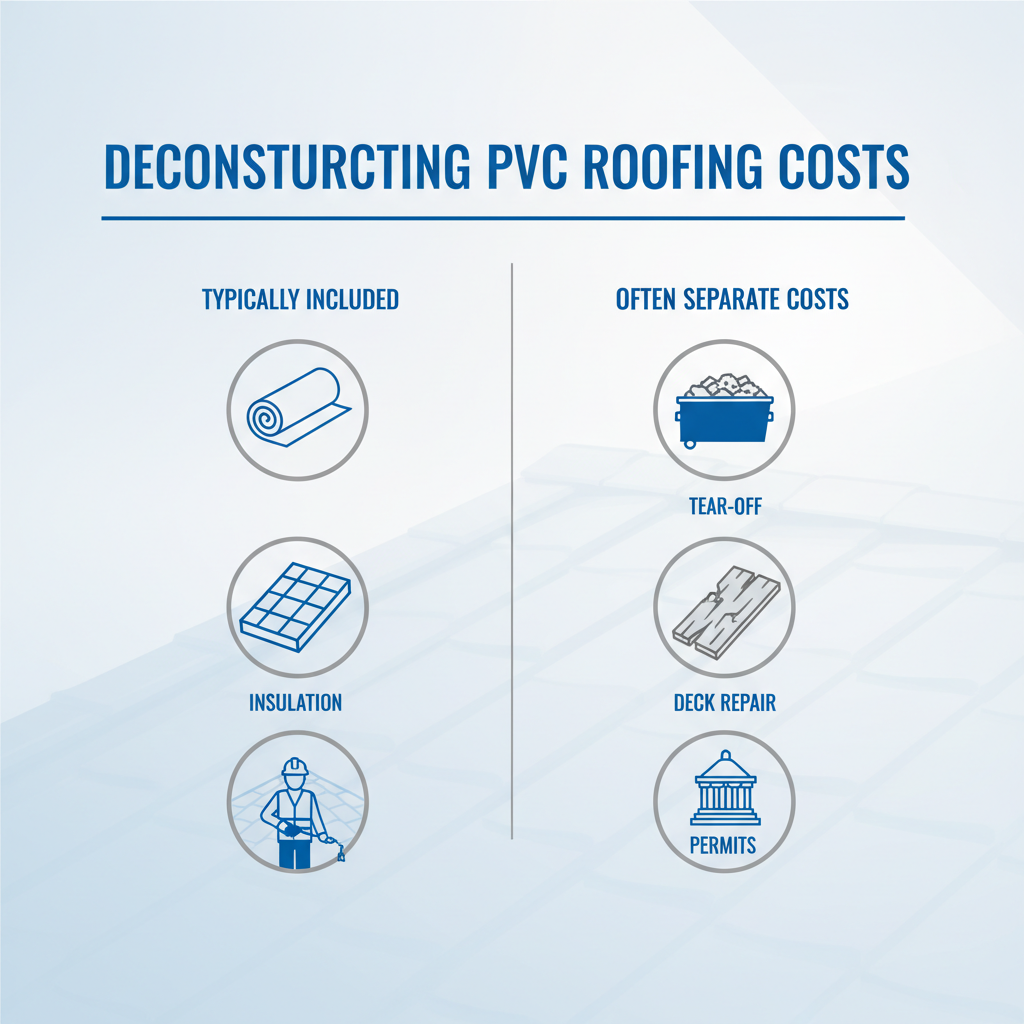
One of the biggest challenges in comparing roofing bids is understanding what the per-square-foot price covers. A lower price might not be a better deal; it might just be an incomplete quote. Here’s a typical breakdown.
What's Usually Included in the Base Price:
- Membrane: The PVC material itself, in the specified thickness (e.g., 50, 60, or 80 mil).
- Insulation: The rigid insulation boards (typically polyisocyanurate) required to meet local energy code R-values.
- Cover Board: A high-density board installed over the insulation to provide a smooth, strong substrate for the membrane and improve fire and impact resistance.
- Fasteners and Adhesives: The screws, plates, or bonding adhesives used to secure the system to the roof deck.
- Standard Flashings: The treatment of roof penetrations like pipes, vents, and drains.
- Labor: The cost of the certified installation crew.
What is Often Excluded and Becomes an "Extra" Cost:
- Tear-Off and Disposal: If your existing roof cannot be recovered, the cost to remove it and dispose of the debris can add $1.50 to $3.00 per square foot.
- Deck Repair Contingency: You never know the true condition of the structural deck until the old roof is removed. If there is rot or damage, you may require extensive roof deck repairs. A prudent budget includes a contingency of 20% to 30% above the base estimate for potential deck replacement.
- Permitting: The cost of municipal permits varies by city and is almost always a separate line item.
- Edge Metal and Coping: Custom-fabricated metal for the roof perimeter is a crucial component but is often priced separately from the membrane system itself.
The most common source of bid confusion is comparing an all-in, turnkey proposal against a quote that only covers the basic installed system. They are not the same thing, and the price difference can be substantial.
Key Specification Variables Driving PVC Cost Differences
Even within an "apples-to-apples" comparison, several factors can drastically change the final cost of a PVC roof. Understanding these variables is key to specifying a roof that meets your performance needs without overpaying.
Membrane Thickness: 50-mil vs. 60-mil vs. 80-mil
Thickness directly correlates to durability and longevity. While a 50-mil membrane might be adequate for a low-traffic roof with a 15-year warranty goal, upgrading to 60-mil or 80-mil provides significantly more puncture resistance and a longer potential service life. An 80-mil membrane, for example, is a common specification for roofs with heavy foot traffic or those subject to hail and debris. The material cost increases with thickness, directly impacting the project's bottom line.
Manufacturer & System Type
Leading manufacturers like Sika Sarnafil, Johns Manville, and Carlisle all produce high-quality PVC membranes. However, there are differences in their chemical formulations, warranty offerings, and system components that affect price. But the most significant cost and performance differentiator in the PVC market is not between these brands, but between how the roof is assembled.
The Duro-Last Difference: Factory-Fabricated vs. Field-Fabricated
Nearly all commercial roofing systems are field-fabricated. This means large rolls of membrane are brought to the job site, rolled out, and cut by hand to fit the roof. Every seam, every corner, and every pipe flashing is measured, cut, and welded manually by a roofer on-site.
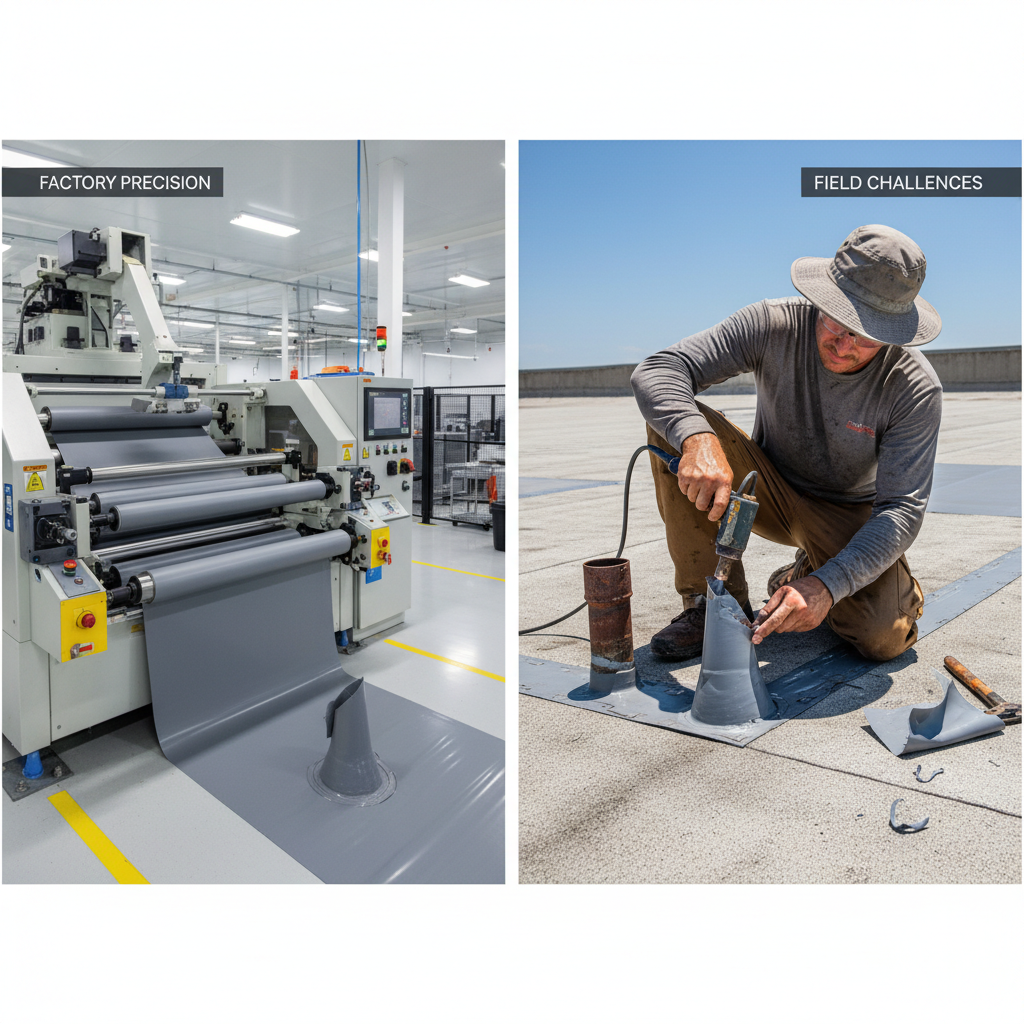
Duro-Last operates on a fundamentally different model. As a Duro-Last Elite Contractor, TriVAN installs systems that are custom-fabricated in a factory before ever arriving at your building. We provide the manufacturer with the exact, field-verified dimensions of your roof. Duro-Last then produces deck sheets in large, custom-sized panels and pre-fabricates all stack and curb flashings in a controlled environment. This approach moves the most critical and leak-prone details, the seams and penetrations, from a hot, unpredictable rooftop into a controlled, predictable factory setting.
The result? Up to 85% of field seams are eliminated. This is not a marketing gimmick; it is a mechanical reality. Since field seams are the number one source of leaks and warranty claims in single-ply roofing, reducing them by 85% drastically reduces the long-term risk profile of the roof. This factory-controlled precision is a primary reason for the system's premium price, and also for its superior performance record.
The Warranty Factor: Why the Duro-Last NDL Warranty Changes the Math
A warranty is only as good as what it covers. Many standard roofing warranties are filled with exclusions that can leave a building owner with major expenses, even on a "covered" claim. The premium price of a Duro-Last system is directly tied to a warranty designed to remove those loopholes.
TriVAN offers a 15-year No Dollar Limit (NDL) warranty that is among the best in the industry. Here’s what makes it different and why it changes the cost equation:
- No Dollar Limit (NDL): Many warranties have a limit on repair costs, often capped at the original purchase price of the roof. An NDL warranty means the manufacturer will pay whatever it takes to fix a covered issue, with no cap on the expense.
- Consequential Damage Coverage: This is the single biggest differentiator. Most roofing warranties explicitly exclude coverage for damage to the building's interior or its contents. If a roof leak damages inventory, computers, or machinery, you are on your own. The Duro-Last warranty covers these consequential damages. For a high-value facility like a data center or manufacturing plant, this coverage alone can justify the roof's entire premium.
- Ponding Water Coverage: Look at the fine print on most commercial roofing warranties. They will explicitly state that damage caused by or related to ponding water is not covered. On the low-slope and flat roofs common in Texas, ponding water is a frequent reality. The Duro-Last warranty does not have this exclusion, providing coverage where others walk away.
The 20-Year Lifecycle Cost: When is the PVC Premium Justified?
A smart capital investment is not about the lowest initial price, but the lowest total cost of ownership over the asset's life. Here, we analyze two common scenarios to see when PVC's upfront cost is a smart buy versus an unnecessary expense.
Scenario A: The Clear Win for PVC (Restaurants and Industrial Facilities)
The Environment: Consider the roofs on restaurants and food processing facilities. These buildings constantly vent grease, oils, and cleaning chemicals onto the roof surface. Industrial facilities may vent other caustic chemicals.
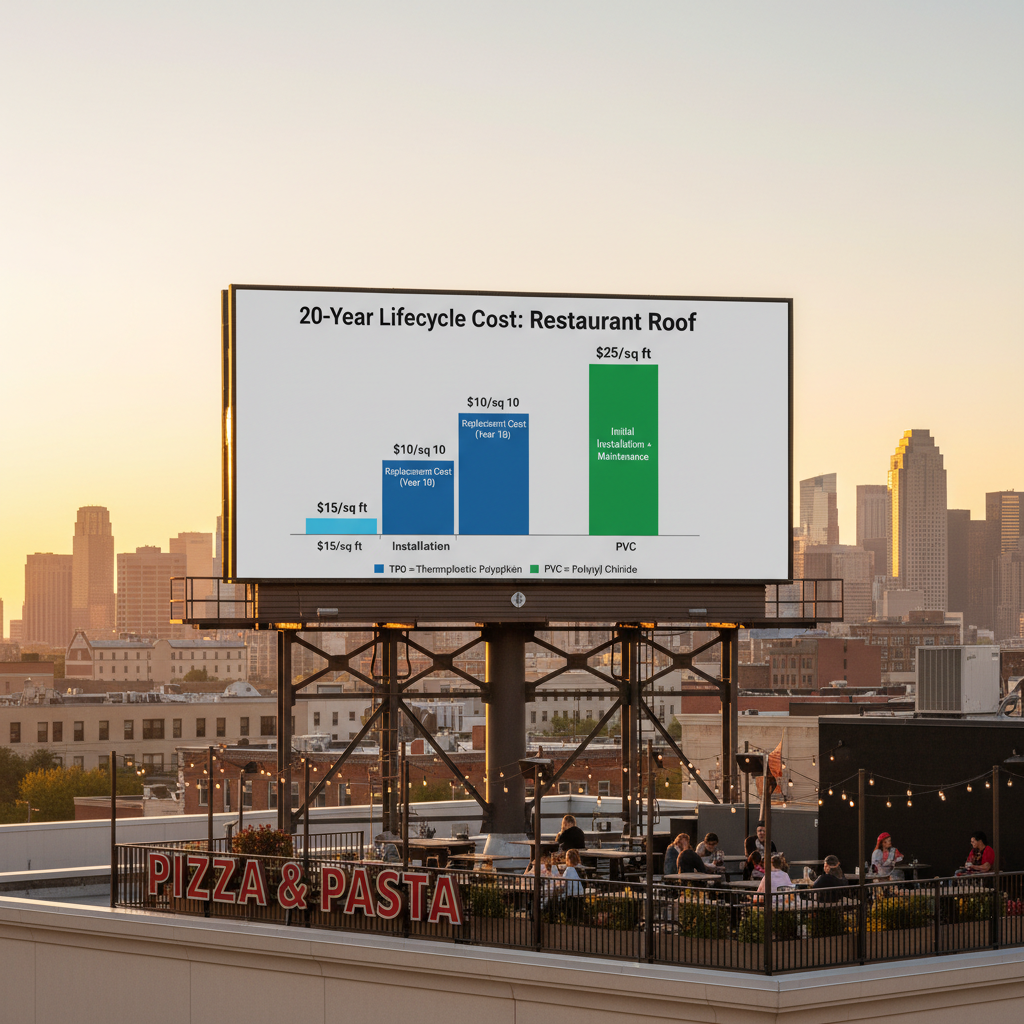
The Impact on TPO: TPO (Thermoplastic Olefin) has poor resistance to these substances. The plasticizers that keep the TPO membrane flexible are broken down by animal fats and certain chemicals. The membrane becomes brittle, cracks, and fails. In this environment, a TPO roof's expected 20-year lifespan can be cut to as little as 5 to 8 years.
The Lifecycle Cost Analysis: A building owner who chooses TPO based on its lower initial cost will likely be facing a full roof replacement in under a decade. PVC, with its inherent chemical and grease resistance, will serve out its full 20 to 25-year lifespan without issue. Over a 20-year period, a facility manager could face the cost of a full roof replacement two or even three times with TPO, compared to only one installation for PVC. When you factor in the cost of business interruption and interior damage from a failing roof, the math overwhelmingly favors PVC.
Scenario B: The Toss-Up (Standard Office or Warehouse)
The Environment: A typical distribution center, self-storage facility, or suburban office building with no rooftop grease or chemical exhaust.
The Impact: In this neutral environment, a well-installed, high-quality TPO system can perform admirably and last for 20 years or more. It is not being attacked by substances it is vulnerable to.
The Lifecycle Cost Analysis: Here, the argument for PVC's premium is much weaker. Both TPO and PVC will offer similar performance and longevity. While PVC is still a tougher and more durable membrane overall, the extra 20-30% upfront cost may not deliver a proportional return on investment. In this situation, a building owner is often better served by investing in a top-tier TPO installation from a certified contractor rather than paying the premium for PVC. Being an honest advisor means telling clients when a less expensive option is the right call.
Finding a Qualified PVC Roofing Contractor in Texas
The best roofing material in the world will fail if installed improperly. Your choice of contractor is more important than your choice of membrane. When vetting a partner for a PVC roofing project, especially a premium system like Duro-Last, your due diligence is critical.
Look for a contractor who can demonstrate financial stability, a long history in your local market, and the highest levels of manufacturer certification. For example, TriVAN Roofing is not just a certified installer; we are a Duro-Last Elite Contractor, a status reserved for the top 3% of contractors nationwide based on quality and volume. We are also a GAF Master Elite certified contractor (top 2% nationwide), showcasing a broad expertise. This level of certification ensures we are masters of the installation process and can offer the best possible warranties.
Ask for proof of experience in the Texas and Oklahoma hail corridor and a portfolio of local projects similar to yours. A reputable contractor will be transparent about their credentials and history. As a woman-owned business founded in 2001, we have built our reputation on trust and performance, not just price. The guide on how to evaluate a commercial roofing contractor is a valuable resource for developing your checklist.
Ultimately, the decision to invest in PVC roofing comes down to a clear-eyed analysis of risk and long-term value. It's not the right choice for every building, but for those exposed to harsh conditions, it is often the only financially sound one.
Tags: pvc roofing cost, commercial pvc roofing cost per square foot, pvc flat roof cost, Duro-Last roofing cost Texas, PVC vs TPO cost commercial, factory fabricated PVC roofing cost, 60 mil pvc roofing cost, 80 mil pvc roofing price, commercial roofing cost Texas, flat roof replacement cost