TPO vs EPDM: Which Commercial Roofing System Fits Your Texas Building?
| By TriVAN Roofing | 17 min read
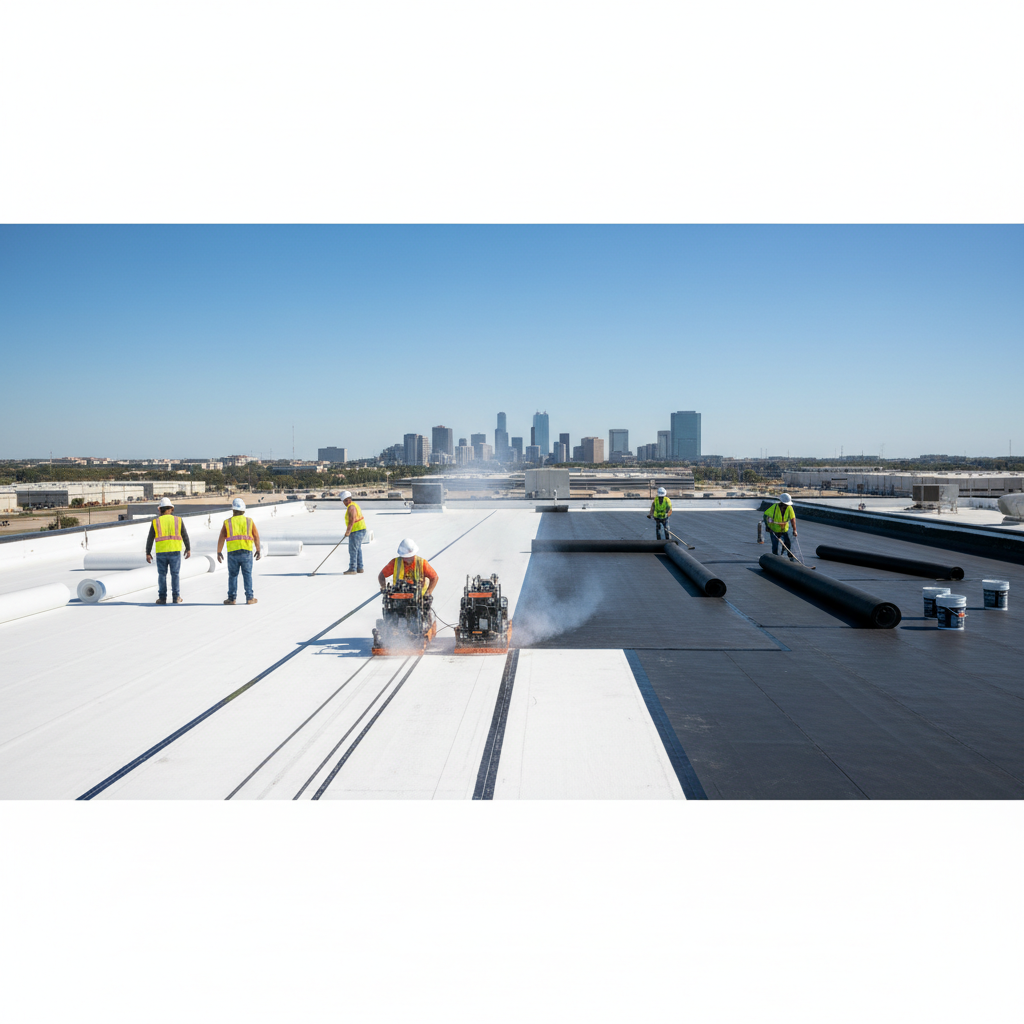
Comparing TPO vs EPDM for your Texas facility? White TPO delivers immediate cooling cost reductions across long Texas summers, while EPDM provides proven durability and flexibility. Here is how regional climate factors decide the matchup.
Categories: Roofing Materials
TPO vs EPDM: The Clear Decision for Texas Facilities
If you manage a commercial building in Texas and hold competing bids specifying thermoplastic polyolefin (TPO) on one sheet and ethylene propylene diene monomer (EPDM) on another, here is the straightforward conclusion: for the overwhelming majority of Texas commercial buildings, white TPO is the superior specification.
Most comparison guides written for national audiences treat this decision as an even split. They explain that EPDM provides outstanding flexibility and a five-decade field record, while TPO offers bright reflectivity and heat-welded seams. In a moderate climate or a northern state like Minnesota or Pennsylvania, that balanced framing makes complete sense. In Texas, however, the local climate fundamentally changes the equation.
Standard black EPDM absorbs solar radiation, transferring heat directly into your building plenum and forcing air conditioning equipment to work overtime across eight or nine continuous warm months. White TPO reflects that solar radiation back into the atmosphere, keeping the roof surface up to sixty degrees cooler. Because Texas commercial properties operate under extreme cooling demands rather than heating demands, specifying a dark, heat-absorbing roof creates an ongoing financial penalty on your utility bills that wipes out any modest upfront material savings.
There are specific architectural and industrial exceptions where EPDM remains the right choice in Texas, which we will examine in detail. For typical commercial warehouses, office buildings, retail centers, and educational facilities across Dallas-Fort Worth, San Antonio, Austin, and Houston, the climate makes this decision far more decisive than standard industry guides suggest.
Understanding the Contenders: TPO and EPDM Basics
Single-ply roofing membranes represent the dominant choice for low-slope commercial roofs across the United States. According to flat roofing market analysis published by roofvista.com in 2026, TPO currently commands approximately 40 percent of the commercial flat roofing market, having expanded steadily over the past two decades. EPDM remains a respected, proven workhorse with a fifty-year documented service history.
To evaluate how these systems perform on your facility, you must first understand how their material chemistry and installation methodologies differ.
What Is TPO?
Thermoplastic Polyolefin is a synthetic single-ply roofing membrane composed of polypropylene and ethylene-propylene rubber polymerized together. Inside the sheet, a polyester reinforcement scrim provides dimensional stability and puncture resistance. TPO is naturally white or light-colored, although grey and tan options exist.
The defining installation feature of TPO is that its seams are fused using hot-air welding equipment. When heated to roughly one thousand degrees Fahrenheit, the overlapping sheets melt and merge together. As they cool, the seam forms a continuous, monolithic piece of material. Once welded, the seam is chemically inseparable from the surrounding sheet.
What Is EPDM?
Ethylene Propylene Diene Monomer is a synthetic thermoset rubber membrane. Derived from oil and natural gas, EPDM has been installed on commercial rooftops since the 1960s. Unlike thermoplastics, EPDM is a cross-linked rubber compound. Once cured during manufacturing, it cannot be melted or reshaped with heat.
Because EPDM cannot be heat-welded, installers join adjacent sheets using specialized chemical primers and double-sided synthetic rubber seam tape. Standard EPDM is naturally dark slate or black due to the carbon black added during formulation, which gives the membrane its exceptional resistance to ultraviolet degradation. White EPDM membranes are produced by incorporating titanium dioxide, though they represent a minor share of total EPDM production.
The Energy Equation: Cooling Days vs. Heating Days
In a technical comparison published in February 2026, commercial roofing leader Nations Roof observed that the decision between TPO and EPDM primarily pivots on facility priorities: TPO excels where UV reflection and cooling utility savings govern, while EPDM leads where long-term material flexibility and cold-weather resistance take precedence. Similarly, single-ply manufacturer American Weatherstar emphasizes that the choice between these two membranes comes down directly to the ratio of cooling degree days to heating degree days at the building's physical location.
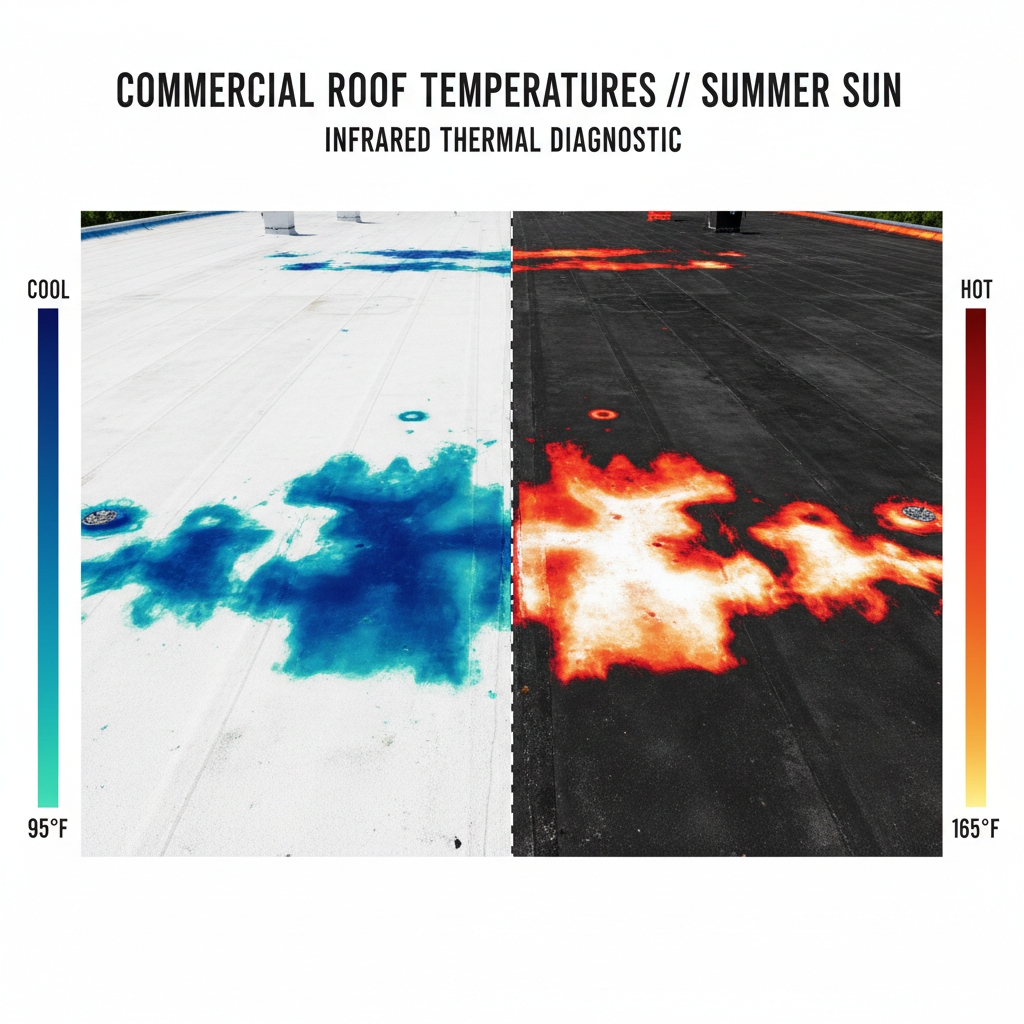
This is precisely where the Texas climate decides the matchup.
Texas commercial buildings operate in an environment defined by intense solar radiation and prolonged summer conditions:
- Major Texas metro areas experience between 100 and 110 days per year with temperatures topping 90 degrees Fahrenheit.
- The Dallas-Fort Worth metroplex and North Texas corridor regularly log 30 to 40 days per year above 100 degrees Fahrenheit.
- Commercial cooling systems in Central and South Texas routinely run from late February through November.
- Heating systems in Texas commercial properties typically operate intermittently for only eight to ten weeks during mid-winter.
In cold northern climates, a dark black EPDM roof functions as a passive solar collector. During long, sub-freezing winters, the black rubber absorbs heat from the sun and transfers it into the building, lowering heating bills. In Texas, that exact same physical process becomes an expensive operational liability.
As documented in 2026 commercial building research by foxhavenroof.com, standard black EPDM absorbs massive amounts of solar radiation, driving rooftop surface temperatures to between 150 and 175 degrees Fahrenheit under direct summer sun. On an afternoon where ambient temperatures touch one hundred degrees, a black surface can easily climb past one hundred sixty degrees, dumping heavy thermal stress into rooftop rooftop HVAC intakes and insulation layers.
By comparison, a smooth white TPO membrane reflects 85 to 90 percent of incoming solar energy back into the atmosphere. On that same 100-degree afternoon, the surface temperature of a clean white TPO membrane rarely exceeds 105 to 110 degrees Fahrenheit. By consulting our resource on cool roofing energy efficiency standards, facility managers can see how direct solar reflectance minimizes heat transfer through the roof deck and keeps rooftop HVAC intake air significantly cooler, reducing compressor wear and lowering peak electrical demand charges.
For a 50,000-square-foot commercial warehouse or retail store in Texas, the difference in electricity consumption between a reflective white roof and a heat-absorbing black roof often amounts to several thousand dollars every summer. Over a twenty-year roof lifespan, those energy penalties completely dwarf any initial material savings.
Cost Comparison: Upfront Price vs. Lifecycle Value
When reviewing contractor proposals, upfront pricing is usually the first point of comparison. According to 2026 commercial estimating figures compiled by buildermuse.com and risingsunartscentre.org, material and installed costs for both systems fall into recognizable ranges:
- EPDM Membrane Only: $0.90 to $1.80 per square foot depending on thickness (45-mil vs. 60-mil).
- EPDM Complete Installed Assembly: $4.00 to $8.50 per square foot, covering tear-off, base insulation, cover board, adhesives, and labor.
- TPO Membrane Only: $0.95 to $2.20 per square foot depending on thickness (45-mil, 60-mil, or 80-mil).
- TPO Complete Installed Assembly: $5.50 to $9.50 per square foot all-in.
On paper, EPDM often appears modestly cheaper on the initial bid, typically running $0.50 to $1.00 per square foot less than an equivalent TPO installation. For a detailed breakdown of current commercial bids, review our comprehensive commercial TPO cost breakdown to understand how membrane thickness, attachment method, and warranty terms shape overall project budgets.
The upfront financial savings of EPDM can tempt property managers operating under strict capital expenditure limits. However, in Texas, looking strictly at the bid price creates an incomplete picture. If an EPDM installation saves $40,000 on a 50,000-square-foot roof upfront, but increases building cooling expenses by $5,000 to $7,000 annually, the initial savings evaporate within six to eight years. Over the remainder of the roof's operational life, the building owner pays a substantial premium to own the cheaper roof.
Lifespan and Track Record: 50 Years of EPDM vs. 25 Years of TPO
Durability and life expectancy represent the area where EPDM holds a clear, documented advantage in national discussions. Because EPDM was introduced in the 1960s, it possesses over fifty years of verified empirical field data across diverse climatic zones.
Manufacturer comparisons, such as technical literature from McElroy Metal, typically rate both systems for a useful service life between 15 and 30 years. However, real-world data reflects differing maturity levels between the products:
The EPDM Track Record
Field studies consistently demonstrate that well-maintained, fully adhered 60-mil EPDM roofs can achieve 25 to 30 years of reliable service, with some documented installations lasting beyond 35 years. The synthetic rubber compound resists thermal expansion cycles without becoming brittle, and its molecular backbone does not break down easily under routine sun exposure.
The TPO Track Record
TPO entered broad commercial use in the late 1990s and early 2000s, giving it roughly 25 to 30 years of real-world history. Early formulations in the late 1990s experienced premature aging issues in extreme desert climates, leading manufacturers to reformulate the polymer matrix with advanced heat and UV stabilizer packages. Modern TPO formulations from premier manufacturers are highly stable, reliable products, but the material simply does not possess five decades of field documentation because it has not existed that long.
Understanding regional performance requires evaluating how local climate stresses the material. The Western States Roofing Contractors Association (WSRCA) Technical Advisory No. 12, revised in April 2025, identified prolonged heat exposure as the primary degradation mechanism for single-ply membranes in the southern and western regions. While UV radiation degrades the surface, sustained high temperatures accelerate the loss of plasticizers and stabilizers over time.
Because white TPO reflects heat rather than absorbing it, the membrane stays much cooler throughout the day. This lower operating temperature counterbalances some of the thermal aging concerns. For building owners weighing long-term durability, reviewing our detailed analysis of the factors affecting TPO service life in Texas explains how proper maintenance and membrane thickness directly influence longevity in our harsh southern weather.
Seam Integrity and Assembly Mechanics
A single-ply roofing membrane is only as dependable as its seams. Water does not penetrate the solid center of a modern commercial membrane sheet; leaks occur at laps, flashings, penetrations, and perimeter terminations. Here, the installation technologies of TPO and EPDM diverge significantly.
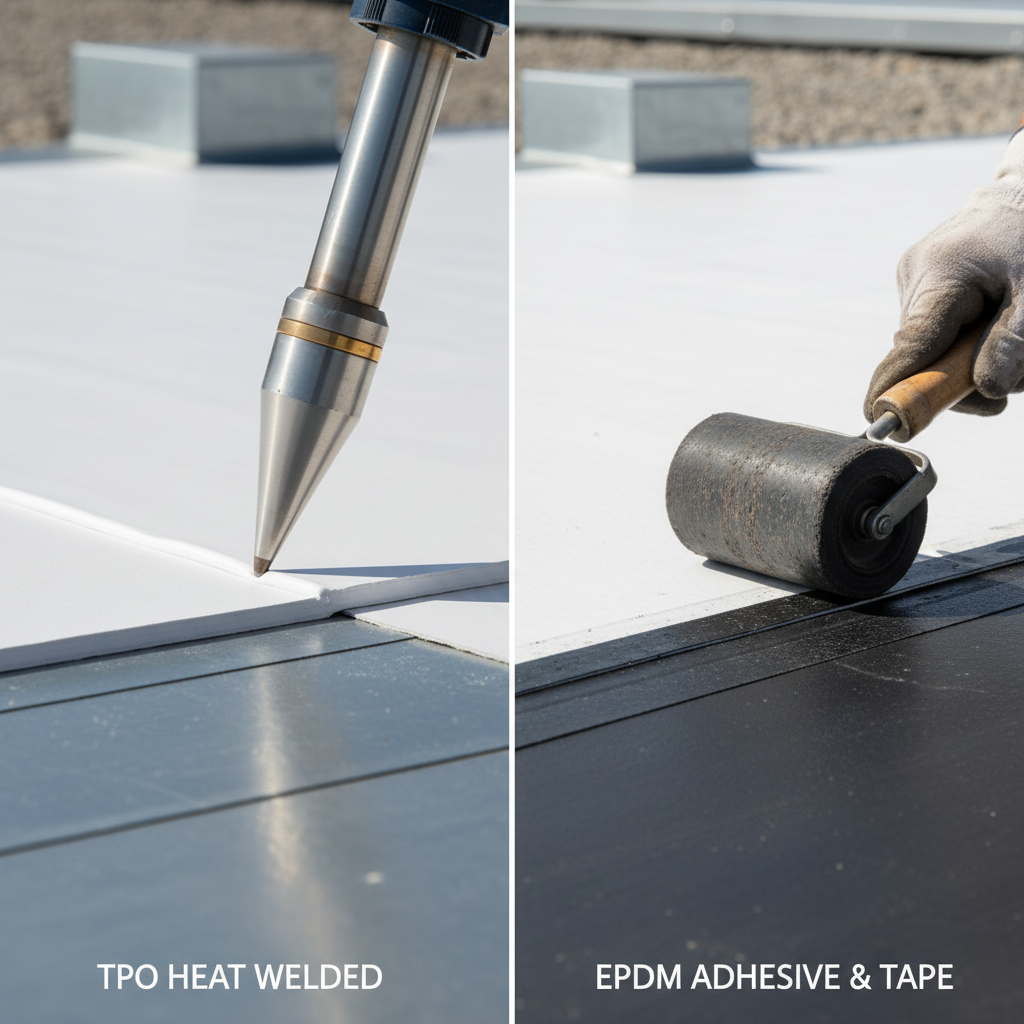
TPO: Monolithic Heat-Welded Seams
TPO seams are welded using specialized hot-air robotic equipment that tracks along the overlap at precise speeds and temperatures. The process liquefies the thermoplastic polymer along the lap, pressing the sheets together under a heavy drive wheel to fuse them into a single continuous sheet.
Because heat welding produces a physical bond stronger than the sheet itself, TPO installations remove reliance on chemical adhesives at the overlaps, which can be vulnerable to improper field application. When tested in a laboratory, pulling a properly welded TPO seam apart will tear the reinforcement scrim inside the sheet before the weld itself fails.
EPDM: Primed and Taped Seams
Because thermoset rubber cannot be heat-melted without scorching, EPDM seams rely on adhesive technology. Crews clean the overlap area, apply a chemical primer to prepare the rubber, allow the primer to flash off until tacky, and install a continuous strip of double-sided butyl seam tape. The seam is then consolidated using a heavy silicone hand roller.
While modern factory-applied tape systems perform vastly better than the liquid contact adhesives used thirty years ago, taped seams remain sensitive to field conditions during installation. If the installer applies primer too thin, rolls the tape unevenly, or works during high humidity or dusty wind conditions, seam performance can be compromised over time. In ponding water conditions, adhesive bonds are also more prone to moisture creep than a fused molecular weld.
Regardless of which system you select, field workmanship dictates performance. Facility owners should utilize our commercial contractor vetting checklist to verify that any bidding contractor maintains factory-certified installer status with major manufacturers.
Hail Performance in the Texas-Oklahoma Weather Corridor
Commercial buildings across North Texas, Central Texas, and Oklahoma sit directly in the most hail-prone corridor in North America. Facility executives frequently ask whether TPO or EPDM offers superior protection against severe hail storms.
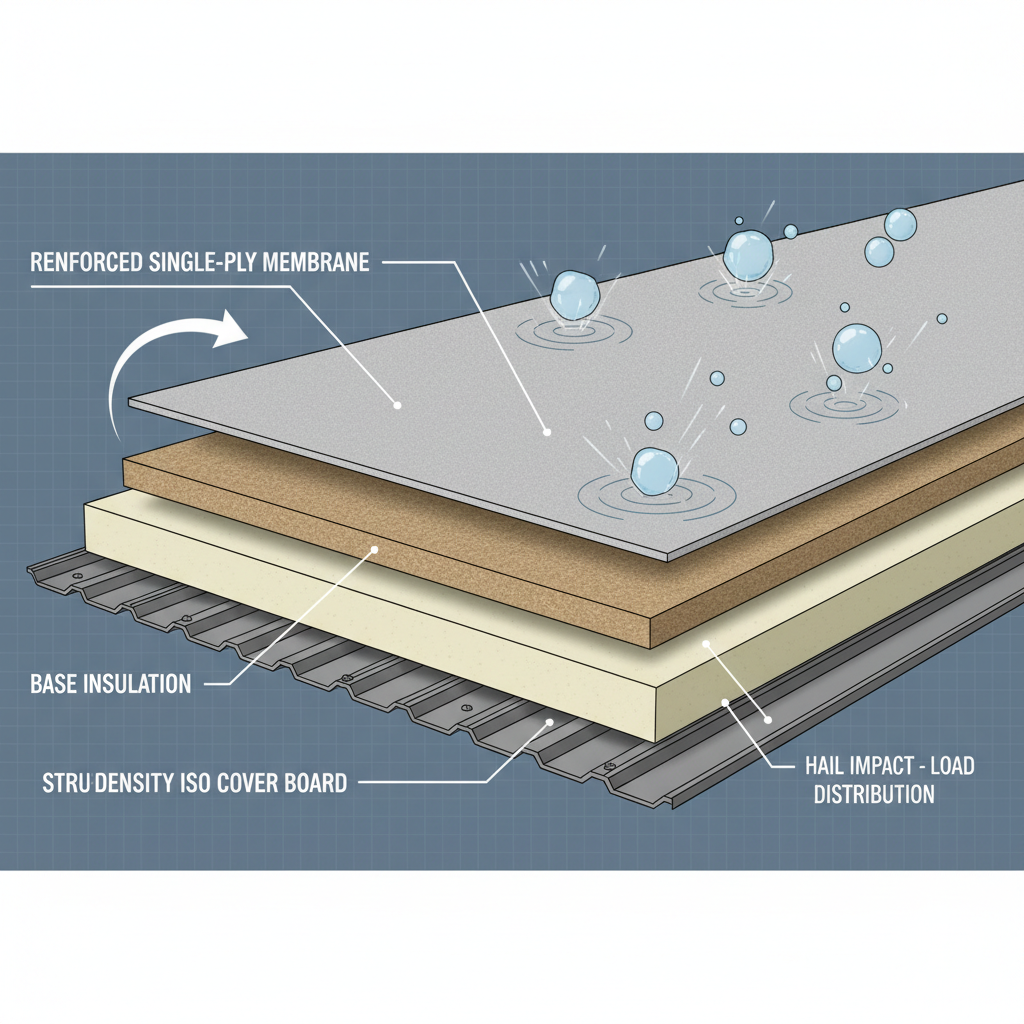
The short answer is that properly specified TPO and EPDM perform comparably during hail events. Neither membrane holds an overwhelming native advantage over the other when subjected to large-diameter hail strikes.
Both rubber and thermoplastic sheets possess natural elasticity that allows them to absorb modest hail impacts without puncturing. However, during severe events featuring hail larger than 1.5 inches in diameter, the membrane itself is rarely the weak link. Punctures occur when the hailstone compresses the membrane against a soft underlying insulation layer, shearing the sheet against the hard edge of an underlying fastener or crushing the insulation core.
The presence of a high-density polyisocyanurate or gypsum fiber cover board directly beneath the membrane provides the compression resistance necessary to prevent punctures during severe hailstorms. Rather than choosing between TPO and EPDM for hail defense, building owners should focus on the underlying assembly:
- Specify a 60-mil or 80-mil membrane: Thicker sheets offer substantially higher puncture resistance than standard 45-mil options.
- Require a rigid cover board: Installing a high-density polyiso board (such as 100+ PSI) or a fiberglass-faced gypsum board directly beneath the membrane absorbs impact force.
- Evaluate FM Global ratings: Ensure the total roof assembly achieves an FM 1-90 rating or an FM Severe Hail (SH) or Very Severe Hail (VSH) designation.
The White EPDM Option: Closing the Reflectivity Gap
Most commercial roofing articles present a simplified binary comparison: white TPO versus black EPDM. This framing ignores white EPDM, an option that alters several standard arguments.
White EPDM incorporates titanium dioxide during manufacturing, transforming the classic black sheet into an off-white membrane capable of reflecting 75 to 80 percent of solar radiation. This allows building owners to obtain the material flexibility and long-term weathering characteristics of synthetic rubber without incurring the heavy heat penalty of standard black EPDM.
If white EPDM solves the solar heat absorption issue, why does it account for a relatively small fraction of commercial installations in Texas? Several practical factors explain its limited market share:
- Material Availability and Lead Times: Commercial roofing supply distributors in Dallas, Fort Worth, San Antonio, and Houston stock millions of square feet of white TPO in multiple widths and thicknesses. White EPDM is rarely stocked in regional warehouses in volume, frequently requiring special orders and extended factory lead times.
- Higher Material Cost: The manufacturing processes and additives required to produce white EPDM make it significantly more expensive than standard black EPDM, often eliminating the initial price advantage it holds over TPO.
- Seam Maintenance: White EPDM still relies on chemical primers and seam tapes. Under extreme southern sun exposure, taped seams on white sheets require the same diligent maintenance inspections as traditional black systems.
Nevertheless, if your facility requires the synthetic rubber characteristics of EPDM but must comply with local cool roof energy ordinances, white EPDM installed in a fully adhered configuration provides a completely viable, code-compliant alternative.
When Does EPDM Make Sense for a Texas Building?
While white TPO remains the logical default choice for most facilities across our region, experienced roofing consultants recognize that broad generalizations do not apply to every structure. There are several clear scenarios where professional EPDM roofing installations remain the smartest choice for a Texas facility:
1. Retrofit-in-Kind Replacements
If your commercial building currently has an EPDM roof that has reached the end of its functional life, replacing it with a new EPDM membrane simplifies installation logistics. Perimeter parapet walls, edge metal transitions, through-wall scuppers, and equipment curb flashings designed around EPDM detailing can often remain in place or receive straightforward overlays. Transitioning an entire facility from EPDM to TPO requires reworking every flashing detail to accommodate heat-welded termination accessories, increasing labor expenses.
2. Severe Thermal Shock and Movement Environments
EPDM possesses outstanding elongation properties, stretching up to 300 percent without experiencing permanent deformation or material failure. On large uninsulated metal buildings, wide-span barrel roofs, or structures subject to dramatic structural shifting and vibration, EPDM accommodates movement better than reinforced thermoplastic sheets. Its rubber composition remains completely flexible even during sudden deep freezes, resisting the stress cracking that can occur on lower-grade plastic membranes.
3. Specific Chemical Exposure Profiles
While neither standard TPO nor EPDM tolerates heavy petroleum or animal fat discharge (which requires specialized PVC or KEE assemblies), EPDM demonstrates superior resistance to specific industrial alcohols, ketones, and alkalis. For industrial manufacturing plants handling specific chemical exhausts, EPDM may provide chemical compatibility where TPO exhibits accelerated surface swelling.
4. Capital-Constrained Applications Using White EPDM
On projects where a building owner demands the field track record of synthetic rubber but must manage building cooling loads, a fully adhered white EPDM membrane delivers proven performance without the solar heat gain of black rubber.
Detailed Comparison Summary: TPO vs. EPDM
To help you evaluate these two single-ply systems across the criteria that matter most to commercial property owners in Texas, review this head-to-head performance breakdown:
| Evaluation Metric | TPO (White) | EPDM (Standard Black) |
|---|---|---|
| Solar Reflectance | High (85-90% initial reflection; lowers cooling load) | Low (5-10% reflection; absorbs heavy solar heat) |
| Texas Climate Fit | Excellent; optimized for long, severe cooling seasons | Poor for standard black; acceptable with white EPDM |
| Seam Method | Hot-air welded; monolithic molecular fusion | Adhesive primer and synthetic butyl seam tape |
| Installed Cost (Typical) | $5.50 - $9.50 per sq. ft. | $4.00 - $8.50 per sq. ft. |
| Documented History | ~25-30 years of widespread commercial use | 50+ years of proven empirical field installations |
| Material Flexibility | Moderate; reinforced with internal polyester scrim | Exceptional; elongates up to 300% without damage |
| Hail Resistance | Comparable; requires rigid cover board assembly | Comparable; requires rigid cover board assembly |
| Regional Product Availability | Abundant across all Texas distribution hubs | Good for black; limited regional stock for white EPDM |
Making the Decision: Practical Recommendations for Facility Managers
When selecting a commercial roofing membrane for your property, avoid evaluating products in isolation from your physical geographic location. The best roof in Michigan is rarely the best roof in North Texas.
Follow this decision framework when reviewing contractor proposals:
- Prioritize cooling efficiency if your AC runs six or more months annually: If your facility is an office, school, retail center, distribution hub, or conditioned manufacturing plant anywhere in Texas or Oklahoma, specify high-reflectivity commercial TPO roofing systems. The operational electricity savings will rapidly surpass the small initial price difference.
- Demand minimum 60-mil thickness: Whether you choose TPO or EPDM, do not specify entry-level 45-mil membrane. The minor cost difference to step up to a 60-mil sheet buys significantly more puncture resistance, greater weathering polymer above the scrim, and extended warranty eligibility.
- Engineer the assembly for hail, not just the membrane: Do not rely on membrane choice alone to protect your building from severe weather. Incorporate a high-density polyisocyanurate cover board beneath your membrane to absorb impact energy and prevent costly interior leaks following severe convective spring storms.
- Evaluate contractor certifications: An advanced single-ply membrane installed by an uncertified crew using incorrect welder temperatures or poorly primed seam tape will fail prematurely. Verify that your roofer holds top-tier manufacturer credentials, such as Duro-Last Elite or GAF Master Elite status, and offers a comprehensive No Dollar Limit (NDL) warranty covering ponding water and consequential damages.
TriVAN Roofing has guided commercial property owners, facility managers, and school administrators across Texas and Oklahoma through commercial roof replacements since 2001. Our team operates as technical advisors dedicated to engineering the right assembly for your operational goals, structural requirements, and long-term capital budget.
Tags: TPO vs EPDM, TPO vs EPDM commercial roofing, TPO vs EPDM Texas, TPO vs EPDM cost, EPDM roofing Texas commercial, TPO roofing vs EPDM which is better, commercial roofing membrane comparison Texas, single ply roofing comparison, commercial flat roof materials, cool roof Texas commercial