Oklahoma Commercial Roofing: Why a Texas Strategy Fails in Tornado Alley and What to Do Instead
| By TriVAN Roofing | 10 min read
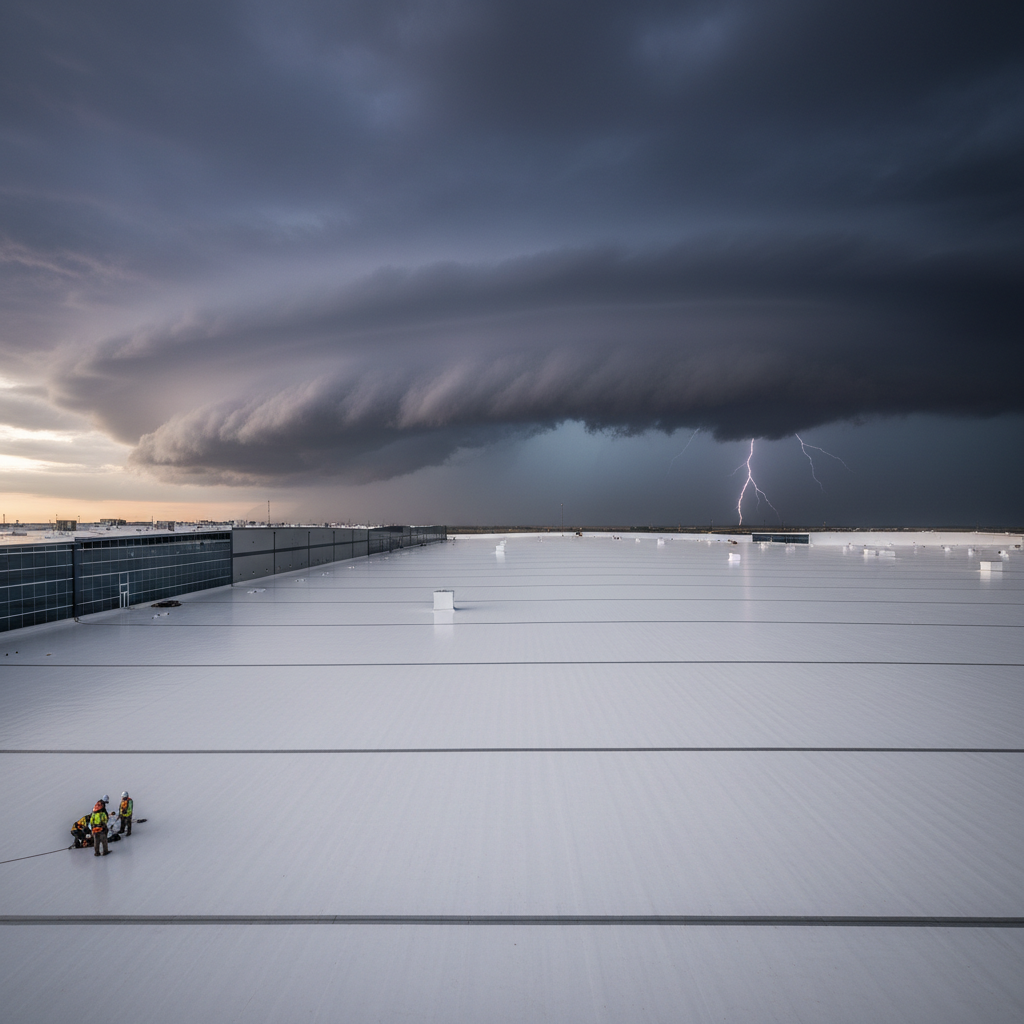
A Texas-based roofing strategy is a liability in Oklahoma. Tornadoes, ice storms, and unique insurance markets demand different specifications. Learn why Oklahoma commercial buildings require a localized approach to wind resistance, drainage, and pro
Oklahoma Isn't North Texas: Why Your Commercial Roofing Strategy Must Be Different
For facility managers and building owners, it can be tempting to view Oklahoma and Texas as a single, contiguous market. The business corridors are connected, the weather feels similar, and contractors often serve both. But when it comes to protecting a multi-million dollar commercial asset with a new roof, this assumption is a dangerous liability. A roofing strategy developed for Dallas or San Antonio will fail in Oklahoma City or Tulsa. The reason is simple: Oklahoma’s threat profile, insurance market, and regulatory environment are fundamentally different.
Ignoring these distinctions means specifying a roof that is unprepared for tornadic winds, susceptible to catastrophic failure during an ice storm, and potentially non-compliant with local codes. For over 24 years, TriVAN Roofing has operated across this entire region. Our experience, grounded by TriVAN’s Pauls Valley office, provides a clear view of where Texas thinking goes wrong. This is not about minor adjustments. It is about a completely different approach to risk, specification, and contractor selection demanded by Oklahoma’s unique conditions.
The Tornado Alley Reality: Wind Resistance Beyond the Basics
Oklahoma averages more tornadoes per square mile than any other state in the union. This is not just a statistic. It is the defining reality for every commercial building in the state. While Texas facilities are designed for high winds, Oklahoma facilities must be designed for tornadic events. The difference is critical. The devastating tornadoes of May 3, 1999, in the Oklahoma City metro and May 20, 2013, in Moore are the benchmarks. These were not just storms; they were events that rewrote the rules for structural performance, demonstrating what F4 and EF5 wind speeds do to entire inventories of commercial buildings.
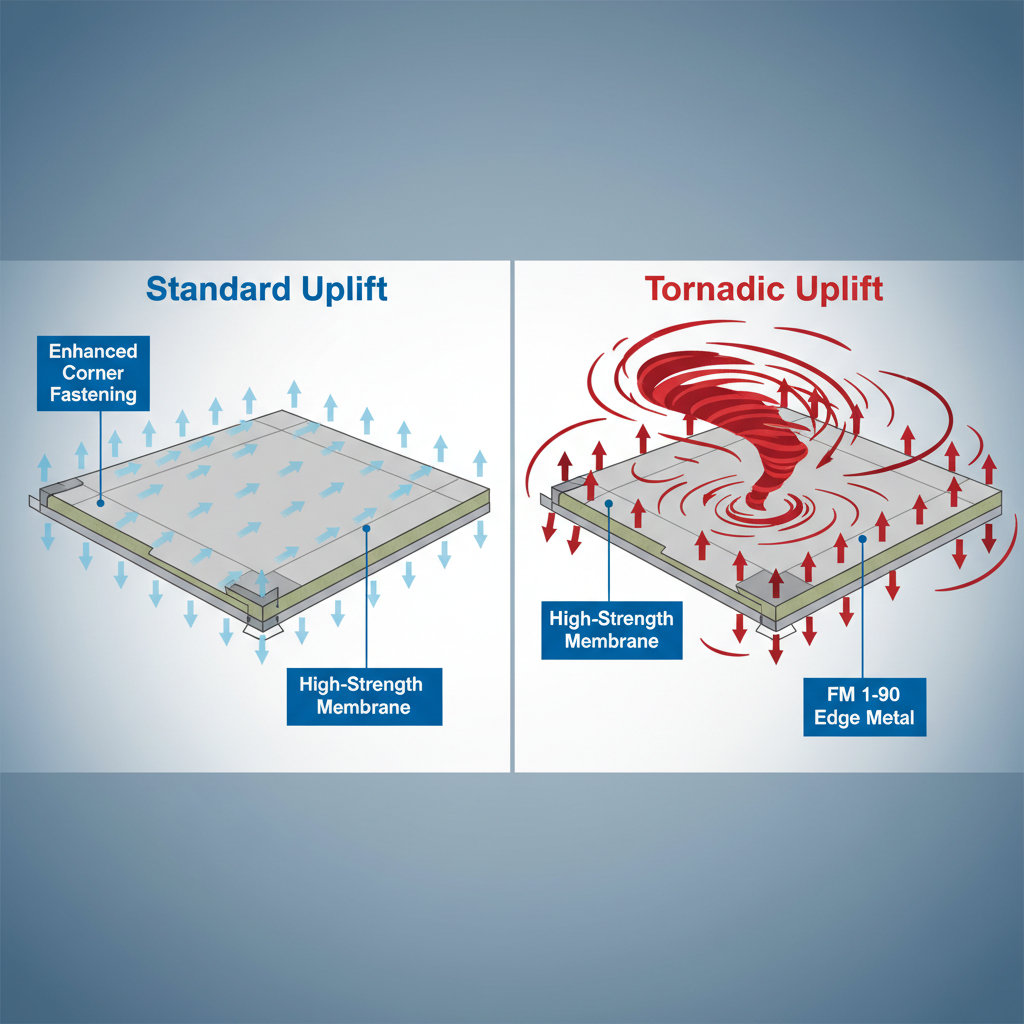
Standard wind speeds in building codes like ASCE 7-22 are based on straight-line wind gusts. A tornado is an entirely different physical phenomenon. It introduces extreme rotational forces and powerful vertical uplift pressures that are most severe at a building’s corners and edges. These events are the ultimate stress test, demonstrating that catastrophic roof failure often begins at the corners and perimeter, where aerodynamic forces are most intense. A roof designed only for straight-line winds as defined by general code is not specified for the rotational, high-velocity suction that a tornado produces.
This is why sophisticated risk managers and insurers like FM Global have Oklahoma-specific wind zone requirements that are far more stringent than those for inland Texas. Meeting these standards involves more than just following the base code. It requires:
- Enhanced Fastener Patterns: The number of fasteners per square foot, especially in the perimeter and corner zones of the roof, must be significantly increased to handle extreme uplift pressures. A typical roof might have 16 fasteners per 4’x8’ board, while a roof in a high-wind zone may require 32 or more in the corners.
- Superior Membrane Strength: The roofing membrane itself must have high breaking strength and tear resistance. This is where robust single-ply membrane systems like Duro-Last, known for their durable, reinforced composition, provide a distinct advantage.
- Engineered Edge Metal: The roof’s perimeter is its most vulnerable point. A simple piece of bent metal is not enough. Oklahoma roofs demand tested and rated edge metal systems (e.g., ANSI/SPRI ES-1 compliant) that are proven to resist peeling and failure under extreme wind load.
Simply put, a specification that is perfectly adequate for a distribution center in Fort Worth could lead to total roof failure on an identical building in Norman. The physics of the threat are different, so the engineering of the solution must be as well.
The Winter Threat: Ice Storms and Freeze-Thaw Cycles
While tornadoes dominate the headlines, Oklahoma’s winters present another distinct threat rarely seen with the same severity in Texas’s major commercial hubs: significant ice storms. Nearly every winter, large portions of Oklahoma experience freezing rain events that can encase everything in a thick layer of ice. For a low-slope or flat commercial roof, this creates two major problems.
Ice Loading and Drainage Paralysis
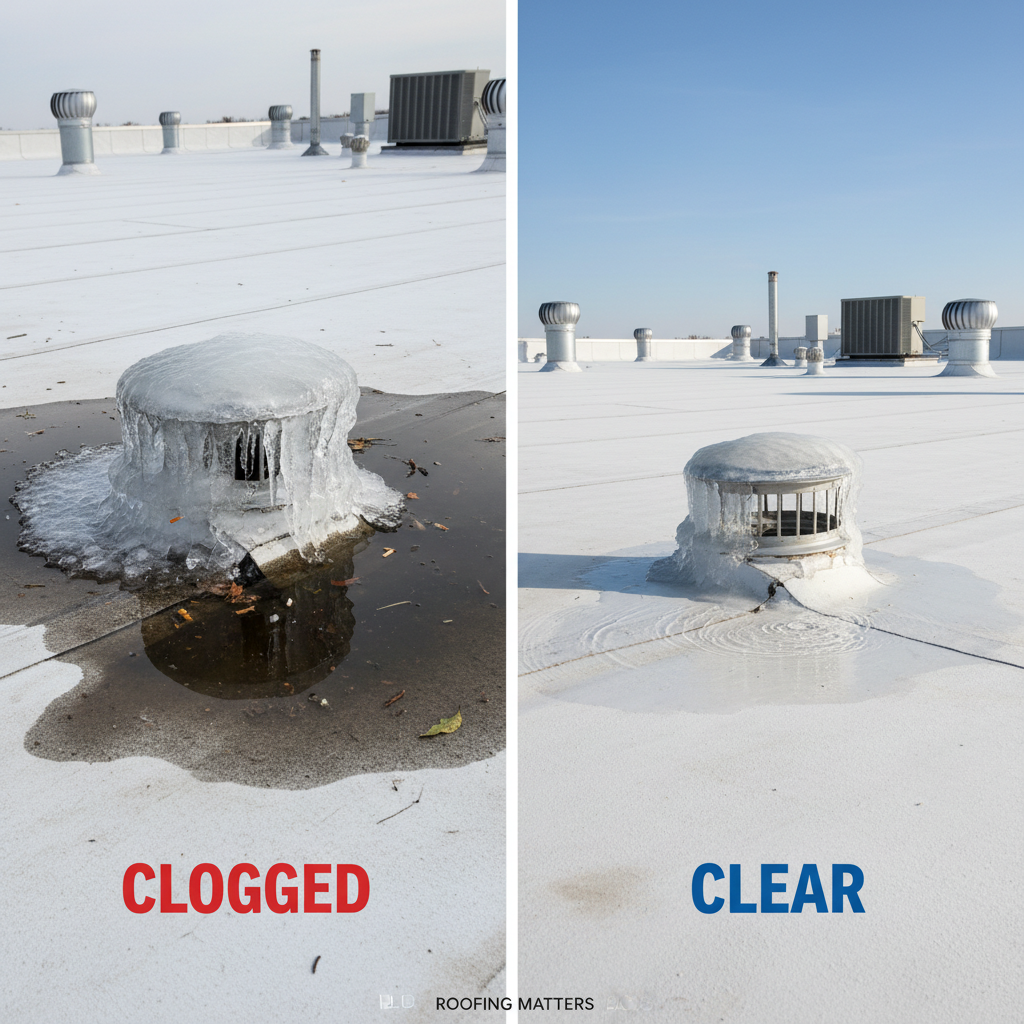
First is the simple issue of weight. Ice is heavy, and several inches of accumulated ice can impose a static load on a large roof that pushes or exceeds its structural design limits. More common, however, is the problem of frozen drainage. Roof drains, scuppers, and gutters become clogged and frozen solid. When this happens, a simple drain blockage transforms into an ice dam. Water that should be exiting the roof now backs up, creating significant ponding. On a roof with even minor imperfections, this standing water will find a way inside, leading to significant interior damage, saturated insulation, and potential structural issues.
This is not a theoretical problem. After a major Oklahoma ice storm, it is common for facility managers to discover that primary drain blockage has turned their roof into a shallow, frozen lake. The resulting pressure forces water into seams and around flashings that would otherwise be watertight, causing small issues to become major roof leaks.
Accelerated Aging from Freeze-Thaw Cycles
The second problem is the repetitive stress of the freeze-thaw cycle. As temperatures fluctuate above and below freezing, water that has penetrated membrane seams or flashing details expands and contracts. This process acts like a tiny jackhammer, fatiguing the materials, widening gaps, and progressively worsening small defects over a single winter. A seam that was marginally secure in October can be a significant failure point by March. This thermal cycling puts immense stress on the entire roofing assembly, accelerating the aging process far more quickly than in a climate with fewer deep freezes.
This means that both material selection and installation quality are paramount. A roof system in Oklahoma needs expertly welded or adhered seams and flashings that are meticulously sealed to prevent any initial water intrusion. Anything less is a countdown to failure.
Navigating Oklahoma's Insurance and Code Landscape
The differences extend beyond the weather. The business environment itself—shaped by insurance carriers and state regulators—imposes a unique set of rules for Oklahoma building owners.
An Insurance Market Hardened by Storms
Following years of repeated, catastrophic convective storm seasons, Oklahoma's commercial property insurance market has tightened considerably. Several national carriers have reduced their exposure, stopped writing new policies in certain areas, or exited the state altogether. The remaining carriers are much more discerning about the risks they are willing to underwrite.
For building owners, this has two main consequences. First, the percentage-based wind and hail deductibles that are a relatively recent adjustment for many in Texas have been the standard in Oklahoma for much longer. Oklahoma facility managers are more accustomed to being financially responsible for the first 1%, 2%, or even 5% of a building's value after a storm. Second, this reality has created an insurance-driven push for higher-performing roof systems. To secure the best available coverage and premiums, owners often must prove their roof meets specific, enhanced standards for wind uplift (like FM 1-90) and severe hail impact (like UL 2218 Class 4). This is not an upsell from a contractor; it is a prerequisite from the underwriter. The conversation in Oklahoma starts with performance ratings, because the insurance market demands it.
Building Codes and Contractor Qualification
On the regulatory side, Oklahoma has adopted the 2021 International Building Code (IBC) with its own set of state-level amendments. Furthermore, major jurisdictions like Oklahoma City and Tulsa can and do layer on additional local amendments that often focus on wind-resistant design and energy code compliance. A contractor must be fluent in not just the state code, but the specific requirements of the municipality where the work is being performed.
A critical distinction from Texas is the lack of a unified state licensing structure for roofing contractors in Oklahoma. This places a greater burden on the building owner to conduct thorough due diligence. You cannot simply check a state license number. Instead, you must verify a contractor’s qualifications through other means:
- Proof of substantial liability and workers' compensation insurance.
- History of successful projects of similar size and scope in Oklahoma.
- Manufacturer certifications, which serve as a proxy for quality. Being a GAF Master Elite (top 2% nationwide) or Duro-Last Elite Contractor (top 3%) means the manufacturer has already vetted the contractor’s financial stability, installation quality, and commitment to training.
Without a state license to rely on, these third-party validations become the most reliable indicators of a contractor’s professionalism and competence. Choosing an unvetted contractor in this environment is a significant gamble that can result in a failed inspection or a complete commercial roof replacement being denied by an insurer.
A Smarter Procurement Path: The TIPS Advantage in Oklahoma
For Oklahoma’s public entities—school districts, universities, municipalities, and state agencies—there is a powerful tool for navigating these challenges that is often overlooked: the TIPS cooperative purchasing program.
While widely used in Texas, awareness of TIPS in Oklahoma’s public sector is lower. Many procurement officers and facility directors default to traditional, lengthy competitive bid processes, unaware that a more efficient solution is available. TIPS is a national purchasing cooperative that satisfies competitive bidding requirements. It allows members to select from a list of vendors who have already been awarded contracts through a rigorous and competitive process.
This process replaces the lengthy and often complex traditional bidding process with a simple purchase order. It provides Oklahoma public entities with immediate access to a pool of highly qualified contractors like TriVAN, whose credentials, insurance, and performance have already been rigorously evaluated by TIPS.
The advantages for an Oklahoma school district or city government are immense:
- Speed: A project can begin in weeks, not months.
- Compliance: TIPS satisfies state competitive bid laws, eliminating legal risks.
- Quality: All TIPS vendors are vetted for quality, financial stability, and past performance, removing the guesswork from contractor selection.
As an awarded vendor with three active TIPS contracts, TriVAN can help Oklahoma public entities streamline their roofing projects, ensuring they get a high-performance roof installed by a proven contractor without the administrative burden of a traditional bid cycle.
Conclusion: Build for Oklahoma, Not Somewhere Else
Your commercial building in Oklahoma City, Tulsa, Lawton, or Norman faces a unique and severe set of environmental and business risks. A roofing strategy that works in another state is not just suboptimal; it is inadequate. The specifications must account for tornadic winds, not just straight-line gusts. The design must anticipate drainage failure from ice, not just heavy rain. The contractor you choose must be proven in the local market and certified by leading manufacturers, because state licensing alone won't tell you the whole story.
Relying on a Texas-centric approach is a bet against the Oklahoma weather, and it’s a bet you will eventually lose. Protecting your asset starts with acknowledging the distinct challenges of the market and partnering with a contractor who has demonstrated experience in meeting them. Before your next storm, a proactive, professional roof inspection can identify vulnerabilities inherited from a strategy that was never meant for Tornado Alley. Building it right the first time, or correcting it before it fails, is the only sound investment.
Tags: Oklahoma commercial roofing, commercial roofing Oklahoma City, Tulsa commercial roofing contractor, tornado alley roofing specifications, Oklahoma ice storm roof damage, commercial roof wind resistance, FM Global Oklahoma wind zone, Oklahoma building codes roofing, percentage based deductibles Oklahoma, Duro-Last Elite contractor Oklahoma