
Metal Roof Condensation vs. Roof Leak: How Warehouse Owners Tell the Difference
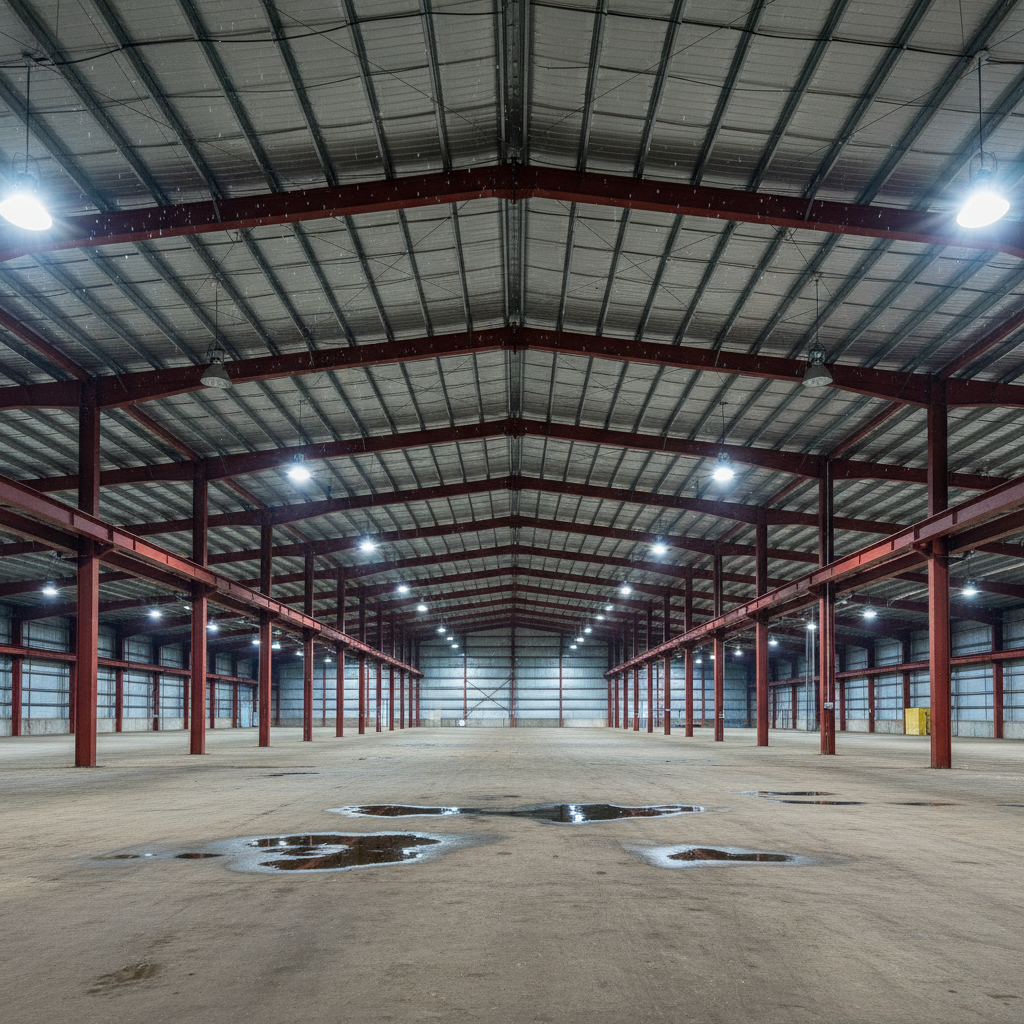
Dripping warehouse ceilings do not always mean a roof leak. Learn how to tell metal roof condensation from an active leak before spending money on roof patches that fail to solve the underlying building envelope moisture issue.
Every year, commercial warehouse owners across Texas and Oklahoma spend thousands of dollars on emergency roof patches that accomplish nothing. The scenario is familiar. A warehouse manager notices water dripping from the ceiling above pallet racking or staging lanes. Water stains appear on carton inventory, slick spots form on concrete slab traffic lanes, and an emergency roofing contractor is called to locate and seal the leak. The technician climbs onto the roof, finds a suspicious fastener or an open lap seam, applies mastic or elastomeric caulk, hands the facility manager an invoice, and departs.
Two weeks later, on a completely clear, cold morning with zero precipitation in the forecast, the ceiling begins dripping again. The patch did not fail because the technician did poor work. The patch failed because the roof was never leaking from the outside in the first place.
Water dripping from a metal ceiling does not automatically indicate an exterior leak. In pre-engineered metal buildings, moisture overhead is frequently caused by psychrometric physics: warm, humid interior air coming into direct contact with cold steel roof panels. This process is condensation, commonly referred to in the field as metal building sweating. Treating condensation as a rain leak leads to wasted maintenance budgets, damaged tenant goods, slip-and-fall liabilities, and accelerated structural corrosion. Before you spend capital on exterior sealants or membrane repairs, you must understand how to distinguish metal roof condensation from an active roof leak.
Understanding the Physics: How Metal Roof Condensation Forms
To identify the source of overhead water, facility operators must first understand the fundamental rule of condensation outlined by engineering resources like Metal Construction News: water condensation forms on any building surface that sits at or below the dew point of the surrounding air. Moisture dripping from your ceiling simply means water vapor in your warehouse air changed phase from gas to liquid against an interior surface.
Air holds moisture in the form of invisible water vapor. The volume of moisture air can hold depends directly on its temperature. Warm air expands and holds substantial quantities of moisture, while cold air contracts and holds very little. Relative humidity (RH) represents the percentage of water vapor present in the air compared to the maximum amount that air could hold at that specific temperature.
The dew point is the precise temperature to which air must be cooled for water vapor to condense into liquid water. When the temperature of an interior surface, such as a purlin, a fastener shank, or an uninsulated metal roof panel, falls below that dew point temperature, the air immediately touching that surface cools rapidly. Its relative humidity reaches 100 percent, and liquid water forms on the steel.
Metal building components are exceptional thermal conductors. Unlike built-up asphalt, modified bitumen, or thick commercial single-ply assemblies, metal panels transmit exterior temperature changes almost immediately to the building interior. In modern standing seam metal roof systems and screw-down R-panel roofs alike, nighttime ambient cooling or sudden atmospheric shifts drop panel temperatures dramatically. If your warehouse interior contains warm, humid air from manufacturing processes, forklift traffic, or external humidity infiltration, that moist air rises naturally via convection toward the ceiling. When it strikes the cold metal skin, the dew point is reached, liquid droplets accumulate, and water begins dripping onto the floor below.
Field Clues: Diagnosing Rain Leaks vs. Dew Point Condensation
Distinguishing between an active roof penetration and internal sweating requires systematic observation rather than guesswork. Technicians evaluate three primary variables: meteorological timing, geographic distribution, and physical droplet behavior.
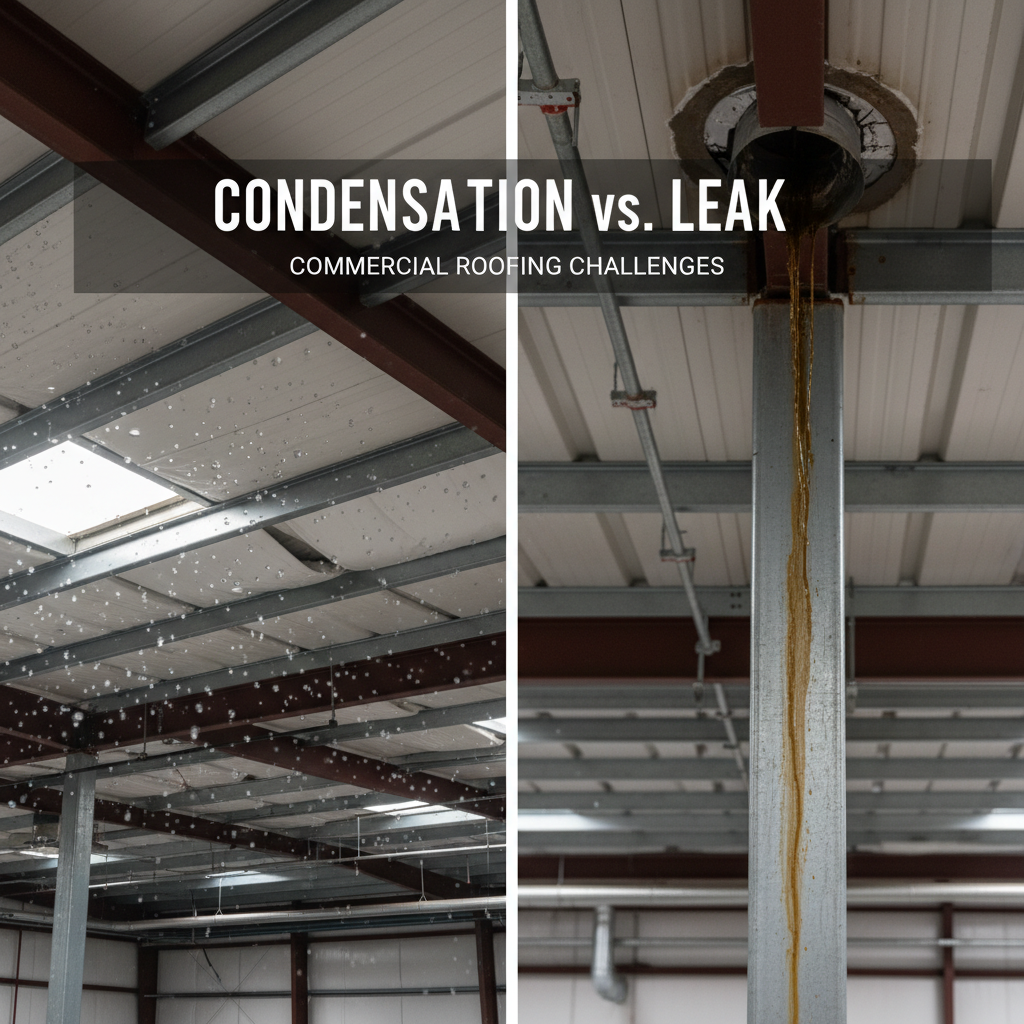
The visual pattern of moisture across your floor and ceiling provides the most reliable field diagnostic clue. Understanding these physical patterns lets you quickly distinguish between exterior penetrations and building envelope moisture issues.
An active exterior leak depends on precipitation. If water only drips during an active downpour, or for a brief period directly following rain, you are likely dealing with a breached flashing, an aged neoprene washer, a failed ridge cap closure, or an unsealed end lap. Rain leaks follow gravity and hydrostatic pressure. The water finds an entry point on the outer shell, travels along the topside of purlins or secondary framing, and drops down in a concentrated, repeatable location. If you place a bucket on the warehouse floor during a storm and the water fills that exact bucket in every rain event, suspect an exterior mechanical breach requiring a comprehensive roof leak diagnostic.
Condensation behaves entirely differently. Sweating is driven by temperature and humidity differentials, not rainfall. Condensation occurs on crystal-clear mornings, during dense fog, or when sudden cold fronts drop external temperatures while warehouse operations remain warm. Rather than entering at a single point, condensation develops simultaneously across vast expanses of the roof deck. You will observe thousands of tiny, uniform water beads forming across dozens of bays, coating red-iron purlins, sweating along electrical conduits, and dripping indiscriminately over wide zones of the facility floor.
The Early-Morning Dry-Night Field Test
In humid operating environments, commercial contractors rely on a dependable diagnostic procedure: the early-morning dry-night inspection. This test eliminates weather variables and clarifies whether moisture is originating from above the roof or beneath it.
Select a clear evening when daytime conditions have been relatively humid and nighttime temperatures are projected to drop significantly. Ensure zero rain has fallen for at least 36 to 48 hours, and verify that the upcoming forecast remains clear. At sunrise, before daytime solar radiation warms the exterior roof panels, enter the warehouse with high-powered flashlights.
Photograph the underside of the roof panels, the structural purlins, the edges of the insulation blankets, and the concrete slab below. If the ceiling deck is wet, if water droplets cling to the steel framing, or if widespread misting is evident without a single drop of rain in the area, your building is experiencing condensation. Photograph the same areas again 24 hours later following a rain event. Comparing these two photo sets reveals whether your moisture issues are weather-dependent leaks or thermodynamic dew point events.
Concealed Signs of Chronic Condensation Damage
Not all condensation announces itself with dramatic overhead dripping. In many commercial facilities, condensation operates quietly for months or years behind insulation facings and above suspended ceiling tiles. By the time water becomes visible at the floor level, internal structural damage may already be extensive.
Facility managers conducting regular commercial roof inspections should watch for these concealed warning signs:
- Purlin and Girt Surface Corrosion: When water vapor condenses behind vinyl-faced fiberglass insulation, moisture remains trapped against cold-formed steel purlins. This leads to premature red rust, pitting, and structural degradation along the upper flanges of secondary structural members.
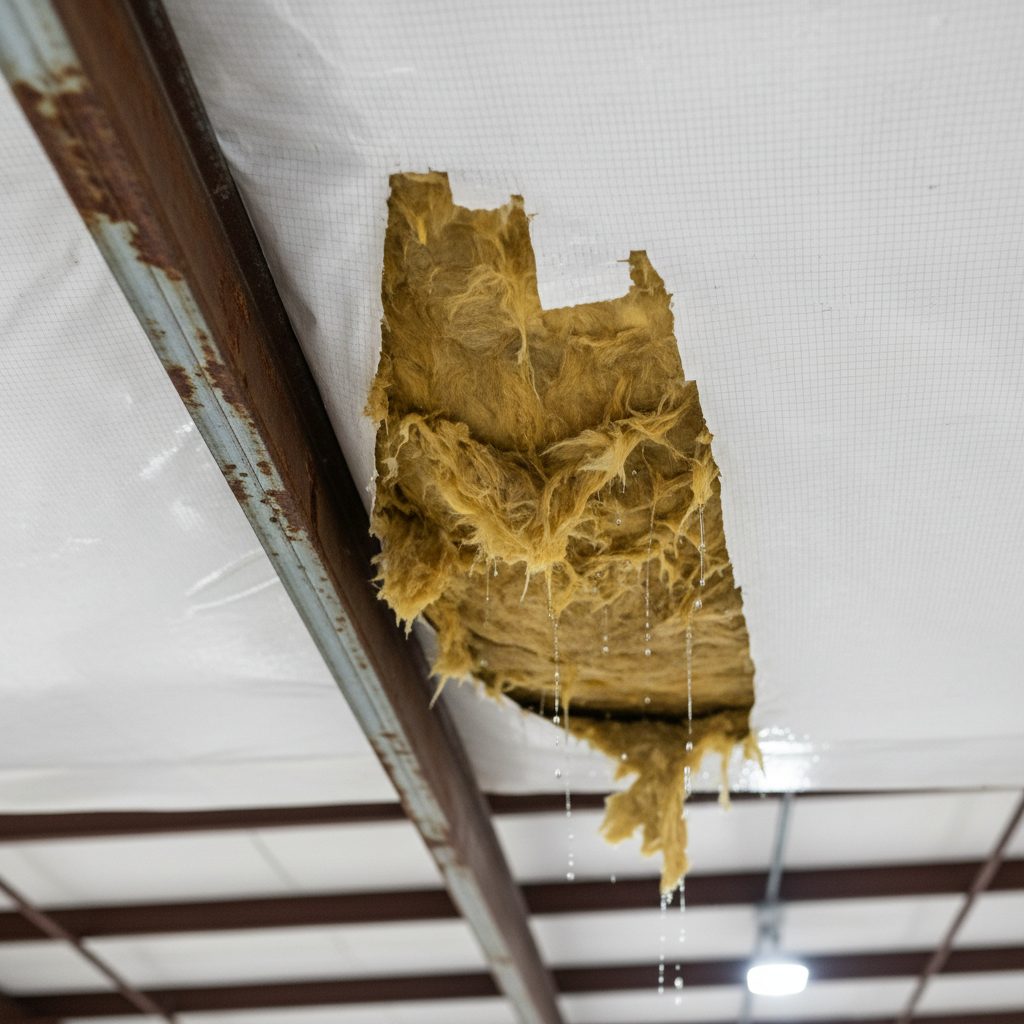
- Sagging, Discolored Insulation Blankets: Fiberglass insulation that absorbs condensation becomes waterlogged and heavy. This weight causes the blanket facing to sag, stretch, and pull away from purlin clips, creating pillowing pockets that trap gallons of hidden water.
- Delaminating Vapor Barrier Facing: The scrim, vinyl, or polypropylene facing on metal building insulation degrades when exposed to persistent moisture, peeling apart at factory seams and taped joints.
- Mildew, Mold, and Musty Odors: Chronic elevated relative humidity beneath the metal deck creates biological growth on paper facings, stored cardboard packaging, and wooden pallets, creating air quality concerns for warehouse personnel.
- Efflorescence and Slab Staining: Water dripping repeatedly over extended periods leaches minerals from concrete, leaving white chalky deposits or rust-colored circular rings on the floor slab long after the moisture has evaporated.
The Critical Role of Insulation and Vapor Retarders
A metal building roof relies on two lines of defense against interior condensation: a thermal insulation layer to keep interior surface temperatures elevated, and an unbroken vapor retarder to prevent warm, humid interior air from reaching cold surfaces.
Fiberglass blanket insulation acts as a thermal buffer. By slowing conductive heat transfer through the metal panels, the insulation ensures that the interior facing material stays closer to the ambient indoor room temperature than to the freezing exterior temperature. When the interior facing stays warmer than the dew point of the indoor air, condensation cannot form on that visible surface.
However, thermal insulation alone is insufficient. Fiberglass batting is highly porous. Air moves easily through yellow or pink fiberglass matrixes. Without a continuous vapor retarder, moist interior air migrates straight through the fiberglass until it hits the backside of the ice-cold exterior metal roof panels. Once inside the cavity, the air condenses against the panel underside. The fiberglass absorbs the water like a giant sponge. Wet fiberglass loses its insulating capability, dropping its thermal R-value to near zero. This accelerates thermal bridging and compounds the condensation cycle.
A single puncture or failed seam tape in a warehouse vapor retarder permits moist indoor air to bypass the thermal barrier and contact bare metal panels. In self-storage facilities and multi-tenant warehouse assets, a single torn vapor barrier seam can generate enough hidden condensation runoff to ruin tenant goods, damage electronic equipment, and spark lease disputes over inventory liability.
What Commercial Specialists Evaluate During an Inspection
Experienced commercial contractors do not guess at moisture sources. They employ systematic diagnostic evaluations to identify the exact psychrometric and structural variables at play. Applying the wrong remedy wastes capital and leaves the underlying problem intact.
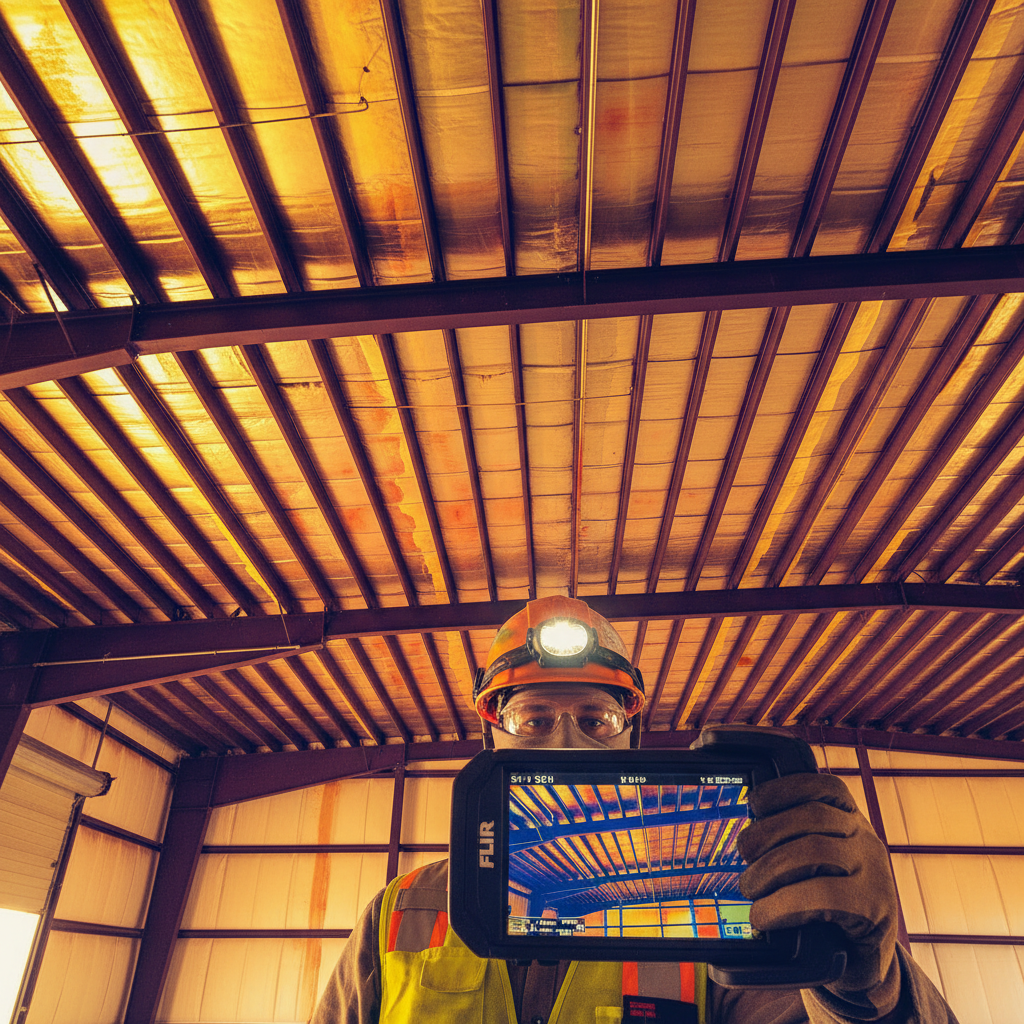
Diagnostic thermal imaging identifies temperature variations across the ceiling assembly that indicate wet insulation, thermal bridging, and dew point vulnerability. Certified technicians utilizing thermal imaging roof inspections can instantly visualize thermal anomalies that remain completely invisible to the naked eye. In a thermal infrared scan, wet fiberglass insulation displays distinct cool signatures due to evaporative cooling and elevated thermal capacitance, pinpointing saturated bays without requiring invasive cuts into the ceiling facing.
A professional evaluation systematically investigates four distinct categories:
1. Meteorological and Operating Timing
Technicians establish an operational timeline. When does the dripping begin? Does it happen at 6:00 AM on clear November mornings? Does it occur during shift changes when bay doors stay open? Does it happen exclusively during southeasterly wind-driven rainstorms? Aligning moisture occurrences with local weather telemetry and internal shift schedules establishes whether the incident is exterior-driven or interior-driven.
2. Interior Moisture Generation and Ventilation Dynamics
Warehouses are often assumed to be dry, passive storage environments, but daily internal operations often generate immense volumes of airborne moisture. Specialists assess:
- Unvented Gas or Propane Space Heaters: Combustion produces water vapor. For every gallon of propane or natural gas burned in an unvented salamander or space heater, approximately one gallon of water vapor is pumped directly into the warehouse air.
- Forklift Battery Charging Stations: Large charging banks release heat and trigger localized convective currents that drive humid air toward the roof deck.
- Wash-Down Bays and Wet Processes: Cleaning vehicles, washing equipment, or processing wet materials introduces high volumes of evaporative moisture into the building envelope.
- Hygroscopic Stored Commodities: Warehouses storing large volumes of unsealed corrugated cardboard boxes, fresh lumber, agricultural products, or green concrete slabs release latent moisture into the building envelope for months after placement.
3. Integrity of the Thermal and Vapor Barrier
Technicians inspect the condition of the vinyl or polypropylene vapor retarder across every bay. They examine whether seams are sealed with compatible vapor-tight acrylic tape, whether penetrations around structural columns, fire sprinkler drops, and mechanical conduits are sealed, and whether bird nesting or forklift mast impacts have compromised the membrane.
4. Physical Roof Condition and Exterior Penetrations
Finally, technicians verify that exterior weatherproofing systems are intact. They inspect standing seam clips, end lap mastic tape, self-drilling screw washers, ridge vents, valley gutters, and rooftop equipment curbs. This ensures that an assumed condensation problem is not masking an actual exterior mechanical failure.
Correcting Dew Point Issues: Engineering Solutions
Resolving commercial roof condensation requires managing either the surface temperature of the roof structure or the moisture content of the indoor air. Coating an uninsulated roof or applying external sealants will not alter the dew point inside the building. Long-term correction requires proven engineering adjustments.
The primary strategy involves controlling relative humidity through balanced air movement and dedicated ventilation. Installing properly engineered commercial roof ventilation systems, such as continuous ridge vents, louvers, or high-volume low-speed (HVLS) destratification fans, eliminates interior humidity traps. HVLS fans mix warm air trapped at the ceiling deck with cooler, drier air near the floor. This air movement increases air velocity across metal surfaces, which discourages boundary-layer cooling and helps keep the metal surface temperature above the dew point.
In facilities with high internal moisture loads, mechanical exhaust systems or industrial dehumidification units may be necessary to extract moisture before it reaches ceiling level. Simple operational adjustments, such as ducting combustion heaters directly to the outdoors, sealing interior wash bays with vapor-tight partitions, and closing dock doors during humid morning hours, drastically reduce internal vapor pressure.
When the ceiling insulation assembly itself is deficient, restoring the thermal envelope becomes necessary. This can involve repairing torn vapor barrier facing with specialized vapor-retarding tape, adding retrofit blanket insulation over existing framing, or installing a continuous rigid insulation system during an external roof retrofit. Keeping the warm interior air isolated from cold roof steel solves the condensation equation permanently.
When the Problem Is Actually an Exterior Leak
While condensation accounts for many unexplained ceiling drips, physical exterior roof damage remains a major hazard for commercial metal buildings. Heavy wind events, thermal expansion cycles, and severe hail storms can compromise structural metal panels and create true water entry points.
Fasteners on metal roofs represent a frequent failure point. Exposed fastener roofs contain thousands of screw penetrations. Over years of thermal cycling, metal panels expand and contract across changing temperatures. This continuous movement can back out fasteners, wallow out screw holes, or degrade neoprene sealing washers. Heavy hail impacts can also crack aged washers or warp panel laps, allowing rainwater to penetrate directly through structural joints.
Flashing assemblies around rooftop HVAC units, skylights, exhaust stacks, and parapet walls are equally susceptible to movement. If caulking dries, splits, or pulls away from sheet metal counterflashings, water tracks into the building envelope during rain events. If your inspection confirms that water intrusion correlates strictly with precipitation, you require targeted commercial roof leak repair to restore the integrity of seams, fasteners, and flashing details.
Texas and Oklahoma Climate Considerations: Vapor Control Realities
Much of the technical literature regarding metal building condensation and vapor barriers was authored for cold northern climates. In northern regions, buildings are heated for most of the year, meaning vapor drive moves consistently from the warm interior toward the cold exterior. In that environment, placing a vapor retarder on the interior face of the insulation is a straightforward, universal rule.
Texas and Oklahoma present a completely different set of climate challenges spanning IECC Climate Zones 2, 3, and 4. In these regions, weather conditions reverse seasonally, and intense atmospheric shifts occur rapidly:
- Rapid Blue Norther Temperature Plummets: A warm, humid autumn afternoon in North Texas or Southern Oklahoma can experience a sudden temperature drop of 30 to 40 degrees within a few hours as a sharp cold front pushes through. The air inside a large warehouse remains warm and moisture-laden, while the exterior metal roof panels drop to near-freezing in minutes. This sudden shift triggers severe, immediate condensation events across uninsulated or poorly insulated decks.
- Reversing Vapor Drive: During hot, humid Texas and Oklahoma summers, outdoor ambient temperatures exceed 95 degrees with high humidity, while warehouse offices or climate-controlled distribution centers maintain indoor temperatures in the low 70s. Under these summer conditions, vapor drive completely reverses: moisture is driven from the humid exterior toward the cool interior. A poorly planned vapor barrier installation can trap summer moisture inside wall and roof assemblies, causing hidden decay.
- High Relative Humidity Corridors: Areas subject to humid air masses pushing north from the Gulf of Mexico experience prolonged periods where dew points remain elevated into the upper 60s and 70s. In these environments, even minor gaps in thermal insulation allow warm outdoor air to contact cooled interior components, generating sweating around air conditioning ducts, structural ties, and uninsulated fasteners.
Because vapor control dynamics vary significantly between unconditioned industrial warehouses and conditioned distribution facilities across Texas and Oklahoma, building envelope designs require careful regional analysis. Facility managers should consult experienced regional commercial roofing professionals to confirm optimal insulation, ventilation, and vapor barrier configurations for their specific climate zone and operational use.
Stop Wasting Capital on the Wrong Fix
Assuming that every ceiling drip requires a mastic patch, a bucket of coating, or a complete roof replacement leads to wasted maintenance budgets and persistent ceiling drips. If you apply an exterior sealant to an uninsulated metal roof suffering from elevated indoor dew points, water will continue to drip onto your warehouse floor during the very next cold snap.
Before committing capital to roof repairs, demand an accurate diagnostic evaluation. By tracking weather timing, mapping moisture distribution patterns, assessing your building's internal humidity sources, and inspecting vapor retarder integrity, you can address the root cause of the problem. Whether your warehouse requires targeted mechanical leak repair, improved passive ventilation, or an upgraded thermal envelope, partnering with an experienced commercial roofing advisor ensures your facility remains dry, secure, and operational throughout the year.
Ready to Protect Your Facility?
Dripping ceilings in a commercial warehouse disrupt operations, ruin inventory, and create serious safety hazards. Before spending capital on temporary roof patches or unnecessary replacements, let the experienced team at TriVAN Roofing pinpoint the true cause. Serving Texas and Oklahoma since 2001, our certified commercial roofing specialists use advanced diagnostic tools to distinguish between active exterior leaks and building envelope condensation issues. Whether your facility needs targeted seam repairs, improved ventilation, or vapor retarder restoration, we provide clear, data-driven solutions backed by our elite industry certifications. Call TriVAN Roofing today at 877-487-4826 to schedule your comprehensive warehouse roof evaluation.
Contact Us Today