
Maximize Tax Benefits with Commercial Roofing Depreciation
Maximize your tax savings with commercial roofing depreciation strategies. Learn how Section 179, bonus depreciation, and MACRS impact your roofing projects—and how proper classification and timing can reduce your tax burden.
How a commercial roof project is taxed affects both your cash flow and long-term capital planning. This guide walks property owners and managers through the federal rules that matter most: Section 179, bonus depreciation, MACRS (39-year) recover, and related incentives like Section 179D that can change the after-tax cost of repairs, replacements, and energy upgrades. You’ll get clear criteria for repair versus capital improvement, practical documentation steps for tax filings, example calculations, and state-focused notes for Texas and Oklahoma. The goal is practical: help you evaluate immediate expensing, compute MACRS results for sample costs, spot qualifying energy upgrades, and assemble the records needed to claim deductions on Form 4562 while keeping audit risk low. Throughout, we use IRS-aligned definitions and actionable checklists so you can coordinate with contractors and tax advisors to tax-optimize your roofing work.
What Are the Key Tax Benefits for Commercial Roofing Projects?

Commercial roofing costs normally fall into three federal tax treatments: Section 179 expensing, bonus depreciation, or multi-year recovery under MACRS for nonresidential real property. Each path changes when you get the tax benefit and depends on eligibility rules, placed-in-service dates, and the nature of the work. Picking the right approach can lower taxable income in the year of the project or spread the deduction over decades, a choice that directly affects cash flow and capital budgeting. Below is a concise summary to help you compare the headline differences and plan accordingly.
The most relevant tax benefits include:
-
Section 179 Expensing: Lets eligible property be deducted immediately in the year it’s placed in service, subject to limits and qualifying rules.
-
Bonus Depreciation: A one-time accelerated first-year deduction (recent law changes restored 100% for certain property acquired after January 19, 2025).
-
MACRS (39-year): Straight-line depreciation for nonresidential real property where capitalized costs are recovered over 39 years.
Each option trades near-term savings against long-term recovery. Which you choose depends on project size, whether the work is a repair or a capital improvement, and your broader tax strategy. The quick comparison table below highlights eligibility, timing, and typical results for a standard commercial roofing project.
This table shows how immediate expensing differs from long-term depreciation and why confirming eligibility and placed-in-service timing matters before you claim a treatment.
How Do Section 179 Deductions Apply to Commercial Roofs?
Section 179 lets businesses elect to expense qualifying tangible property in the year it’s placed in service rather than depreciate it. Some roofing-related components may meet the “tangible personal property” tests and qualify, but the roof structure itself is typically treated as real property and capitalized. Qualification depends on how the work is classified and on evolving legislation and IRS guidance (for example, changes from OBBBA 2025). Evaluate whether removable equipment platforms, non-structural attachments, or other discrete components qualify separately from the roof assembly. Because these rules change, consult IRS guidance and your tax professional before applying Section 179 — correct classification can produce substantial first-year tax savings when it applies.
What Is Bonus Depreciation and How Does It Affect Commercial Roof Replacement?
Bonus depreciation accelerates first-year deductions for qualifying property. Recent law restored 100% bonus depreciation for eligible property acquired and placed in service after January 19, 2025, subject to specific rules and any phase-in provisions. For roof replacements, eligible non-building components may be written off immediately under bonus rules, while the roof structure itself generally remains on a 39-year MACRS schedule unless it qualifies otherwise. Section 179 and bonus depreciation can interact; businesses typically choose the approach that delivers the best near-term tax benefit while following stacking rules and limitations. For example, a $200,000 replacement where certain components qualify for bonus depreciation could produce a large first-year deduction and improve short-term cash flow. Understanding how bonus depreciation works helps you decide whether to proceed with a full replacement now or defer for tax or operational reasons.
How Is Commercial Roof Depreciation Calculated Under IRS Rules?
Federal rules generally treat commercial roof depreciation under MACRS with a 39-year straight-line recovery period for nonresidential real property. Start by determining the depreciable basis, usually the portion of the project cost attributable to the capital improvement after excluding land and other non-depreciable items, then apply the straight-line method and the applicable convention. The placed-in-service date determines the tax year for the deduction and can trigger mid-month or half-year conventions, so accurate timing and documentation are important to compute the correct deduction.
The following sample calculation illustrates annual and first-year outcomes for a $100,000 roof under different tax options.
That comparison shows MACRS spreads the cost over decades, while Section 179 or 100% bonus depreciation can move the entire deduction into the acquisition year, underscoring why correct classification and eligibility checks are vital. Use these differences to estimate tax impact and coordinate project timing with your tax advisor.
What Is the MACRS 39-Year Depreciation Schedule for Commercial Roofs?
Under MACRS, nonresidential real property generally uses a 39-year straight-line recovery period, so the depreciable basis is divided evenly over 39 years. To calculate annual depreciation, allocate the total project cost to the building improvement portion and remove any non-depreciable items; for example, a $150,000 capitalized roof yields roughly $3,846 in annual depreciation. Timing rules, such as mid-month conventions, can tweak first- and last-year amounts, so precise placed-in-service dates matter. Keep clear cost allocations and documentation to support depreciation claims and simplify coordination with tax filings and potential audits. These practical computation points also matter when recent law changes affect available first-year options.
Most built-up commercial roofs treated as capital improvements will be depreciated over a 39-year period under current federal rules.
Tax Deductions for Commercial Roof Replacements: Depreciation and Documentation
To claim a roof replacement expense as a deduction, the new roof generally must be a capital improvement rather than a repair. Proper documentation typically supports 39-year depreciation for built-up roofs.
How Do Recent Tax Law Changes Impact Commercial Roof Depreciation?
Recent federal legislation effective in 2025 broadened some first-year expensing options by increasing Section 179 thresholds and restoring 100% bonus depreciation for qualifying property acquired after January 19, 2025. Those changes make it possible to accelerate deductions for eligible components, but they also add complexity because the roof structure itself often remains nonresidential real property on a 39-year MACRS schedule. Timing a project to fall inside favorable placed-in-service windows can unlock larger immediate tax benefits, but state conformity to federal changes varies and needs local review. Coordinate construction schedules and procurement decisions with your tax advisor to align with the best federal rules and ensure correct component classification for optimal tax treatment.
What Is the Difference Between Roof Repair and Replacement for Tax Purposes?
The IRS draws a key line between deductible repairs and capital improvements: repairs keep property in working condition and are often deductible as current expenses, while replacements increase value or extend useful life and must be capitalized and depreciated. The repair-versus-replacement determination depends on facts and circumstances, how much work was done, whether the project simply restores or actually improves, and how the useful life changes. That distinction matters because repairs typically give an immediate deduction and simpler bookkeeping, while capitalized replacements affect basis and trigger multi-year depreciation. The practical decision rules and examples below help owners and contractors classify work correctly and prepare supporting documentation.
When evaluating repair versus replacement, consider the following decision rules:
-
Treat as a repair if the work restores functionality without materially extending the asset’s useful life.
-
Treat as a replacement (capital improvement) if the job swaps out a major component or meaningfully lengthens useful life.
-
Capitalize costs that add new systems or substantially upgrade the roof assembly beyond its original condition.
Applying these rules to real projects reduces audit risk and clarifies whether to expense costs now or capitalize them for MACRS recovery. Keep documentation that shows scope, before-and-after conditions, and estimated useful life to support your tax position and to aid discussions with advisors.
Legal and tax debates over repairs versus capital improvements make careful classification an important part of project planning.
Repairs vs. Capital Improvements: Tax Deductions in US Income Tax Law
The distinction between deductible repairs and capital improvements is a recurring issue in federal tax law. This article reviews the problem and possible approaches.
When Is a Commercial Roof Repair Deductible as an Expense?
A commercial roof repair is deductible when the work returns the roof to normal operating condition without materially increasing its value or useful life. Routine patching, flashing repair, and targeted membrane sealing normally qualify as deductible maintenance.
To support a repair treatment, keep itemized invoices, clear scope-of-work descriptions, and evidence the work addressed deterioration rather than an upgrade. Recording repairs as maintenance expense on financial statements aligns bookkeeping with tax treatment and creates a solid audit trail. Good documentation and a clear distinction from capital projects help prevent misclassification and protect immediate deductions.
Why Is Roof Replacement Considered a Capital Improvement Subject to Depreciation?
Roof replacement is usually a capital improvement because it restores or increases property value and extends useful life. Costs for replacements are added to the building’s basis and recovered through depreciation. Jobs that remove the old deck, add new membranes or insulation, or materially change materials (for example, moving from single-ply flat roofing to standing-seam metal) are capital in nature and should be capitalized. When capitalizing, allocate costs between building and other components, record placed-in-service dates, and calculate depreciation correctly, these steps protect you when filing Form 4562 and in the event of an audit. Accurate allocations also help spot components that might qualify for accelerated treatments like Section 179 or bonus depreciation.
How Can Energy-Efficient Commercial Roofing Qualify for Additional Tax Credits?
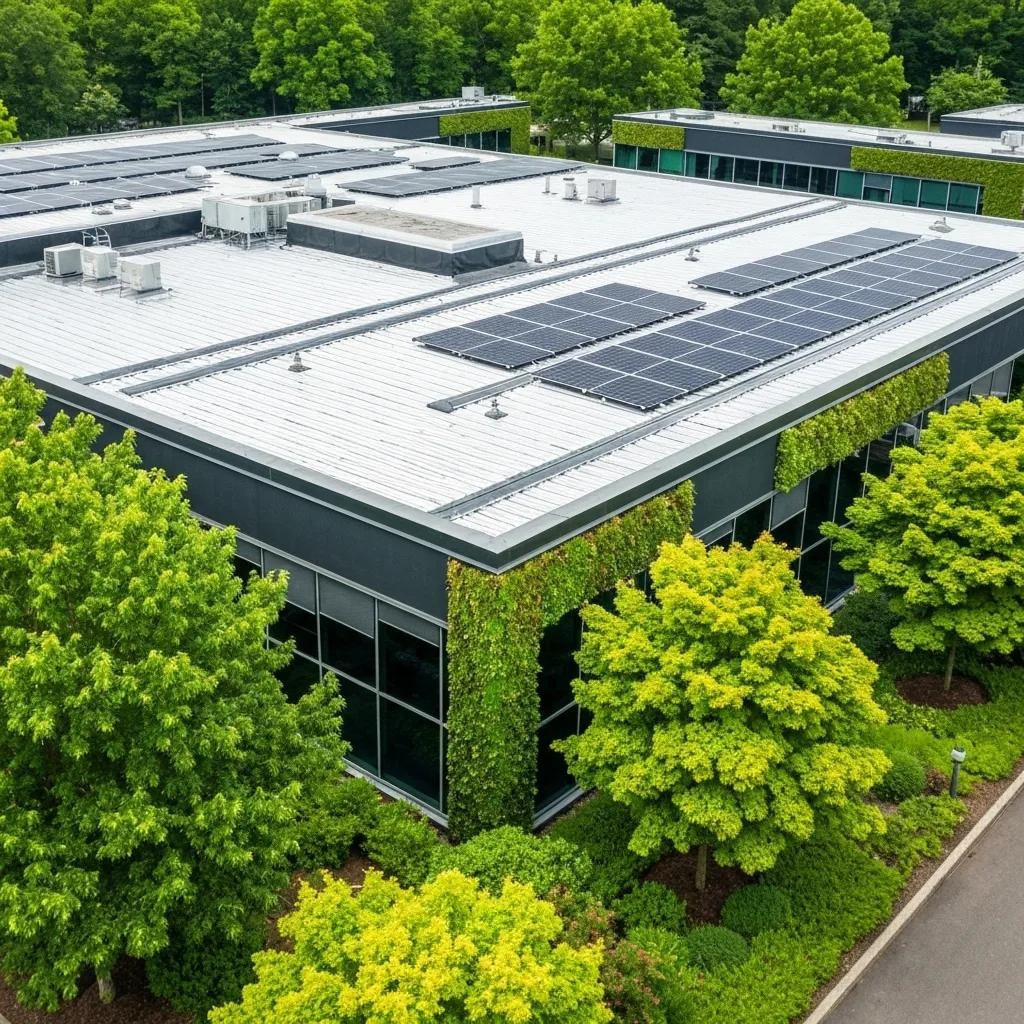
Energy-focused roof upgrades can unlock extra incentives such as Section 179D and utility or state programs when the project measurably reduces energy use and meets technical standards. Eligible measures include higher-R insulation, reflective membranes, or roof assemblies designed to cut cooling loads, and sometimes solar-ready or integrated renewable systems. To claim these incentives, you must document energy savings, follow performance standards (often ASHRAE or Energy Star), and secure required certifications or engineer reports. Knowing the documentation and certification steps is key to maximizing after-tax benefits and blending energy upgrades into your roofing plan.
The Section 179D and related incentives can be summarized as follows:
-
Section 179D: Deduction for qualifying energy-efficient commercial building property that meets specific energy-reduction criteria and requires certification.
-
Utility and state rebates: Local programs that often supplement federal incentives and improve project economics.
-
Documentation requirements: Engineering reports, measured energy savings, and certification forms are commonly required to substantiate claims.
These incentives affect basis and depreciation calculations, so coordinate with tax advisors to stack benefits correctly and remain compliant. The table below clarifies common qualifying materials and typical benefits.
Energy upgrades can add incremental tax and cash incentives, but eligibility depends on measurable performance and timely certification.
Section 179D represents a meaningful opportunity to reduce tax liability by investing in energy-efficient building improvements.
Section 179D Deduction for Energy Efficient Commercial Buildings
Overview of Section 179D and the compliance steps required to claim the deduction.
What Is the Section 179D Deduction for Energy-Efficient Commercial Roofs?
Section 179D gives a deduction for qualifying energy-efficient building improvements when upgrades hit specific energy savings targets and are certified by a qualified individual. Common roofing measures that qualify include added insulation, reflective membranes that reduce cooling loads, and assemblies that tighten the thermal envelope. Each measure must be supported by calculations or simulations showing improvement against a baseline. Be aware of statutory deadlines and potential rule changes; projects that begin construction after June 30, 2026, may face different rules, so plan early. Obtain engineering certifications and keep detailed records to substantiate any deduction and to coordinate claims with other depreciation strategies.
Which Energy-Efficient Roofing Materials Qualify for Tax Incentives?
Materials that often qualify include high-R-value insulation, cool reflective membranes that cut solar heat gain, and metal roofing systems with reflective coatings, plus components that enable on-roof renewable systems. Each material contributes differently: insulation reduces conductive heat loss, reflective membranes lower cooling loads in warm climates, and standing-seam metal with reflective coatings improves durability and reflectivity. Certification usually relies on standards like ASHRAE or Energy Star and may require third-party testing or engineering validation, so collect manufacturer specs, test results, and installation records. Designing the project with qualifying materials in mind helps you improve building performance and maximize incentives.
How Can Texas and Oklahoma Businesses Maximize Commercial Roofing Tax Savings?
Businesses in Texas and Oklahoma should align federal opportunities with state-specific treatment and local incentives, and coordinate project timing, documentation, and certifications with local tax advisors and contractors. While federal rules set the baseline for depreciation and deductions, states vary in whether they conform to or decouple from federal provisions, which can affect state taxable income and timing of benefits. Local utility rebates or municipal programs in Texas and Oklahoma can further improve project economics, so identify regional programs and time projects to match application windows. Working with a contractor who knows local building practices and documentation expectations reduces administrative burden and speeds the process.
TrivVAN Roofing, a regional commercial roofing specialist serving Texas and Oklahoma, can help by coordinating project schedules, providing detailed invoices and placed-in-service dates, and gathering manufacturer specifications needed for tax and energy-incentive claims. We work on flat and metal roofing systems, including standing seam metal roofs and common flat membranes, and can recommend materials that align with tax-advantaged options and local climate needs. If you want to optimize tax outcomes, we’ll help you communicate with your tax advisor and supply the documentation needed to support depreciation, Section 179D claims, or rebate applications.
What Local Tax Considerations Affect Commercial Roofing Depreciation?
State treatment of federal depreciation and deductions varies: some states fully follow federal rules while others decouple specific provisions, which can change state taxable income when you claim Section 179 or bonus depreciation federally. Texas and Oklahoma each have their own corporate and property tax frameworks, so although federal depreciation sets the federal timing, you may need state-specific adjustments or add-backs. Local utility rebates and municipal incentives also carry geographic eligibility and documentation requirements. Consult state tax guidance and a local CPA early in planning to understand state-level consequences and avoid surprises on state returns.
How Can TriVAN Roofing Help with Tax-Optimized Commercial Roofing Projects?
TrivVAN Roofing brings regional know-how and practical experience documenting projects to support tax claims and energy-incentive applications. We provide itemized invoices, component descriptions, placed-in-service confirmations, and manufacturer specifications your tax advisor will want to see. In practice, we’ll coordinate scheduling to optimize placed-in-service timing, advise on materials that support energy-efficiency claims, and deliver the paperwork your CPA requests. For businesses that want roofing expertise plus administrative support, TrivVAN offers free estimates and works to make tax-focused project execution simpler and more transparent.
What Are the Steps to Claim Commercial Roofing Tax Deductions?
Claiming roofing-related tax deductions takes organized documentation, correct cost classification, and proper reporting (typically on Form 4562). A stepwise approach reduces errors and strengthens your position if the IRS asks questions. Start by scoping and classifying the work (repair vs. capital improvement), allocate costs between building, land, and personal-property components, secure engineering certifications for energy claims, and record placed-in-service dates. Then assemble invoices, contracts, and performance reports, choose between Section 179, bonus depreciation, or MACRS with your tax advisor, and file the appropriate entries on your return. The checklist below outlines the core steps to keep the process compliant and efficient.
Follow these essential steps to document and claim roofing-related tax benefits:
-
Classify the Work: Decide whether the project is a repair or a capital improvement and document why.
-
Allocate Costs: Itemize invoices to separate building, equipment, and material costs for correct basis computation.
-
Document Timing: Record installation and placed-in-service dates to establish tax-year eligibility.
-
Gather Certifications: Get engineering reports or third-party certifications for energy-saving claims or Section 179D.
-
Select Tax Treatment: Work with your tax advisor to elect Section 179, bonus depreciation, or MACRS as appropriate.
-
File Correct Forms: Report depreciation and elections on Form 4562 and keep supporting documents for audits.
Following this process helps you keep an audit-ready file, ensures elections are timely and accurate, and aligns the chosen tax treatment with your overall financial plan. Clear documentation and advisor coordination make claiming deductions straightforward and defensible.
Which IRS Forms and Documentation Are Required for Roofing Depreciation?
Form 4562 is the main IRS form used to report depreciation and amortization, including Section 179 and bonus depreciation elections. Complete the relevant sections, attach required statements, and retain supporting documentation. Helpful records include itemized invoices with labor and material breakdowns, asset descriptions and serial numbers if applicable, placed-in-service dates, contracts, before-and-after photos, and engineering certifications for energy credits. A well-organized file simplifies tax prep and creates an audit trail for your chosen classification and election. Documentation needs vary by deduction or credit, so coordinate with contractors and tax advisors to make sure you have everything required.
To support your paperwork, TrivVAN Roofing provides itemized invoices, clear asset descriptions, and placed-in-service confirmations on request, helping reduce administrative friction and ensuring tax filings reflect accurate project information. We still recommend relying on a qualified tax advisor for final reporting decisions.
When Should Business Owners Consult Tax Professionals for Roofing Deductions?
Consult tax professionals early when planning significant roofing projects, especially for large expenditures, when pursuing energy credits like Section 179D, or when multiple properties and state tax differences complicate the analysis. Early advice lets you align procurement, construction timing, and material choices with tax-efficient strategies and ensures elections such as Section 179 are timely and correctly reported. A tax pro can model cash-flow and tax outcomes for different depreciation choices, advise on state conformity issues, and help assemble documentation to withstand scrutiny. Coordinated planning among owners, advisors, and contractors clarifies expected tax results and reduces the risk of costly reclassification or missed opportunities.
For help with project documentation and timing coordination, TrivVAN Roofing will supply the records and technical details CPAs commonly request, while recommending you rely on a qualified tax advisor for final decisions and filings.
TrivVAN Roofing can provide a free estimate and detailed project documentation to support your tax planning and filings for roofing projects in Texas and Oklahoma. Contact Trivan Roofing to schedule an estimate and request the paperwork your tax advisor needs to evaluate Section 179, bonus depreciation, MACRS, or energy-incentive opportunities.
Conclusion
Understanding commercial roofing depreciation and tax deductions helps property owners make smarter financial decisions. By using options like Section 179 and bonus depreciation where appropriate, you can move significant deductions into the near term and improve cash flow. Work with tax professionals and a contractor experienced in documentation, like TrivVAN Roofing, to streamline the process and stay compliant with IRS rules. Ready to explore your options? Contact TrivVAN Roofing for a free estimate and the documentation your advisor will need.
Ready to make your next roofing project tax-efficient?
Contact Trivan Roofing for a free estimate and the documentation your tax advisor needs.
Contact Us Today