
Elevate Your Building's Value with Green Roofing Solutions
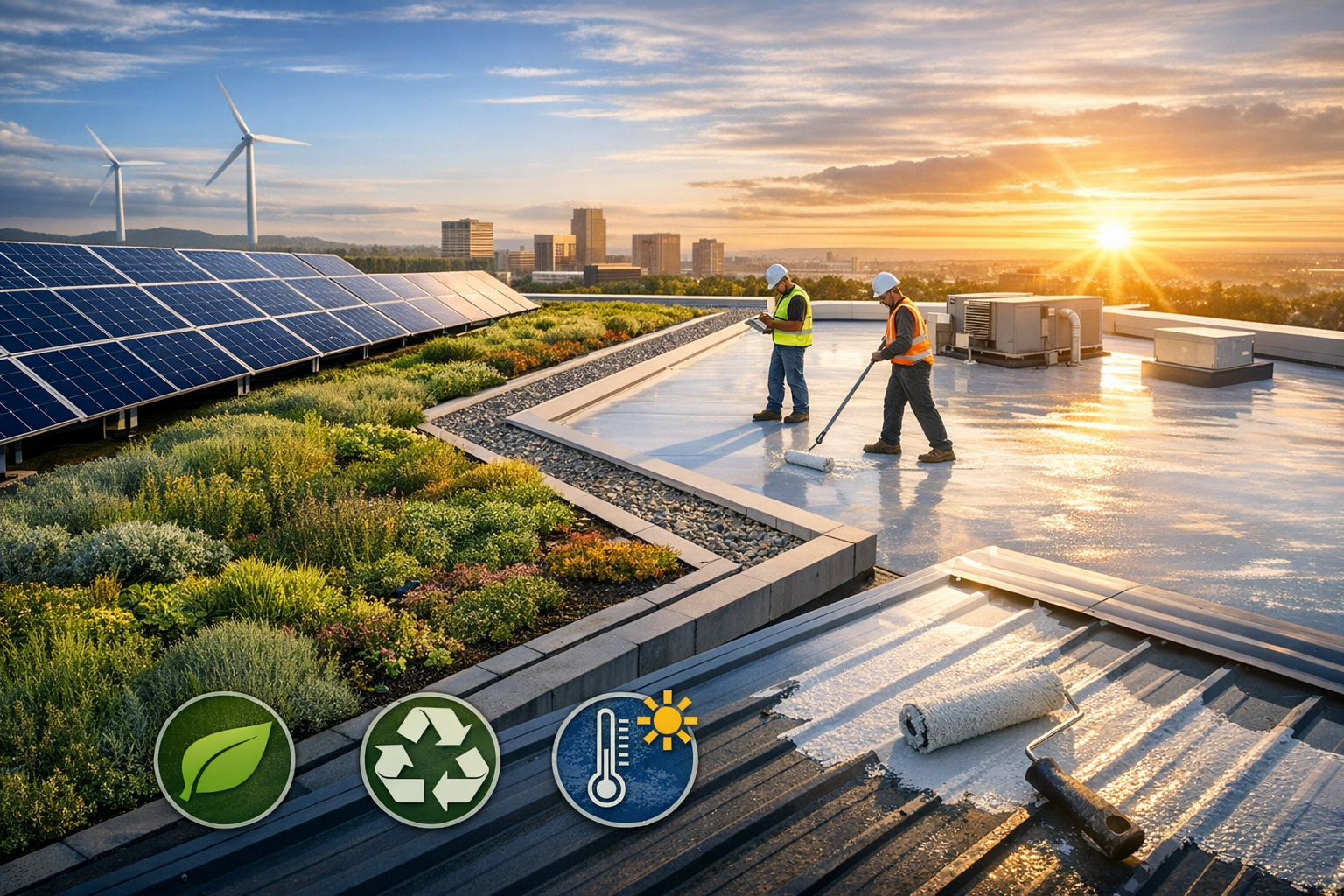
Sustainable commercial roofing solutions reduce energy costs, extend roof lifespan, and increase property value. Learn how energy-efficient materials, green roofing systems, and preventive maintenance protect your investment while meeting modern environmental standards.
Sustainable commercial roofing ties smart material choices, system design and routine maintenance into one plan to cut energy use, lower life-cycle costs and reduce environmental impact for commercial properties. This article breaks down what sustainable roofing looks like in practice - from reflective single-ply membranes and vegetated roofs to rooftop solar and restorative coatings - and explains why lifecycle planning and preventive maintenance matter for facility managers. You’ll see how common materials - TPO, PVC, recycled metal and emerging bio-based composites - compare on recyclability, reflectivity and longevity, and how systems like cool roofs and rooftop photovoltaics translate into measurable energy savings. We also cover green roof benefits (stormwater retention and urban heat-island mitigation) and how restoration and coating programs extend service life while keeping waste out of landfills. Finally, you’ll find practical vendor-evaluation tips to help select the right partners for your sustainable roofing projects. Keywords such as commercial roofing sustainability, energy-efficient roofing options and cool roof technology are woven through to support decision-making and planning.
What Are Sustainable Commercial Roofing Solutions and Why Do They Matter?
Sustainable commercial roofing means using products and practices that shrink a roof’s environmental footprint while improving building performance - energy savings, longer life and less waste. These strategies increase solar reflectance, improve thermal resistance, enable on-site renewable generation and extend service life so that fewer materials are consumed over time. The payoff: lower operating costs, more comfortable interiors and measurable reductions in embodied and operational carbon. Facility managers who understand these mechanics can prioritize interventions that deliver the best lifecycle returns and help meet regulatory or corporate sustainability targets. The sections that follow outline the core mechanisms and summarize the practical business benefits before discussing implementation considerations.
Sustainable roofing delivers three primary, measurable benefits:
-
Lower energy use via reduced cooling loads and improved insulation.
-
Reduced lifecycle costs by delaying replacement and cutting reactive repairs.
-
Smaller environmental footprint through less landfill waste and lower carbon emissions.
Those benefits explain why owners combine reflective membranes, restorative coatings and renewable energy on commercial roofs. The next sections show how reflectivity, insulation and solar generation produce those results.
How Does Sustainable Roofing Reduce Energy Costs and Environmental Impact?
Sustainable roofing lowers energy bills mainly by reducing heat gain and improving thermal performance, which shortens HVAC runtime. High-reflectance membranes and low-emissivity coatings send more solar radiation back to the sky, while added insulation and continuous air barriers cut conductive heat transfer. Together, these measures can substantially reduce cooling energy in warm climates. Industry analyses typically show cool roof measures cutting peak cooling demand and producing cooling savings in the 10-30% range for heavily conditioned spaces, though actual results depend on climate, roof assembly and building use. For example: at a large distribution center in a hot region, installing a reflective membrane plus targeted insulation upgrades - combined with utility incentives and avoided HVAC upgrades - can often bring payback down to a few years. Knowing how these measures interact with local climate helps owners choose the interventions that maximize both economic and environmental returns.
Those energy and emissions gains naturally raise implementation questions: which membranes and coating chemistries support the best long-term performance, and how can contractors ensure durable outcomes?
Which Eco-Friendly Commercial Roofing Materials Drive Industry Change?
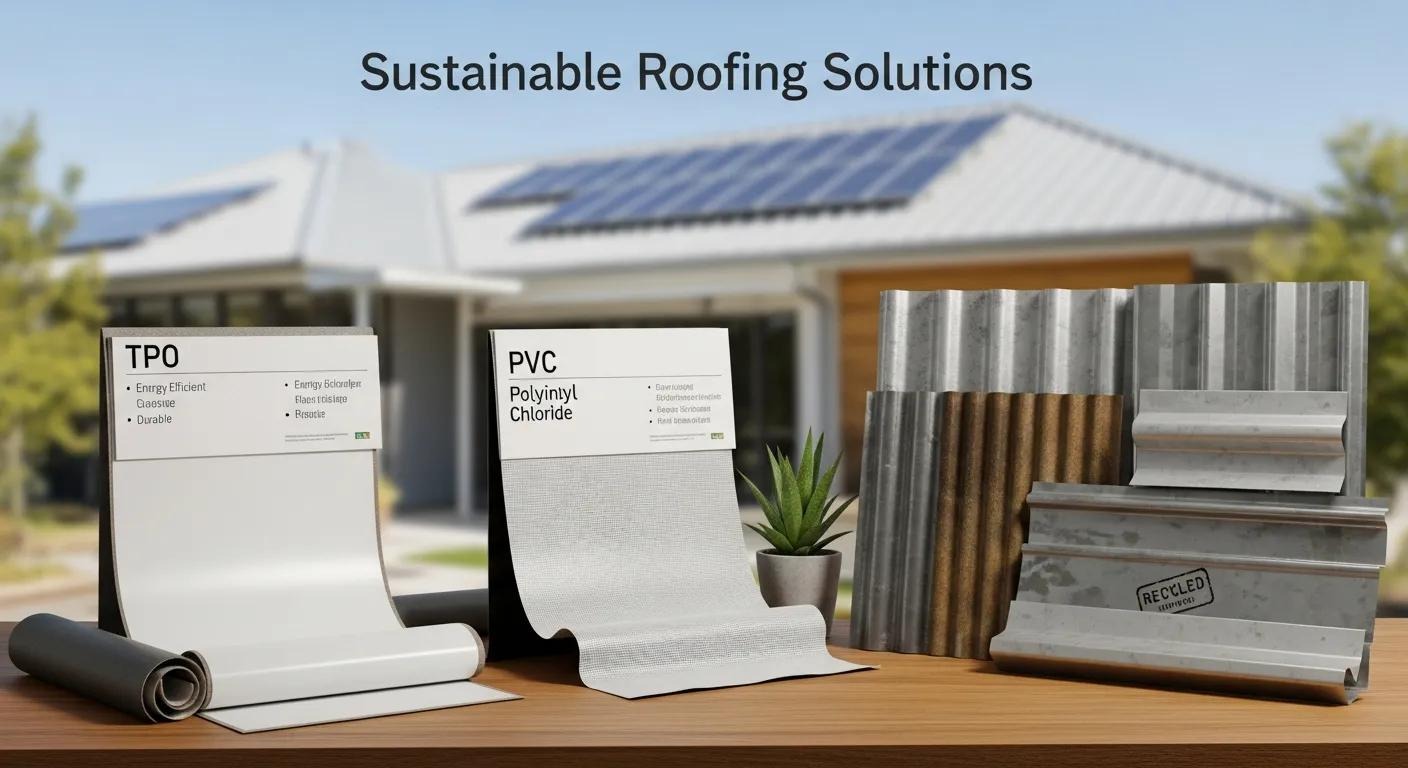
Material choice is central to commercial roofing sustainability because options differ in durability, recyclability, reflectivity and emissions. Common eco-friendly choices include single-ply membranes (TPO and PVC), recycled and recyclable metal roofing, and growing use of bio-based composite panels and low-VOC coatings. Comparing recyclability, reflectivity, expected service life and VOC levels helps owners match materials to operational goals and end-of-life strategies. The table below summarizes those trade-offs and supports practical selection criteria for owners balancing first cost, expected service life and environmental performance.
Different roofing materials show distinct eco-attributes:
|
Material |
Recyclability |
Reflectivity |
Longevity (typical) |
VOC Level |
|---|---|---|---|---|
|
TPO membrane |
Medium - recyclable at specific facilities |
High - good solar reflectance |
20-30 years |
Low |
|
PVC membrane |
Medium - recyclable where programs exist |
High - durable reflectance properties |
25-30+ years |
Low |
|
Recycled metal roofing |
High - widely recyclable at end-of-life |
Medium - reflective when painted |
40-70 years |
Very low |
|
Bio-based composites |
Low-Medium - evolving recyclability |
Variable - depends on finish |
Emerging multi-decade potential |
Lower VOC formulations available |
This comparison shows why many owners pick TPO or PVC for reflective performance and cost effectiveness, while recycled metal is preferred where long life and circularity are top priorities. The next section looks more closely at the strengths of these leading options.
What Are the Benefits of TPO, PVC, and Recycled Metal Roofing?
TPO membranes are popular for high solar reflectance, reliable seam welding and cost-efficient installation - features that reduce cooling loads and make repairs straightforward. PVC offers strong chemical resistance and long-lasting reflectivity, a good match for roofs exposed to oils, grease or regular traffic. Recycled metal roofs deliver exceptional lifespan, broad recyclability and strong weather resistance, lowering lifecycle environmental impact despite higher upfront cost. Lifespans vary by system and maintenance: metal often endures for decades, while well-maintained single-ply membranes commonly reach 20+ years. These differences help owners align procurement with priorities, whether minimizing replacement cycles or maximizing near-term energy performance.
Choosing among these materials should also account for roof geometry, mechanical loads and in-house maintenance capacity; those operational factors drive which option produces the best sustainability outcome.
How Do Low-VOC Roof Coatings and Bio-Based Composites Enhance Sustainability?
Low-VOC coatings and bio-based composite panels reduce onsite emissions and lower embodied carbon versus conventional petrochemical products, improving worker safety during installation and the roof’s long-term environmental profile. Elastomeric and silicone coatings can restore watertightness and boost reflectivity, lowering surface temperatures and extending life without a full tear-off. Bio-based composites replace a portion of virgin polymers with renewable feedstocks, cutting lifecycle greenhouse-gas intensity and supporting circular-materials strategies. A common approach is to apply a low-VOC reflective coating as an interim strategy to lengthen a membrane’s useful life, then plan phased replacement or upgrades with recyclable or lower-carbon panels when budgets allow. These steps combine emissions reductions with lifecycle benefits that facility managers can track in sustainability reporting.
After selecting materials, owners frequently evaluate system-level measures - cool roofs, insulation and roof asset management - that multiply the performance gains.
How Do Energy-Efficient Commercial Roofing Systems Improve Building Performance?
Energy-efficient roofing systems pair reflective surfaces, thermal upgrades and on-roof energy generation to lower operational energy demand, improve occupant comfort and delay major capital replacements. Cool roofs reduce surface temperatures through high reflectance and emissivity; insulation and continuous air barriers cut heat transfer; and rooftop photovoltaics generate on-site electricity to offset purchased power. These measures differ in installation complexity, ROI timeline and maintenance needs, but combined they can deliver meaningful cooling savings and lower peak demand.
The table below helps facility teams weigh energy impact, complexity and expected payback when evaluating integrated roof-system investments.
|
System |
Energy Impact |
Installation Complexity |
ROI (years) |
Maintenance Needs |
|---|---|---|---|---|
|
Cool roof (reflective membrane/coating) |
-10% to -30% cooling savings in hot climates |
Low-Medium |
2-7 |
Annual inspection, recoating cycles |
|
Rooftop PV |
Offsets electricity use; depends on system size |
Medium-High (structural/readiness checks) |
3-10 |
Panel cleaning, inverter servicing |
|
Insulation upgrades/continuous air barrier |
Reduces both heating and cooling loads |
Medium |
3-8 |
Low - periodic inspection |
Combining measures often shortens payback and spreads risk: a reflective coating delivers immediate cooling relief while PV supplies long-term generation. The following sections explain cool roof mechanics and PV integration in practical terms.
What Is Commercial Cool Roof Technology and How Does It Save Energy?
Cool roof technology reduces solar heat gain using materials and coatings with high solar reflectance and thermal emissivity. Lower roof surface temperatures mean less heat flow into the building, which cuts peak cooling demand and HVAC runtime - the biggest benefits occur in warm, sunny climates. Facility-level savings commonly fall in the 10-30% range for cooling-dominated buildings. Cool roofs also reduce thermal cycling stress on roof assemblies, helping extend membrane life and lower repair frequency. When planning a cool roof upgrade, evaluate reflectance/emissivity ratings, roof slope and local climate to estimate savings and choose membranes or coatings that retain reflectivity over time. That attention to details helps ensure both energy and durability gains.
Lower roof temperatures also influence rooftop equipment choices and long-term membrane wear, factors that affect decisions about solar integration and roof-mounted infrastructure.
How Can Solar Panel Integration Transform Commercial Roofs?
Rooftop solar turns a passive roof into an energy asset by converting sunlight into on-site electricity, reducing purchased power and improving operating costs. Successful integration requires a structural assessment, membrane compatibility checks and careful coordination of PV racking with roof drainage. When done correctly, PV provides steady offsets and attractive returns - especially when paired with utility incentives or demand-charge strategies. Mounting options include ballast, penetration and rail-attached systems; selection depends on roof type (single-ply, metal, standing seam) and warranty considerations. Pairing PV with cool-roof strategies can be complementary: panels offset energy while shaded areas slightly reduce membrane temperature. Still, designers must align lifecycles and mounting methods to avoid premature membrane replacement or warranty conflicts.
Green Roofs and Coatings Enhance Commercial Solar PV Performance
Solar photovoltaic (PV) technology is widely adopted in sub-Saharan regions because of abundant solar irradiation and intermittent grid reliability. This review examines how roof type and surface coatings affect rooftop PV performance across four common roofs - green, clay tile, metal and plastic tile - under sub-Saharan climates. Key findings: green roofs can lower PV module temperatures by about 1.5-3 °C and boost power output efficiency by up to 6%; clay tile roofs offer up to 2.6 °C cooling versus metal roofs, producing a ~0.378 V increase per module; and coated metal roofs using reflective pigments such as TiO₂ and Fe₂O₃ improved PV performance by up to 10.4%. The review concludes that roof material and coatings significantly influence PV efficiency and longevity, with green roofs showing the largest performance gains despite higher costs and maintenance. It also notes research gaps in comparative thermal performance across coated metal, clay tile and plastic tile roofs under varying sub-Saharan conditions.
Assessing the suitability of different roof types and coatings on roof-installed solar photovoltaic performance in sub-Saharan climates: a review, AH Mourad, 2025
These system-level upgrades pair naturally with vegetated roofs in urban settings, where green roofs add ecological services beyond energy reduction.
What Are the Environmental and Economic Benefits of Green Roofs for Commercial Buildings?
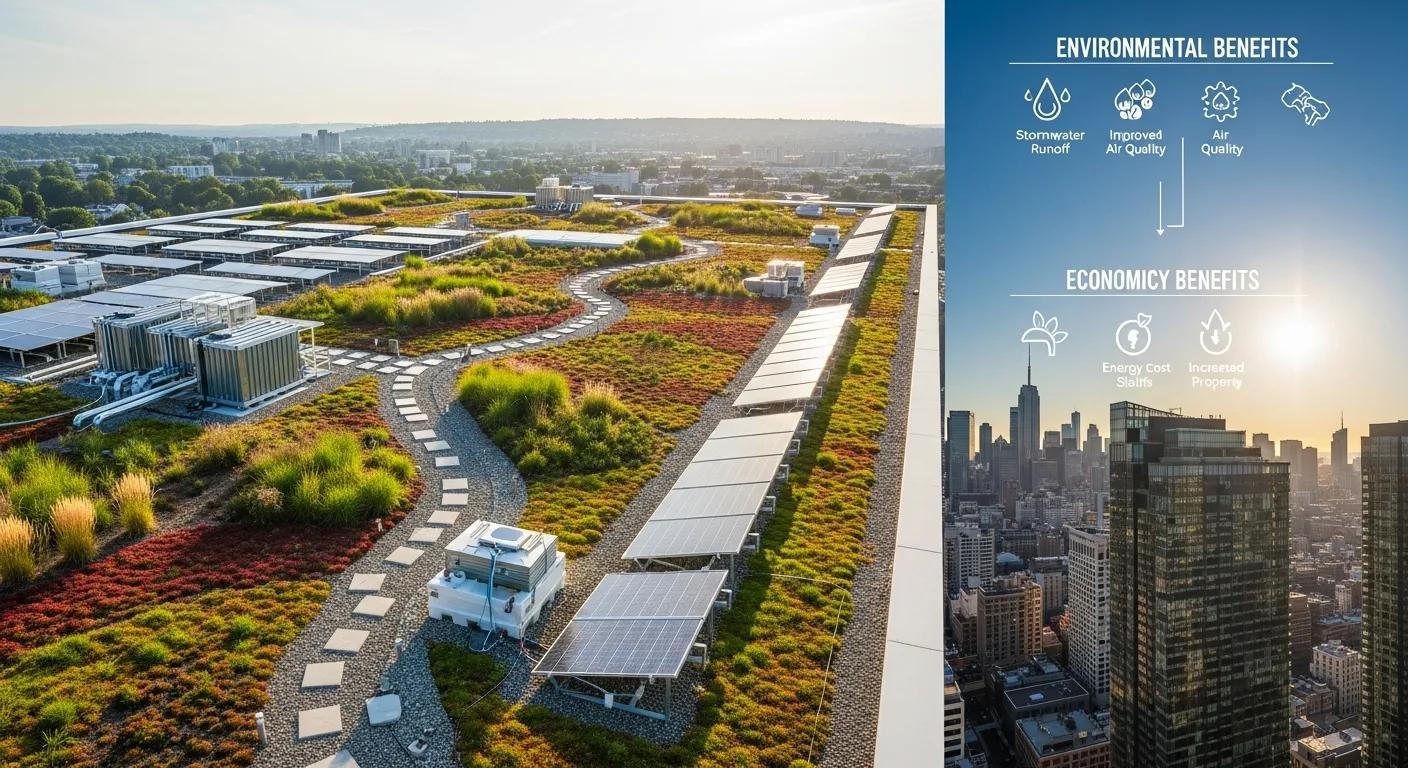
Green roofs - vegetated roof systems - provide multiple ecosystem services: they capture rainfall, add insulation, support biodiversity and improve rooftop aesthetics, which can boost occupant well-being. Their mechanisms include stormwater retention in substrate layers, evapotranspiration cooling that lowers surface and local air temperatures, and added thermal mass and insulation that reduce heating and cooling loads. Financially, green roofs can protect the membrane from UV and thermal extremes, extending service life and improving marketability, but they require planned maintenance and structural checks during design. The next subsections unpack stormwater benefits, urban heat-island mitigation and long-term cost considerations to help owners weigh trade-offs for commercial projects.
Green roofs deliver three core ecological and economic benefits:
-
Stormwater retention that lowers runoff volumes and peak flows.
-
Urban heat-island mitigation through surface cooling and shading.
-
Potential lifecycle savings from membrane protection and improved comfort.
Those advantages make green roofs especially relevant in dense urban areas and for owners pursuing green infrastructure or LEED objectives.
How Do Green Roofs Manage Stormwater and Mitigate Urban Heat Island Effects?
Green roofs retain rainfall in the growing medium and plant layers, reducing runoff and slowing peak discharges to municipal systems; actual retention depends on substrate depth and plant selection but can be significant during short storms. Evapotranspiration and plant shading cool roof surfaces and nearby air, helping mitigate urban heat-island effects at the neighborhood scale. Biodiverse plantings support pollinators and urban ecology, while porous substrates can filter particulates and some pollutants. Choices such as extensive versus intensive green roofs determine water retention capacity and maintenance needs, so owners must balance ecological goals with structural limits and cost. Understanding these mechanisms helps integrate green roofs into broader stormwater and urban resiliency plans.
After stormwater and microclimate benefits, many decision-makers ask whether green roofs pay back financially; the next section covers long-term value.
What Are the Long-Term Cost Savings and Property Value Benefits of Green Roofing?
Green roofs can deliver long-term savings by extending membrane life, reducing HVAC demand and improving tenant appeal - which can translate into higher occupancy and rents. By shielding waterproofing layers from UV and extreme temperature swings, vegetated systems reduce thermal cycling and material fatigue, delaying replacement and lowering lifecycle costs. Property value may increase where green infrastructure is prized by tenants or regulators, especially in markets that value sustainability credentials. However, green roofs have higher upfront costs and ongoing maintenance for irrigation and vegetation care, so lifecycle analyses should compare total cost of ownership over multiple decades. Thoughtful financial modeling can show when green roofs produce net positive returns through combined energy savings, deferred replacement and market differentiation.
For owners with tighter budgets, restorative coating strategies often provide a lower-cost pathway that still improves sustainability metrics; the next section explains that option.
How Does Roof Restoration and Coating Extend Roof Life and Support Sustainability?
Roof restoration and coating programs are sustainable alternatives to full replacement: they repair and seal existing membranes, restore reflectivity and postpone material disposal and new-material manufacture. Coatings lower surface temperatures and reduce leak potential while sealing minor defects; restoring a membrane typically costs a fraction of replacement and keeps large volumes of waste out of landfills. Preventive maintenance paired with periodic recoating can extend service life by many years and improve lifecycle carbon profiles compared with repeated replacements. The table below compares common coating types by VOC profile, reflectivity, expected lifespan and best use so facility managers can pick the restorative chemistry that fits their roof.
Coating choices influence environmental performance and durability:
|
Coating Type |
VOC |
Reflectivity |
Typical Lifespan |
Best Use Case |
|---|---|---|---|---|
|
Elastomeric |
Low |
Medium-High |
7-12 years |
Flexible membranes needing waterproofing |
|
Silicone |
Low |
High |
10-15 years |
Ponding water conditions and long-term reflectivity |
|
Acrylic |
Low |
High (initial) |
5-10 years |
Sloped roofs with good drainage |
These comparisons explain why silicone is often chosen for ponding conditions, while elastomeric systems give durable flexibility for joints and details. The following subsections outline the energy and maintenance advantages in practical terms.
What Are the Advantages of Roof Coatings for Energy Efficiency and Durability?
Coatings boost energy efficiency by increasing surface reflectance and cutting absorbed solar radiation, which lowers interior cooling loads and peak demand. They also provide robust waterproofing that seals small breaches, slows membrane degradation and reduces the need for disruptive repairs or early replacement. By deferring end-of-life disposal and stretching service life, coatings directly reduce material waste and improve lifecycle sustainability metrics. Lifespans vary by chemistry and exposure, so scheduled recoating based on inspections preserves reflectivity and waterproofing performance. Facilities that adopt coating programs within their asset-management plans turn reactive repairs into predictable, sustainable maintenance cycles.
How Does Preventive Maintenance Reduce Commercial Roofing Costs and Environmental Impact?
Preventive maintenance cuts costs and environmental impact by finding and fixing small problems before they become full failures and by scheduling cleaning and recoating to maintain performance. Recommended tasks include semiannual inspections, prompt sealing of flashings and penetrations, routine debris removal to prevent ponding, and records of moisture or thermal readings where appropriate; these steps limit water intrusion and thermal cycling damage. Smart monitoring - for example, IoT sensors for moisture or temperature - enables condition-based maintenance that targets resources efficiently and avoids unnecessary work. Keeping membranes in good condition and avoiding emergency replacements reduces material consumption, labor disruption and landfill waste across the roof’s lifecycle.
Conclusion
Adopting sustainable commercial roofing improves energy performance, lowers lifecycle costs and reduces environmental impact. By prioritizing materials like TPO, PVC or recycled metal - and considering green roofs, coatings and PV where appropriate - facility managers can achieve clear, measurable gains in performance and sustainability. Companies like Trivan Roofing offer tailored assessments and expert installations to help businesses achieve these objectives, guiding them toward greener, longer-lasting roofs.
Reduce Energy Costs While Protecting Your Investment
Make your commercial property more sustainable with energy-efficient roofing solutions. TriVAN Roofing provides free building assessments that analyze your roof's energy performance and identify opportunities for cool roof systems, solar-ready installations, or green roof conversions. As a Duro-Last Master Contractor and GAF Master Elite provider, we install high-performance sustainable systems backed by extended warranties. We're licensed, bonded, and insured across Texas and Oklahoma.
Contact Us Today