Flat Roof Replacement Cost in 2026: TPO, EPDM, PVC, and Modified Bitumen Compared
| By TriVAN Roofing | 16 min read
Planning a flat roof replacement in 2026? Compare real installed costs per square foot for TPO, EPDM, PVC, and modified bitumen, plus tear-off expenses, code insulation rules, and Texas market factors.
Categories: Roof Repairs & Restoration
Replacing a flat roof in 2026 costs between $4.50 and $12.50 per square foot installed for the four primary commercial membrane systems, with most building owners paying an average of $7.50 to $9.50 per square foot for a complete system replacement. That wide price window reflects significant material differences, project scope variations, code-mandated insulation upgrades, and structural deck conditions that have nothing to do with the visible top membrane. Whether you manage a 40,000 square foot distribution center in Dallas or own a modern residential property with a flat roof deck in San Antonio, understanding how these variables interact enables you to build a reliable capital expenditure budget before you request a single contractor estimate.
Flat roofing represents a unique construction category. Because flat roofs have minimal slope, typically between one-eighth inch and one-half inch per linear foot, they cannot shed precipitation through gravity alone like steep-slope shingle roofs. Every seam, penetration, and perimeter termination must form a completely watertight barrier against standing water. In 2026, navigating this purchase requires accounting for recent shifts in raw material feedstocks, updated International Energy Conservation Code requirements, and regional labor variations across Texas and Oklahoma.
Comparing the Four Core Flat Roofing Systems
The four primary flat roofing materials used in modern construction are Thermoplastic Polyolefin (TPO), Polyvinyl Chloride (PVC), Ethylene Propylene Diene Monomer (EPDM), and Modified Bitumen. Each system utilizes distinct chemistry, installation methodologies, and seam joining technologies that determine both upfront installation price and expected operational lifespan.

Published industry pricing benchmarks from foxhavenroof.com, askdoss.com, and calcuris.com provide a clear baseline for 2026 material and labor costs. Selecting the correct membrane involves balancing upfront capital allocation against expected service life and site-specific exposure conditions.
1. TPO Roofing (Thermoplastic Polyolefin)
Installed Cost: $5.00 to $10.00 per square foot
Expected Lifespan: 20 to 30 years
Total Cost for 1,000 to 2,000 Sq. Ft.: $6,000 to $14,000
TPO has grown into the dominant single-ply membrane specification in the commercial sector, capturing well over half of new low-slope installations. Composed of an ethylene propylene rubber blend compounded with polypropylene and reinforced with polyester scrim, TPO combines the flexibility of synthetic rubber with the heat-weldable seams of thermoplastic materials.
TPO seams are fused together using hot-air welding equipment operating at temperatures between 800 and 1,000 degrees Fahrenheit. This process forms a physical bond that is stronger than the membrane itself, eliminating the long-term adhesive breakdown common in older rubber systems. The bright white reflective surface of standard TPO reflects roughly 80 percent of solar radiation, significantly reducing building cooling loads during hot Texas summers. Property owners evaluating this material can review our comprehensive TPO roofing cost guide for a granular breakdown of 45-mil, 60-mil, and 80-mil options.
2. EPDM Roofing (Ethylene Propylene Diene Monomer)
Installed Cost: $4.00 to $9.00 per square foot
Expected Lifespan: 20 to 25 years
Total Cost for 1,000 to 2,000 Sq. Ft.: $5,000 to $12,000
EPDM is a cured synthetic rubber membrane that has protected low-slope buildings for over five decades. It is widely recognized for exceptional elasticity, thermal shock resistance, and performance in northern freeze-thaw cycles. Because it expands and contracts readily without cracking, EPDM handles extreme building movement better than almost any alternative.
However, EPDM is traditionally black, meaning it absorbs rather than reflects radiant solar heat. In southern climates across Texas and Oklahoma, an unballasted black EPDM roof can reach surface temperatures exceeding 165 degrees Fahrenheit during July and August, transferring tremendous heat loads into the building interior. Furthermore, because EPDM is a thermoset rubber, its seams cannot be heat-welded. They must be spliced using specialized liquid primers and double-sided seam tapes. Over a 15 to 20-year cycle in high-heat environments, these taped seams require routine maintenance to prevent delamination. For a closer look at black rubber performance, read our breakdown of commercial EPDM roofing systems.
3. PVC Roofing (Polyvinyl Chloride)
Installed Cost: $6.00 to $12.00 per square foot
Expected Lifespan: 25 to 30 years
Total Cost for 1,000 to 2,000 Sq. Ft.: $7,000 to $15,000
PVC represents the premium tier of single-ply thermoplastic sheet membranes. Manufactured with specialized plasticizers added to flexible polyvinyl chloride polymers, PVC provides superior resistance to animal fats, industrial greases, jet fuels, and harsh chemical exhaust. Like TPO, PVC seams are fused permanently using automated hot-air welding systems.
PVC is the standard specification for restaurants, food processing plants, manufacturing facilities, and hospital flat roofs where rooftop HVAC units, kitchen exhaust hoods, or chemical flues discharge corrosive compounds. While PVC commands a higher initial price point than TPO or EPDM, its resistance to chemical degradation and proven thirty-year track record justify the investment for facilities with severe environmental exposures. Consult our detailed PVC roofing cost guide to see how manufacturer warranties and membrane formulations impact final bidding.
4. Modified Bitumen Roofing
Installed Cost: $4.50 to $8.00 per square foot
Expected Lifespan: 15 to 20 years
Total Cost for 1,000 to 2,000 Sq. Ft.: $5,000 to $13,000
Modified bitumen is an evolution of traditional multi-ply built-up asphalt roofing (BUR). It combines asphalt with synthetic rubber polymers (SBS, or styrene-butadiene-styrene) or plastic polymers (APP, or atactic polypropylene), reinforced with fiberglass or polyester mats. Installed in two-ply or three-ply assemblies, modified bitumen features a base sheet fastened or adhered to the deck, followed by a mineral-surfaced cap sheet applied with hot asphalt, cold adhesive, or open torch welding.
Modified bitumen provides exceptional puncture resistance against heavy foot traffic, hail impact, and service technicians working on rooftop mechanical equipment. However, it is heavier, more labor-intensive to install, and has a shorter operational lifespan than modern single-ply thermoplastics. Recent volatility in asphalt feedstock costs has also narrowed its traditional cost advantage over single-ply options.
2026 Flat Roof Cost Comparison Matrix
The table below compares installed costs, typical lifespans, and best-use cases across all four systems based on current 2026 contractor pricing data for both residential and commercial structures. To help facility managers contextualize major capital expenses, total project cost ranges are calculated for a representative 20,000 square foot commercial property.
| Roofing System | Installed Cost / Sq. Ft. | 20,000 Sq. Ft. Project Range | Expected Lifespan (TX / OK) | Best Application |
|---|---|---|---|---|
| Modified Bitumen | $4.50 - $8.00 | $90,000 - $160,000 | 15 - 20 Years | Heavy foot-traffic zones, multi-family flat roofs, heavy mechanical equipment areas |
| EPDM Rubber | $4.00 - $9.00 | $80,000 - $180,000 | 20 - 25 Years | Cooler microclimates, high-movement decks, non-reflective applications |
| TPO Single-Ply | $5.00 - $10.00 | $100,000 - $200,000 | 20 - 30 Years | Warehouses, retail big-box stores, office complexes, energy-conscious flat structures |
| PVC Single-Ply | $6.00 - $12.00 | $120,000 - $240,000 | 25 - 30 Years | Restaurants, chemical facilities, food processing plants, airports, severe exposure roofs |
Sources: Industry data aggregated from foxhavenroof.com 2026 full pricing guide, askdoss.com flat roof repair and replacement benchmarks, and calcuris.com July 2026 calculator estimates. Total installed figures reflect complete membrane assemblies under normal site accessibility conditions.
The Tear-Off Versus Recover Financial Decision
Outside of material selection, the largest single variable influencing flat roof replacement budgeting is whether the existing assembly can be recovered or must be completely torn off and hauled to a disposal site. According to July 2026 calculation data from calcuris.com, tearing off and disposing of an existing commercial roof adds $1.00 to $2.00 per square foot to the total contract sum. On a compact 1,500 square foot residential flat addition, tear-off represents an added line item of $1,500 to $3,000. On a 20,000 square foot commercial property, tearing off the assembly adds between $20,000 and $40,000 in labor, dumpster rentals, and municipal tipping fees.

A roof recover involves mechanically fastening a high-density polyisocyanurate cover board directly over the existing membrane and installing a new single-ply sheet over top. This method eliminates tear-off labor, protects the interior of an occupied building from weather exposure during construction, and avoids massive landfill disposal expenses. However, a recover is not always an option. Two strict criteria govern this decision: municipal building codes and substrate moisture condition.
The Two-Layer Building Code Limit
The International Building Code (IBC Chapter 15) and International Residential Code (IRC Chapter 9) explicitly prohibit installing a new roof covering over a building that already has two or more applications of any type of roof covering. If your commercial property has already received an overlay in past years and currently carries two roofing systems, local building departments will deny permit applications for a recover. You have no legal choice but to perform a full tear-off down to the structural roof deck, eliminating any potential savings.
The Substrate Moisture Constraint
Even if a building has only one existing roof layer, a recover cannot proceed if the underlying insulation board contains moisture. Installing a non-breathable single-ply membrane over saturated polyisocyanurate or fiberboard traps water inside the roof sandwich.
A building owner who recovers when the existing insulation contains trapped water seals that decay into the roof system permanently. Over subsequent summer heat cycles, that trapped water boils into high-pressure vapor, causing massive membrane blistering, rotting wooden structural decks, corroding metal decking flutes, and degrading the insulation R-value to zero.
Before budgeting for a low-cost recover option, property owners must commission an infrared thermal imaging roof inspection. Conducted at dusk as the roof cools, a thermal camera detects heat radiating from damp insulation, precisely outlining wet zones. If moisture is localized to less than 15 to 20 percent of the total roof surface, those wet sections can be surgically cut out and replaced with dry insulation before an overlay is installed. If moisture saturation exceeds 25 percent, a complete tear-off is the only viable option. To explore the detailed financial comparison of both approaches, review our commercial roof recover versus tear-off guide.
The Five Primary Cost Drivers in 2026
When bids for the same flat roof range from $6.00 to $11.00 per square foot using the exact same brand of membrane, building owners are often confused. The gap almost always comes down to five distinct job site variables that dictate the true cost of execution.
1. Membrane Thickness Specification
Calling an estimate a "TPO installation" or a "PVC installation" fails to tell the entire financial story. Single-ply membranes are manufactured in various thicknesses measured in mils (thousandths of an inch), typically 45-mil, 60-mil, and 80-mil. A 45-mil sheet is the thinnest code-compliant option, commonly specified on budget-conscious speculative developments. An 80-mil sheet features nearly double the weathering polymer thickness above the reinforcement scrim, offering vastly superior puncture resistance and prolonged UV resistance.
Upgrading from an entry-level 45-mil sheet to a commercial-grade 60-mil membrane adds approximately $0.40 to $0.75 per square foot. Moving up to a premium 80-mil membrane adds $1.10 to $1.80 per square foot. While thicker membranes cost more upfront, major manufacturers often restrict their 25-year and 30-year No Dollar Limit (NDL) warranty programs to installations using 60-mil or 80-mil membranes.
2. Energy Code Insulation Upgrades
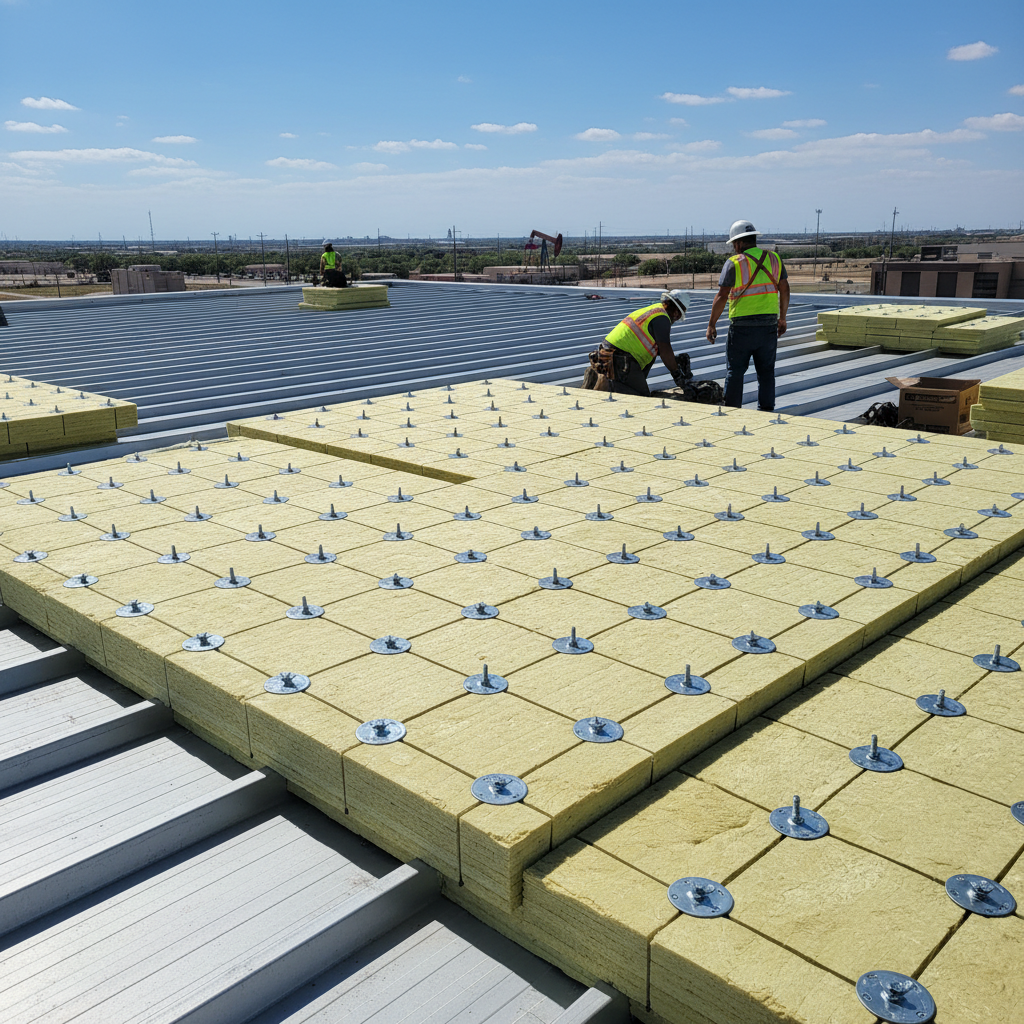
Meeting strict energy conservation codes often represents the largest additive expense outside of the membrane itself. Under the current International Energy Conservation Code (IECC) adopted across Texas and Oklahoma municipalities, flat roofs undergoing full replacement down to the deck must meet minimum continuous thermal insulation requirements.
In Texas (Climate Zones 2, 3, and 4), code mandates continuous roof insulation values between R-25 and R-30. Achieving R-30 using standard polyisocyanurate board requires two staggered layers of 2.6-inch insulation (5.2 inches of total foam). If your existing flat roof only has two inches of legacy insulation providing R-12, bringing the assembly up to current municipal code will add $2.00 to $4.00 per square foot for new insulation boards, long fasteners, and upgraded metal edge terminations. For an in-depth breakdown of insulation cost calculations, review our complete commercial roof replacement cost breakdown.
3. Hidden Structural Deck Deterioration
The structural decking beneath the roofing membrane, whether corrugated 22-gauge steel, poured-in-place concrete, lightweight insulating concrete, or plywood, cannot be visually inspected until the old system is completely torn off. If the previous roof suffered from chronic, long-term water intrusion, structural deck damage is almost guaranteed.
Replacing deteriorated structural steel decking costs between $4.50 and $8.50 per square foot of damaged area. Replacing rotted wood decking costs between $3.00 and $6.00 per square foot. Because contractors cannot confirm the extent of deck rot prior to tear-off, honest commercial proposals include an itemized unit-cost price schedule for deck repairs rather than attempting to bury the cost in an inflated lump sum.
4. Roof Geometry and Penetration Density
An open, rectangular 20,000 square foot warehouse flat roof with four simple plumbing stacks is exceptionally cost-effective to replace. A commercial crew can unroll wide 10-foot or 12-foot membrane sheets and run automated robotic welders continuously without interruption.
Conversely, a 20,000 square foot medical clinic or restaurant roof with three split levels, forty-five parapet wall corners, twenty RTU air conditioning curbs, gas lines, skylights, and multiple exhaust vents requires extensive hand-welding and custom detail flashing. Each mechanical curb requires field fabrication of corners, target patches, and termination bars. High penetration counts and complex roof geometries increase labor overhead, adding 15 to 30 percent to the total base installation price.
5. Occupied Facility Constraints and Logistics
Roofing an empty warehouse during standard business hours is straightforward. Roofing an active healthcare facility, elementary school, retail storefront, or downtown office building introduces complex site constraints:
- Restricted material delivery windows and staging areas.
- Mandatory night or weekend work schedules to avoid disrupting tenants.
- Specialized safety perimeters and pedestrian protection canopies.
- Fume-mitigation protocols, such as using cold-applied adhesives instead of hot asphalt or low-VOC solvent-based bonding adhesives near fresh air intakes.
Operational restrictions that force after-hours labor or specialized material handling add between 10 and 25 percent to contractor labor and project management costs.
The 2026 Material Pricing Landscape: Tariffs and Feedstocks
Commercial building owners who built flat roof replacement budgets using cost estimates from 2023 or 2024 will find those numbers insufficient for 2026 projects. The roofing industry has experienced sharp price adjustments driven by international trade tariffs, supply chain realignments, and raw petrochemical feedstock spikes.
Published industry tracking from BuildRefs July 2026 data shows that raw asphalt experienced an unprecedented 35 percent price increase over a recent three-month window. This spike severely affected modified bitumen cap sheets, base plies, and asphaltic adhesives. Concurrently, chemical feedstock constraints pushed TPO and EPDM raw material costs up by 12 to 18 percent. PVC, which relies on resin production that has been subject to targeted import tariffs on chemical stabilizers, saw price increases ranging between 20 and 30 percent across multiple tier-one manufacturers.
Any capital improvement budget developed prior to 2025 must be revised upward by 15 to 25 percent to reflect current distributor material pricing. Working with a contractor who maintains direct relationships with major manufacturers helps minimize excessive distributor markups.
Texas and Oklahoma Regional Labor and Climate Factors
Commercial roofing in Texas and Oklahoma presents operational challenges rarely encountered in other regions of the country. From Dallas-Fort Worth and San Antonio to Oklahoma City and Tulsa, roofing assemblies face severe weather extremes. Blistering summer roof temperatures exceeding 160 degrees Fahrenheit are routinely followed by intense spring supercells producing baseball-sized hail and straight-line winds exceeding 70 miles per hour.
In the July 2026 contractor bidding analysis published by buildermuse.com, which tracked real bids across 14 Texas commercial roof replacements, installed labor rates for TPO single-ply systems averaged between $5.50 and $7.00 per square foot. This places regional Texas labor slightly below high-density East Coast and West Coast metro markets, while maintaining an exceptionally high standard of workmanship to meet rigorous wind-uplift engineering standards.
In this regional hail corridor, membrane specification requires close attention to hail impact ratings. Factory Mutual (FM Global) requires Class 1-SH (Severe Hail) or Class 1-VSH (Very Severe Hail) ratings across most of North Texas and Oklahoma. Meeting VSH ratings requires installing high-density gypsum cover boards beneath the single-ply membrane to absorb kinetic impacts, adding roughly $1.25 to $2.00 per square foot to the assembly. Skipping this step often leaves commercial property owners vulnerable to premature hail punctures that compromise warranties and lead to denied insurance claims.
How to Accurately Estimate Your Flat Roof Replacement
To establish a realistic baseline budget before calling roofing contractors out to your property, follow this straightforward four-step calculation process:
Step 1: Calculate Total Square Footage and Roof Squares
Measure your building footprint and add a percentage for perimeter parapet wall flashings. In commercial roofing, one "square" equals 100 square feet. A 15,000 square foot building footprint with three-foot parapet walls will typically require approximately 16,500 square feet of membrane, or 165 roofing squares.
Step 2: Determine Your Replacement Scope (Tear-Off vs. Recover)
Check historical property records or cut a small test core to verify how many roofing systems are currently installed on the deck. If two roofs are present, add $1.00 to $2.00 per square foot for tear-off and disposal. If only one roof exists, arrange for a thermal imaging inspection to confirm whether the existing insulation is dry and eligible for an overlay.
Step 3: Factor in Code Insulation Requirements
Determine whether your project requires bringing insulation up to R-25 or R-30. If your project is a complete tear-off, you must include $2.00 to $4.00 per square foot for polyisocyanurate insulation boards to comply with current local building energy codes.
Step 4: Select Membrane Material and Mil Thickness
Apply the current material baseline rate based on your building's operational requirements:
- Standard commercial or residential flat: TPO (60-mil) at $6.50 to $8.50 per sq. ft. installed.
- Restaurant or chemical exposure: PVC (60-mil) at $7.50 to $10.50 per sq. ft. installed.
- High foot-traffic utility deck: Modified Bitumen 2-ply at $5.50 to $7.50 per sq. ft. installed.
Selecting an experienced partner is just as critical as selecting the right membrane. Review our comprehensive guide on choosing a qualified commercial roofing contractor to verify installer certifications, safety records, and local manufacturer relationships before signing an agreement.
Frequently Asked Questions About Flat Roof Replacement Costs
What is the most cost-effective flat roof system for commercial buildings?
TPO single-ply roofing consistently delivers the best balance of upfront installation cost, energy efficiency, and long-term performance for commercial buildings. At $5.00 to $10.00 per square foot installed, its heat-welded seams prevent leaks, while its highly reflective white surface lowers summer cooling costs throughout southern climates.
How long does a flat roof replacement take?
A typical 10,000 to 20,000 square foot commercial flat roof replacement requires between five and ten business days, depending on tear-off requirements, weather conditions, and mechanical penetration counts. Professional crews execute tear-offs in sections, securing and waterproofing each section before leaving the job site at the end of every workday.
Does property insurance cover flat roof replacement?
Commercial property insurance policies typically cover flat roof replacement when damage is caused by sudden and accidental peril events, such as windstorms, severe hail impact, or falling debris. They do not cover normal wear and tear, age-related deterioration, ponding water damage, or leaks resulting from neglected maintenance. Detailed photo documentation and regular inspection records are vital when filing hail damage claims across Texas and Oklahoma.
What type of warranty should I demand on a commercial flat roof?
Always seek a manufacturer-backed No Dollar Limit (NDL) warranty. Unlike standard material-only warranties, an NDL warranty covers 100 percent of labor and material costs to repair leaks throughout the warranty period without a financial cap. Look for warranties that explicitly cover ponding water and consequential interior damage, backed by elite contractors certified directly by top-tier manufacturers like Duro-Last and GAF.
Investing in a flat roof replacement requires balancing initial capital expense against decades of operational performance. By taking into account material chemistry, tear-off logistics, insulation codes, and regional weather hazards, property owners can protect their physical assets with complete confidence.
---Tags: flat roof replacement cost, flat roof replacement cost per square foot 2026, TPO flat roof cost, EPDM flat roof replacement cost, PVC flat roof cost, modified bitumen replacement cost, flat roof cost comparison, flat roof tear off vs recover cost, commercial flat roof replacement cost Texas, flat roof installation cost