Commercial Roofing in Oklahoma City: A Guide for Building Owners & Facility Managers
| By TriVAN Roofing | 11 min read
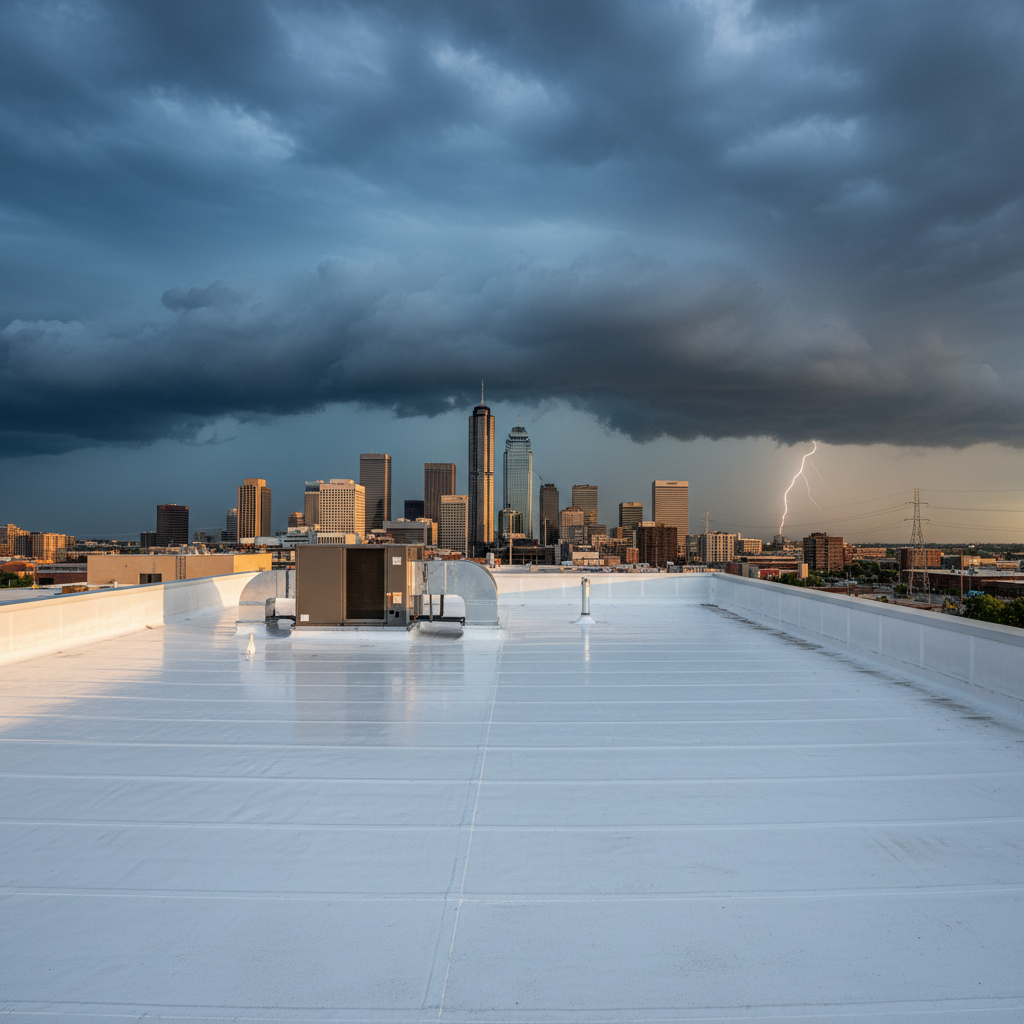
Oklahoma City's unique weather—high winds, severe hail, and ice storms—demands specialized commercial roofing. This guide covers OKC-specific wind design, ice load challenges, local insurance factors, and how to select a qualified commercial roofing
Categories: Industry Insights
For commercial building owners and facility managers in Oklahoma City, roofing decisions carry a weight unlike those in other parts of the country. Standard roofing practices and generic advice often fall short here. Why? Because Oklahoma City stands at a unique meteorological crossroads, facing a trio of severe weather threats that demand a specialized approach to roofing design, materials, and installation. Applying generic specifications to an OKC building is not just a missed opportunity; it is an acceptance of unnecessary risk. A commercial roof replacement in Edmond, Moore, or Norman requires local knowledge to ensure long-term performance.
This guide is written specifically for the Oklahoma City commercial property owner. It addresses the distinct challenges of our environment: the high winds of Tornado Alley, the relentless barrage of severe hail, and the structural stress of significant ice storms. We will cover the technical specifications, insurance realities, and contractor market dynamics you need to understand to protect your asset effectively. This is not about abstract threats; it is about making informed, practical decisions for your facility.
The Oklahoma City Weather Gauntlet: A Three-Pronged Threat
To understand commercial roofing in OKC, you must first appreciate the specific environmental forces at play. It is not just one type of bad weather; it is the combination of three distinct and powerful phenomena that makes this region so challenging for building envelopes.
1. Tornado Alley and Extreme Wind Exposure
Oklahoma City lies in the heart of Tornado Alley, an area with the highest frequency of significant tornado activity in the world. While a direct hit from a violent tornado is a catastrophic event that few structures can withstand, the more common threat comes from the extreme straight-line winds and weaker tornadoes that frequent the region. This exposure means that wind uplift is not a theoretical concern; it is a recurring stressor on every commercial roof in the metro area.
2. The Hail Corridor
Alongside high winds, Oklahoma experiences an extraordinary number of hail events. The state averages 297 major hail events annually, with hailstones frequently reaching sizes capable of damaging commercial roofing membranes, denting metal panels, and shattering rooftop equipment. This constant threat of impact damage means that material selection is critical. A roof membrane that might last 20 years in a less active climate could be compromised in a single afternoon in central Oklahoma.
3. The Ice Storm Complication
The threat that non-local contractors often underestimate is Oklahoma's ice storm season. While Texas markets might see a rare icing event, OKC averages one to two significant ice storms each year. These events can deposit a half-inch to over an inch of solid ice across vast, flat rooftops. This introduces two major problems: immense weight (ice load) that can exceed a building's design capacity and widespread drain blockage that leads to dangerous water ponding. The subsequent freeze-thaw cycles put immense stress on seams and flashings, accelerating wear and tear.
Tornadoes, Wind Design, and Your Commercial Roof
Given Oklahoma City's position in Tornado Alley, wind design is the most critical factor in specifying a durable commercial roof. Simply meeting the bare minimum building code is not enough to mitigate the real-world risk. An informed approach considers higher standards based on documented weather history and building importance.
ASCE 7-22 Wind Speed Requirements
The American Society of Civil Engineers (ASCE) publishes the standards for structural design, including wind loads. The latest standard, ASCE 7-22, places the Oklahoma City area in a design wind speed zone of 120 to 130 mph for typical commercial buildings (Risk Category II). However, this is just the baseline. For critical facilities like schools, hospitals, and emergency operation centers (Risk Category III and IV), the design wind speeds are even higher. A building owner in Yukon or Midwest City must ensure their roofing contractor is designing the assembly based on the correct Risk Category for their specific building, not a generic assumption.
The FM Global Factor
Many commercial properties in Oklahoma are insured by FM Global, which has its own stringent engineering standards that often exceed local building codes. Because of the documented tornado climatology, FM Global's Oklahoma-specific requirements for insured properties are some of the toughest in the nation. Building owners with an FM Global policy must verify their property's specific Data Sheet requirements and use a RoofNav-approved assembly. Failure to comply can jeopardize insurance coverage. These requirements frequently mandate assemblies with much higher wind uplift ratings than the code minimum.
Practical Specification: Adhered vs. Mechanically Attached
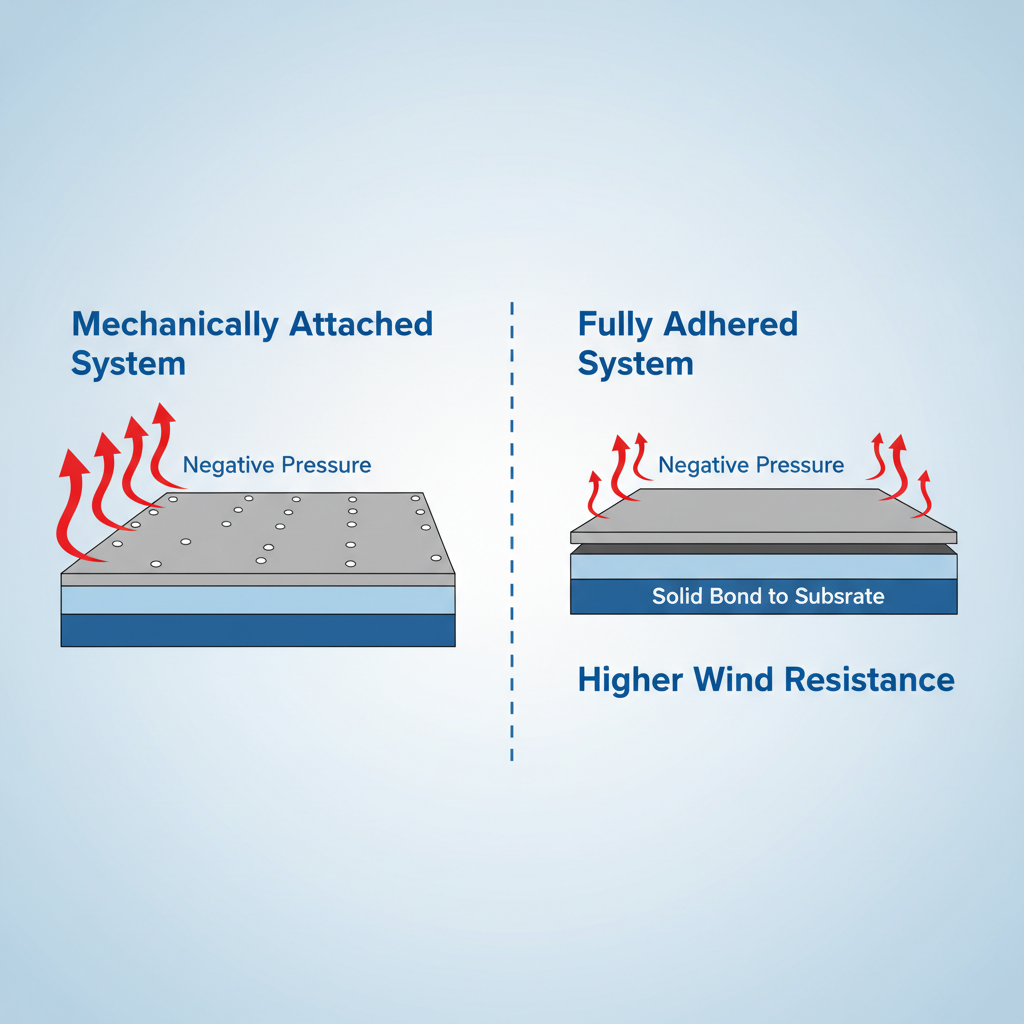
The engineering standards translate into real-world installation choices. For commercial membrane roofs (like TPO or PVC), there are two primary installation methods: mechanically attached (fastened with plates and screws) and fully adhered (glued down to the substrate). While a mechanically attached system can be installed to meet basic code, it creates individual stress points at each fastener. The practical specification implication is that fully adhered membrane systems and higher fastener density in mechanically attached systems are more appropriate for OKC commercial buildings than minimally compliant specifications that pass code but do not reflect the actual risk environment. A fully adhered system creates a monolithic bond, distributing wind uplift forces across the entire roof surface, providing superior resistance in the face of tornadic winds.
The Underestimated Threat: Oklahoma Ice Storms
Contractors without extensive Oklahoma experience often focus on wind and hail while underappreciating the destructive potential of ice. A significant ice storm can compromise a commercial roof in ways that wind and hail cannot, creating both immediate structural danger and long-term degradation.
Ice Loading and Drainage Blockage
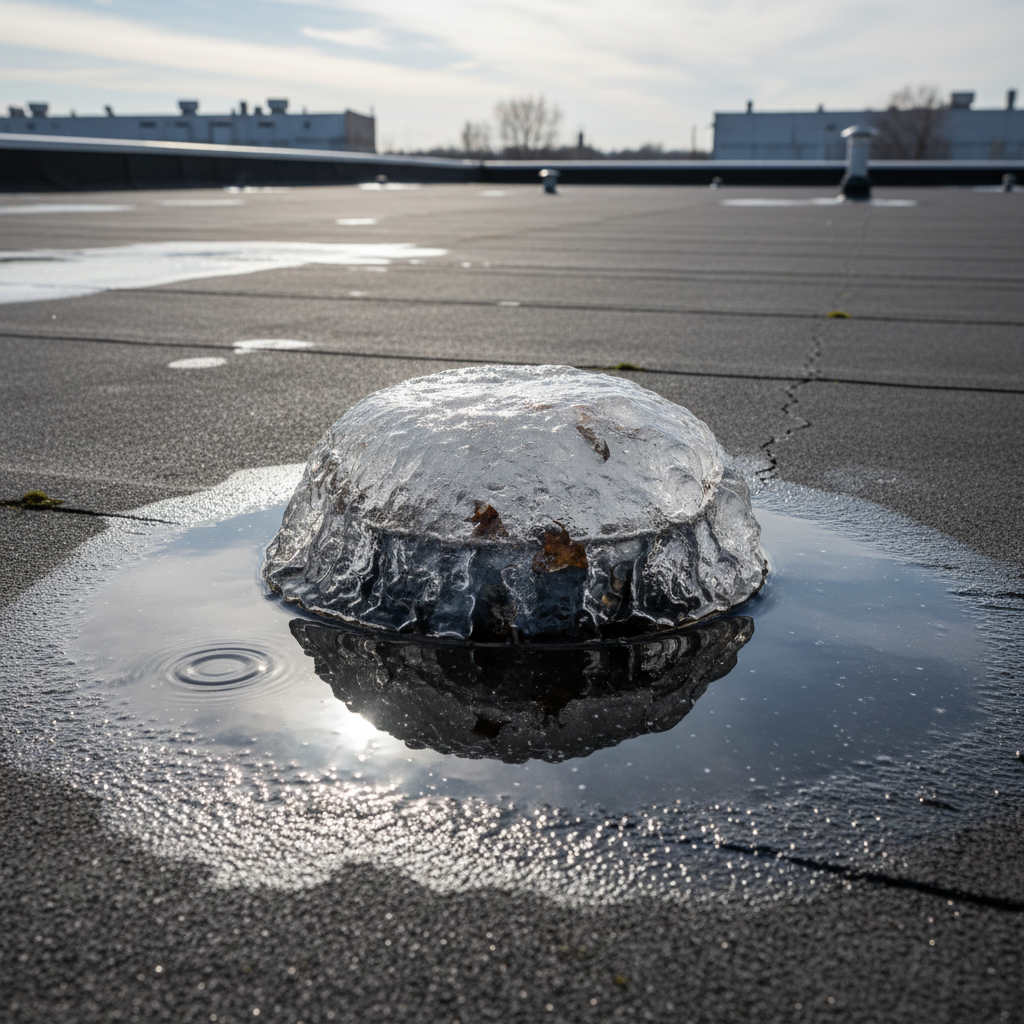
Water weighs about 8.3 pounds per gallon. Ice is only slightly less dense. When an inch of ice accumulates over a 50,000-square-foot commercial roof, it adds over 260,000 pounds of dead load to the structure. This alone can push the structural system to its limits. The problem is compounded when that ice forms over and blocks the primary roof drains. As the top layer of ice melts or subsequent rain falls, the water has nowhere to go. This ponding water adds even more weight and can find its way into any minor weakness in the roof membrane. Ice loading on flat commercial roofs creates structural load demands beyond standard design assumptions, blocks primary drains when ice forms over drain grates, and subjects membrane systems to freeze-thaw cycling that accelerates seam stress and penetration flashing fatigue.
Designing for Ice: Scuppers and Heated Drains
An Oklahoma-savvy roofing design anticipates drain blockage. The solution involves robust secondary drainage. Overflow scuppers, which are openings in the parapet wall, should be positioned just above the roofline. They are designed to function only when water begins to pond, providing a passive, foolproof escape path for water when primary drains are clogged with ice. For critical facilities where any amount of ponding is unacceptable, installing heated drain systems is a wise investment. These systems use electric heat tracing cables to keep the area around the drain free of ice, ensuring it remains functional throughout the winter storm.
Navigating Oklahoma's Commercial Insurance Market
The persistent severe weather has had a direct impact on Oklahoma's commercial property insurance market. For building owners, understanding these dynamics is key to managing financial risk. The roof you choose has a direct effect on your insurance costs and your exposure to out-of-pocket expenses.
Over the last decade, repeated catastrophic storm seasons have caused the Oklahoma insurance market to tighten considerably. Some national carriers have reduced their commercial portfolios in the state, while others have implemented stricter underwriting guidelines, particularly concerning the age and condition of a building's roof. A roof that is approaching the end of its service life can make a property difficult or expensive to insure.
The Reality of Percentage Deductibles
Percentage-based wind and hail deductibles have been standard in Oklahoma commercial policies for much longer than in Texas. Instead of a flat dollar amount, the deductible is a percentage (typically 1% to 5%) of the building's total insured value. For a commercial property insured for $3 million, a 2% deductible means the building owner is responsible for the first $60,000 of any wind or hail claim. On a larger $5 million facility, a 3% deductible is a $150,000 exposure. This reality means Oklahoma building owners absorb a significant portion of the loss before the insurance policy responds. This financial structure creates a powerful incentive to invest in a more resilient roof assembly. A higher-performance roof that reduces both the frequency and severity of damage provides a measurable return on investment by minimizing the number of times that large deductible is triggered.
Choosing a Contractor in the OKC Market
The commercial roofing contractor market in Oklahoma City is different from larger metros like Dallas-Fort Worth. Understanding this context is crucial for facility managers looking to secure reliable, high-quality service, especially when a storm is on the horizon.
The OKC market, due to its size, has a smaller pool of manufacturer-certified commercial roofing contractors compared to DFW. This creates two distinct challenges for building owners:
- Pre-Storm Contractor Access: If you wait until you have a leak or until a hailstorm is in the forecast, you may find that the most qualified local contractors are already booked for weeks or months. Establishing a relationship with a reputable roofer before you need them is more critical in the OKC market.
- Post-Storm Contractor Quality: After a major hail or wind event, the gap in local contractor availability is quickly filled by out-of-state "storm chasers." While some may be legitimate, many lack proper licensing, insurance, and the local expertise to address Oklahoma's specific weather challenges. Vetting contractors becomes exponentially more important in a post-storm environment.
A building owner in Moore or Edmond who has a pre-established relationship with a certified contractor is in a much better position than one searching Google after a storm has already hit. TriVAN Roofing's presence in Pauls Valley provides a committed Oklahoma base, offering the resources of a large, established contractor with the accessibility and local knowledge of a regional partner. We are not an out-of-state firm chasing storms; we are part of the Oklahoma business community.
A Smarter Procurement Path: TIPS for Oklahoma Public Entities
For public entities like school districts, municipalities, and state agencies, the traditional process of procuring roofing services through an annual Request for Proposal (RFP) can be slow and inefficient. Fortunately, there is a better way that is still underutilized in Oklahoma: the TIPS cooperative purchasing advantage.
TIPS (The Interlocal Purchasing System) is a national purchasing cooperative that allows public entities to access competitively bid contracts for a variety of services, including roofing. Because the contracts have already been procured at a national level, TIPS members can bypass the time-consuming local bidding process. Oklahoma school districts, universities, and cities are eligible to become TIPS members at no cost.
Oklahoma City Public Schools, Edmond Public Schools, Midwest City-Del City, and other major Oklahoma City metro districts managing multi-building campuses with aging roofing infrastructure can access multi-year JOC contracts through TIPS that eliminate annual RFP requirements and establish scheduling priority with certified contractors through the summer installation window. This is a massive advantage when facing a tight summer construction window. With a smaller pool of certified contractors serving the state, having a pre-competed contract in place with a TIPS vendor like TriVAN ensures that your district’s projects get scheduled and completed on time, before students return in the fall.
Understanding Commercial Roofing Costs in Oklahoma City
When budgeting for a roof replacement, it is important to have realistic cost expectations for the local market. In general, OKC commercial roofing costs are comparable to the DFW metro for materials, as both markets are served by similar distribution networks. However, pricing is influenced by a combination of slightly lower regional labor costs offset by the higher specifications often required for wind and impact resistance.
The following ranges are for planning purposes. The final cost will depend on the specific building, roof condition, chosen system, and warranty requirements. [VERIFY: against current TriVAN Oklahoma project data before publishing]
- TPO Roofing Systems: For a standard TPO installation, building owners in Oklahoma City can expect costs to range from $8.50 to $11.50 per square foot. Systems requiring full adhesion for wind zone compliance or thicker membranes for hail resistance will be at the higher end of this range.
- Standing seam metal Roofing: As a premium, long-life system, standing seam metal roofing typically costs between $15.00 and $26.00 per square foot installed. Pricing is heavily influenced by the gauge of the metal, the type of paint finish, and the complexity of the roof geometry. Steel tariffs and supply chain fluctuations affect OKC pricing identically to other regional markets.
Conclusion: An Informed Decision is Your Best Defense
Your commercial roof in Oklahoma City is more than just a cover; it is your building’s primary defense against a uniquely challenging weather environment. From designing for 130 mph winds to planning for ice-blocked drains, every decision requires a level of local insight that goes beyond standard practice. By understanding the specific risks, investing in superior specifications, and partnering with a qualified, locally committed contractor, you can ensure your roof performs not just for years, but for decades, protecting your people, your operations, and your investment.
---
Tags: commercial roofing Oklahoma City, commercial roofer OKC, commercial roof replacement Oklahoma City, OKC commercial roofing contractor, flat roof replacement Oklahoma City, commercial roofing Edmond OK, commercial roofing Moore OK, TPO roofing Oklahoma City, commercial roofing contractor Oklahoma, commercial roof repair Oklahoma City