
Commercial Roofing in Houston: What Owners Need to Know About Storms, Humidity, and Industrial Demands
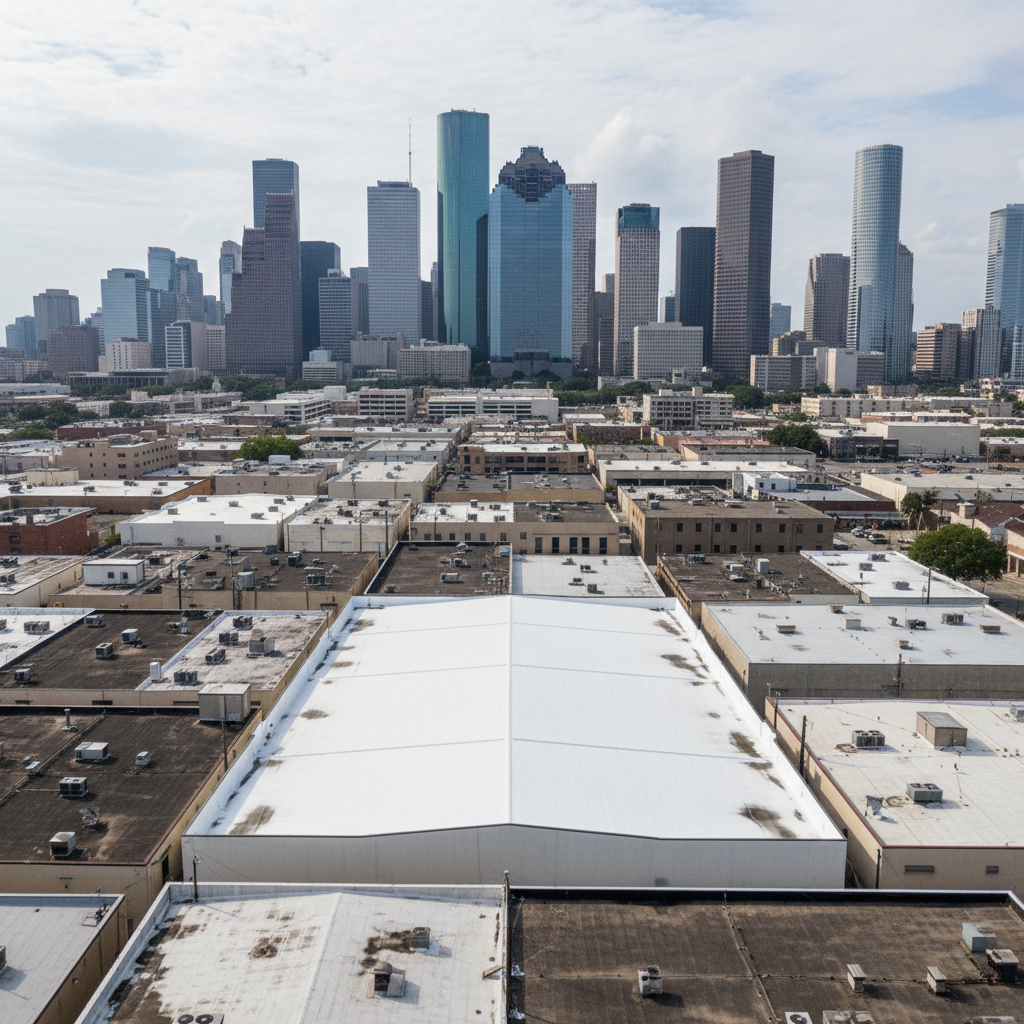
Houston's unique climate, hurricane risk, and industrial needs demand specialized commercial roofing knowledge. This guide covers drainage, wind design, PVC vs. TPO for chemical exposure, and insurance factors for Houston building owners and facility
Applying roofing knowledge from other Texas cities to a Houston commercial property is a recipe for premature failure. The Bayou City is not just a larger version of Dallas or a more humid version of San Antonio; it is a fundamentally different environment that places extreme and unique demands on commercial roofing systems. Houston is home to the largest medical complex in the world, the nation’s second-largest petrochemical industry cluster, and one of the country’s most active commercial real estate markets. This combination of scale, industrial activity, and a relentless coastal climate means that facility managers who apply inland Texas thinking to their buildings often face drainage failures, chemical degradation, and wind damage that proper, Houston-specific specifications would have prevented. For building owners and managers, understanding these differences is the first step toward protecting a multi-million dollar asset. It is why a generic Texas specification is not good enough for a Houston building, and why a contractor’s experience must be specific to this unique market, not just the state in general. The difference between roofing specifications for other Texas markets and Houston can mean decades of performance versus a few years of constant problems.
Houston’s Climate: More Than Just Heat and Humidity
While much of Texas is hot, Houston’s climate brings a combination of factors that directly impact commercial roof performance in a way that is distinct from any other major metro area in the state. The city sits in International Energy Conservation Code (IECC) Climate Zone 2, which dictates baseline insulation requirements. But the raw data on humidity, rainfall, and topography tells the real story.
Persistent Moisture and Vapor Drive
Houston’s defining climatic feature is its persistent, oppressive humidity. With an average annual relative humidity above 70%, the air is almost always saturated with moisture from the Gulf of Mexico. For a commercial roof, this is not just an issue of comfort; it is a technical challenge related to vapor drive. In humid climates, moisture vapor can be driven from the outside into the building and the roof assembly itself. If a roofing system is not designed to properly manage this vapor, condensation can form within the insulation layers. This trapped moisture drastically reduces the insulation's R-value, can lead to the degradation of roofing components, and creates an environment for mold growth. Proper vapor barrier placement and assembly design are far more critical in Houston than in the drier climates of North and Central Texas.
Extreme Rainfall on a Flat Landscape
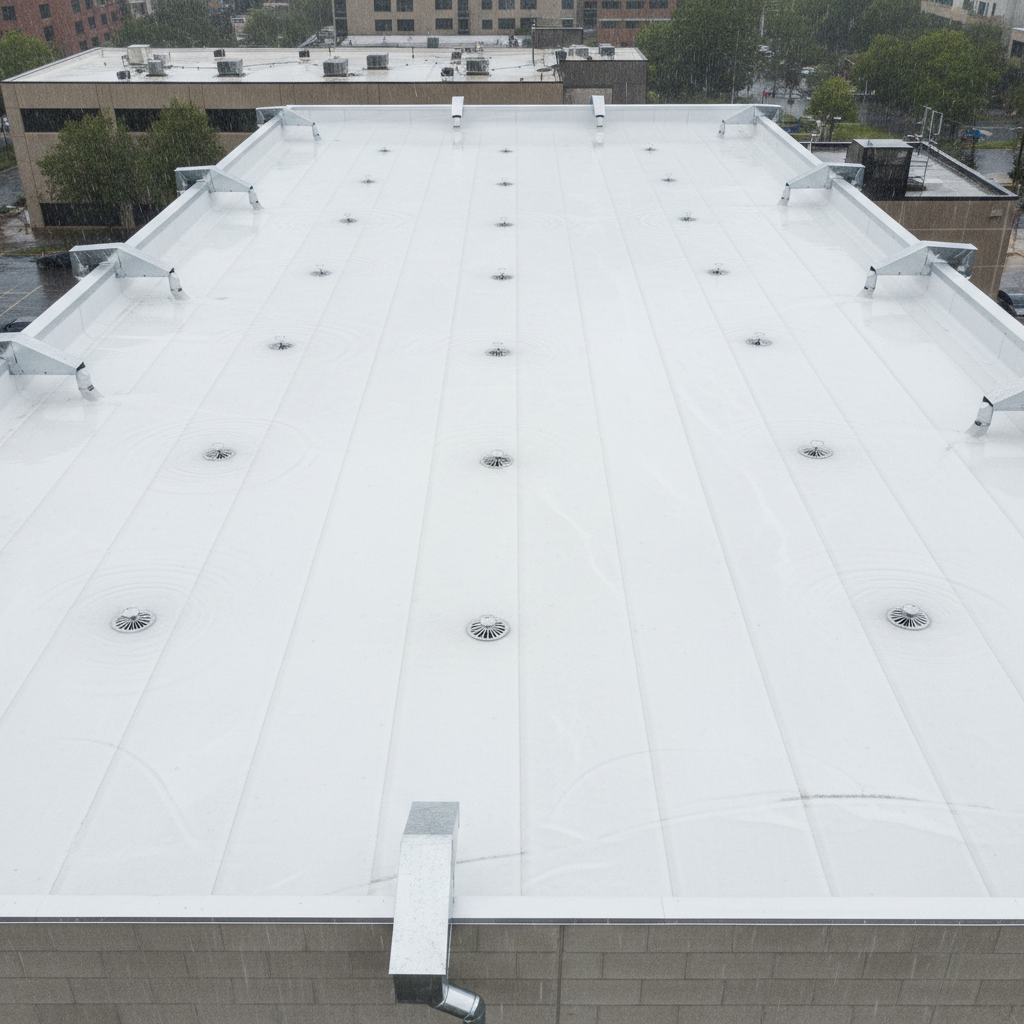
Houston averages nearly 50 inches of rain per year, a significant increase compared to DFW's 37-42 inches or San Antonio's 32 inches. This sheer volume of water would be a challenge anywhere, but it is compounded by Houston's famously flat topography. The entire metro area sits on a coastal plain with minimal natural slope, meaning water does not drain away from properties easily. This puts an immense burden on the commercial roof's drainage system.
The lessons from Tropical Storm Harvey in 2017 were stark and clear. Analysis of commercial building performance during the 50-plus-inch rainfall event revealed a critical truth: the adequacy of the roof’s secondary drainage system was a primary predictor of whether a building suffered catastrophic interior flooding. Buildings that relied solely on primary drains were quickly overwhelmed, leading to massive ponding water loads and eventual intrusion. Those with properly sized and maintained overflow scuppers and secondary drains fared dramatically better. The result is that every aspect of drainage design, from the size and number of drains to the placement of overflow scuppers, carries more weight in Houston than in markets with natural topographic assistance. These systems are not just for code compliance; they are the first line of defense against catastrophic water intrusion.
Hurricane Exposure: Designing for Extreme Wind and Water
Houston's history is marked by major tropical weather events. Hurricanes Alicia (1983), Ike (2008), and Harvey (2017), along with Tropical Storm Allison (2001), provided real-world stress tests for the region's building stock. These storms demonstrated that the primary threats to commercial roofs in this environment are not the same as those in inland Texas. While hail is a concern, the combination of extreme sustained winds and wind-driven rain presents a more consistent and destructive threat.
Wind-Driven Rain: A Unique Failure Mechanism
A hurricane does not produce rain that simply falls down; it produces rain driven horizontally at speeds exceeding 100 mph. This creates pressures that standard commercial roofing details, like edge metal, coping caps, and penetration flashings, were never designed to withstand. Water is forced into tiny gaps and seams, bypassing flashings and creating widespread leaks even on a roof where the membrane itself remains intact. A roof that is perfectly watertight under normal conditions can fail from dozens of intrusion points during a tropical system. This is why the quality of detail work and the specification of hurricane-rated edge metal and flashings are critical in Houston.
Engineered for Uplift: Attachment Is Everything
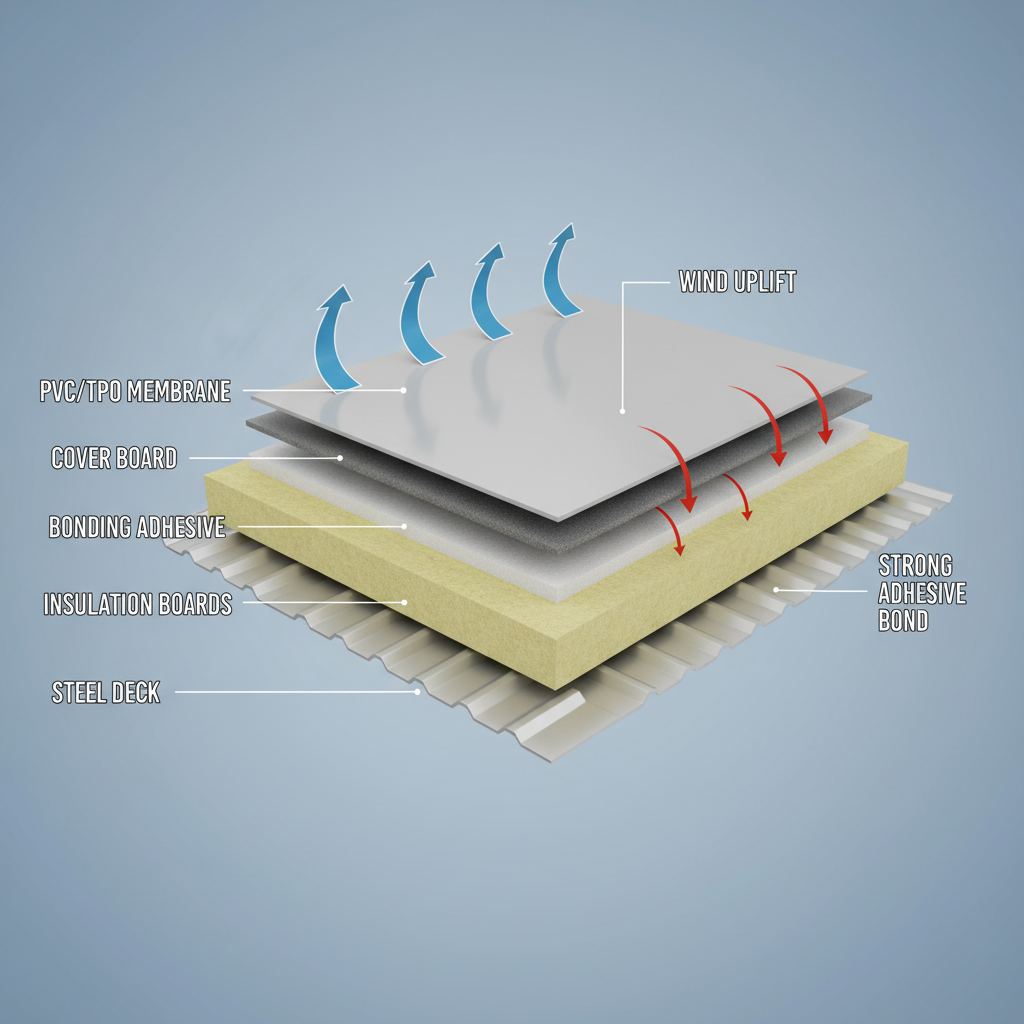
According to the ASCE 7-22 wind speed maps, the Houston metro area requires designs for wind speeds of 130 to 150 mph for Risk Category II buildings. This is substantially higher than the design requirements for Dallas-Fort Worth. These powerful winds create immense negative pressure, or uplift, on large, flat commercial roofs. A mechanically attached system, where the membrane is fastened with plates and screws, can create points of stress that may lead to fastener pullout or membrane tearing under these extreme loads. This is why fully adhered roofing systems are often the superior, and sometimes required, specification for Houston. In a fully adhered system, the entire membrane is bonded to the substrate below with a powerful adhesive. This distributes the wind load evenly across the entire roof surface, eliminating the point-loading stress of fasteners and providing massively increased resistance to wind uplift. This requires roofing systems engineered specifically for high-wind zones. Attachment methods that are sufficient for inland Texas may not meet the code or real-world performance requirements for a building in Harris or Galveston County.
Industrial Demands: The Case for PVC in the Petrochemical Corridor
The Houston Ship Channel is the epicenter of the nation's petrochemical industry. The corridor is lined with refineries, chemical plants, and manufacturing facilities, all of which release a variety of chemical exhausts, vapors, and particulates into the atmosphere. This creates a highly specialized roofing environment for the thousands of industrial buildings, warehouses, and administrative offices that support this sector.
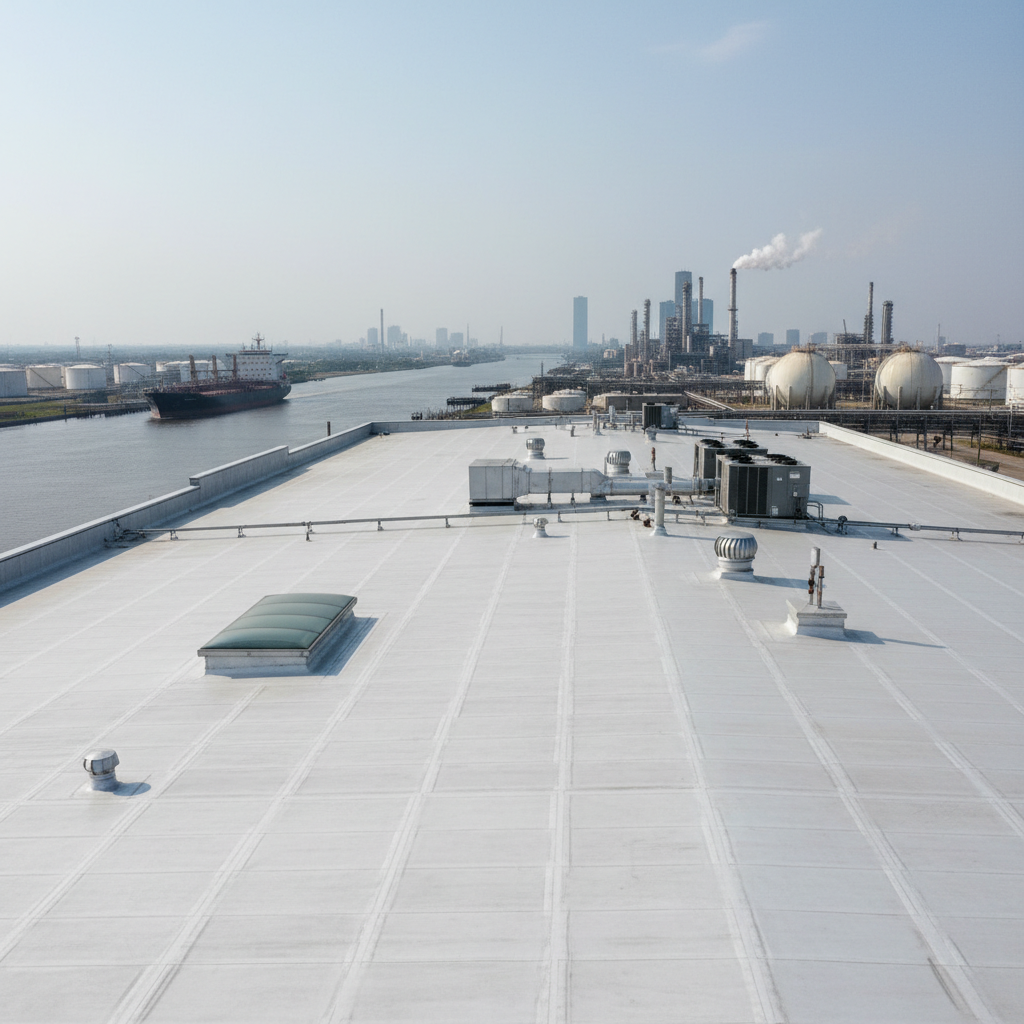
The chemical resistance of a roofing membrane is not a theoretical concern here; it is a daily performance requirement. TPO (Thermoplastic Olefin) is an excellent, cost-effective roofing membrane used on millions of square feet of commercial roofs. However, it is vulnerable to degradation when exposed to certain fats, oils, greases, and industrial solvents. In an environment with constant exposure to petroleum product vapors and other chemical exhausts, a TPO membrane can lose its flexibility, become brittle, and fail prematurely. This is where PVC membrane specifications become essential. PVC (Polyvinyl Chloride) is inherently more resistant to this wide range of chemicals. For an industrial facility, restaurant with a grease trap, or any building with chemical exhaust, PVC provides the long-term durability that TPO cannot. A contractor who defaults to TPO on an industrial building in Houston without performing a thorough assessment of the surrounding chemical environment is specifying the wrong system. Facility managers should be wary of any bid that does not include a discussion about chemical exposure and membrane selection.
The Texas Medical Center: A World-Class Roofing Environment
The Texas Medical Center (TMC) is a city within a city. With 54 institutions spread across more than 1,300 buildings, it represents the largest single concentration of healthcare facility roofing in the world. While these are commercial buildings, they come with a set of challenges that are entirely unique to the medical field.
Roofing projects at the TMC and other Houston-area medical facilities demand a contractor with expertise in the specific requirements for healthcare facility roofing. This includes:
- Infection Control Risk Assessment (ICRA): Contractors must follow strict protocols to contain dust, debris, and fumes to protect vulnerable patient populations.
- Occupied Building Constraints: Work must be meticulously scheduled and executed to minimize disruption to sensitive 24/7 operations, including noise and vibration control.
- Dense Rooftop Equipment: Hospital roofs are often crowded with critical HVAC, medical gas lines, and other essential equipment, requiring complex flashing and detail work.
- Contractor Credentialing: Hospitals require extensive background checks and credentialing for all on-site workers.
In this context, general commercial roofing experience is insufficient. Facility managers at Houston’s medical centers need to partner with contractors who can provide documented proof of successful projects in active healthcare settings. It is a niche that demands a specialized skill set, and one that defines a significant portion of the Houston roofing market.
Navigating the Post-Harvey Commercial Insurance Market
The Texas commercial property insurance market has become increasingly difficult in recent years, but Houston building owners have been on the front lines of this shift for longer than anyone else. The massive insured losses from Hurricane Harvey accelerated market hardening in the Houston area well before it became a statewide phenomenon. As a result, Houston facility managers are now dealing with some of the most challenging underwriting conditions in the country.
Key trends include the widespread adoption of percentage-based wind and hail deductibles, which can be 1%, 2%, or even 5% of the total insured value of the property, leading to massive out-of-pocket costs after a storm. Carriers are also aggressively non-renewing policies for buildings with roofs older than 15 years, regardless of their current condition. The shift from Replacement Cost Value (RCV) to Actual Cash Value (ACV) coverage for older roofs is now standard practice, meaning insurance payouts are reduced by depreciation. In this environment, navigating the complex insurance landscape requires proactive management. Carriers routinely use high-resolution aerial and satellite imagery to assess roof conditions before offering a renewal. A roof with visible ponding water, deterioration, or deferred maintenance is a prime target for non-renewal or unfavorable terms. Conversely, a building with a new roof or a documented roof maintenance program is in a much stronger negotiating position. Documentation is key to proving proactive asset management and securing the best possible coverage.
Understanding Commercial Roofing Costs in Houston
Several local factors influence the cost of commercial roof replacement in Houston, creating a pricing structure that is distinct from DFW or other inland markets.
- Material Costs: Houston's proximity to Gulf Coast ports and its status as a major distribution hub means that material costs are generally comparable to other large Texas cities. Availability is strong, which helps keep prices competitive.
- Labor Costs: While the base labor rate is similar to DFW, Houston's extreme summer heat and humidity have a real impact on project costs. The heat index often forces shorter working days for safety, which can extend project timelines and increase the effective labor cost per project. Productivity is simply lower during the peak summer months.
- Specification-Driven Costs: The biggest cost differentiator is the requirement for hurricane-rated assemblies. A fully adhered system, required for high-wind zones, involves more labor and adhesive material costs than a standard mechanically attached system. The use of heavier gauge edge metal, impact-rated cover boards, and other storm-resistant components adds to the total project cost. These are not optional upgrades; they are essential components for long-term performance in Houston.
The Right Partner for a Complex Market
Houston's commercial roofing environment is a convergence of coastal weather, industrial demands, and immense scale. Protecting a commercial building here requires a deep understanding of drainage science, wind engineering, and material chemistry. It requires a contractor who sees a roof not as a commodity, but as an integrated system designed to perform in one of the most challenging environments in the country.
At TriVAN Roofing, our 24-plus years of experience in Texas and Oklahoma are backed by credentials as a GAF Master Elite and Duro-Last Elite Contractor. We have the technical expertise and regional knowledge to specify and install the right system for your Houston property, whether it's a warehouse near the Ship Channel, a building in the Texas Medical Center, or a suburban office park. We understand how to design for hurricane uplift and torrential rain, and we know the entire roof replacement process from initial inspection to final warranty. In a market this demanding, you need a partner you can trust.
---
Ready to Protect Your Facility?
Houston’s complex roofing environment requires more than a standard commercial contractor. It demands a partner with proven experience in high-wind designs, advanced drainage solutions, and the right material science for industrial applications. For over 24 years, TriVAN Roofing has served Texas and Oklahoma, earning certifications as a GAF Master Elite and Duro-Last Elite Contractor, placing us in the top tier of installers nationwide. We understand Houston's unique demands, from hurricane-rated assemblies to chemically resistant PVC systems for industrial facilities. Our 15-year NDL warranty covers consequential damages and ponding water, providing unmatched protection. Don't risk your Houston asset with an ordinary roofer. Call 877-487-4826 for an expert consultation.
Contact Us Today