Commercial Roof Replacement Cost in Texas: 2026 Price Guide by System, Market, and Hidden Variables
| By TriVAN Roofing | 11 min read
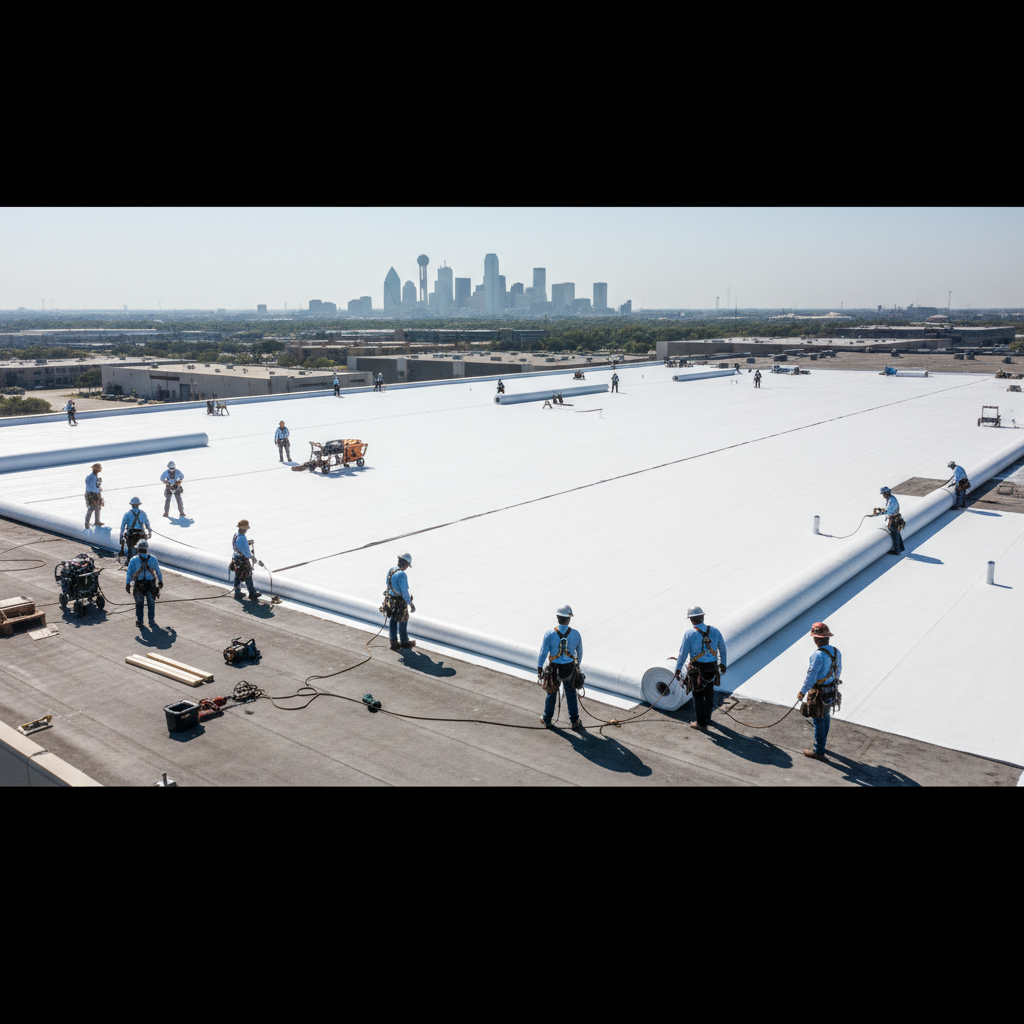
Get Texas-specific 2026 commercial roof replacement costs. This guide breaks down pricing per square foot for TPO, PVC, Metal, and more. Learn about the hidden costs like tear-off, deck repair, and code upgrades that impact your final project total.
Categories: Industry Insights
Why Is It So Hard to Get a Straight Answer on Commercial Roofing Costs?
If you are a facility manager, property manager, or building owner in Texas, you have probably asked this question. You are trying to plan a budget for a commercial roof replacement, and the information available online is often conflicting, outdated, or frustratingly vague. One source gives a price per square foot so wide it’s useless, while another quotes residential shingle prices that have no bearing on a 50,000 square foot low-slope roof.
The truth is that giving a "simple" price is genuinely difficult, and any contractor who does so without a thorough inspection is not being entirely honest. The cost difference between a straightforward TPO overlay on a clean, solid deck and a complex replacement on an occupied hospital with significant deck rot, code-mandated insulation upgrades, and after-hours work requirements can be more than 100%.
This guide is different. As a Texas and Oklahoma-based commercial roofing contractor with over two decades of experience, we believe an educated client is the best partner. Here, we will break down the real-world costs for 2026, based on our project data and current market conditions. We will cover costs by system type, detail the "hidden" costs that are often excluded from initial quotes, analyze how pricing changes from DFW to West Texas, and give you concrete examples to help build a realistic budget.
2026 Commercial Roof Replacement Cost Per Square Foot in Texas
Let's start with the numbers everyone wants: the all-in, installed cost per square foot for a standard commercial replacement on a roof with a solid structural deck. These ranges account for materials, labor, basic flashings, fasteners, and manufacturer warranty fees. They are the baseline from which your project's specific variables will adjust the final price up or down.
[A NOTE ON TIMING: These 2026 projections account for recent and anticipated material cost increases. Verify all pricing with current bids, as market volatility can shift these numbers.]
- TPO (Thermoplastic Olefin): $8.50 – $11.50 per square foot. This is the most common system for low-slope commercial roofs in Texas. Mechanically attached systems are on the lower end of this range. A fully adhered system, which uses bonding adhesive across the entire surface, typically adds $0.75 to $1.25 per square foot. TPO single-ply systems offer excellent energy efficiency and durability.
- PVC (Polyvinyl Chloride): $10.00 – $13.50 per square foot. PVC is a premium single-ply membrane. Its higher cost is justified in specific applications, such as restaurants, food processing plants, or manufacturing facilities where the roof is exposed to grease, chemicals, or oils that can degrade TPO over time.
- EPDM (Ethylene Propylene Diene Monomer): $8.00 – $11.00 per square foot. This durable synthetic rubber membrane has been used for decades. The standard black EPDM is on the lower end, while reflective white EPDM, which helps with energy costs, carries a modest price premium. It is known for its long service life and resistance to weathering.
- Modified Bitumen: $7.00 – $10.00 per square foot. A modern evolution of traditional asphalt roofing, "mod-bit" systems involve multiple layers of asphalt-based sheets. A typical two-ply system (torch or cold-applied) is often less expensive than single-ply but is heavier and more labor-intensive to install.
- Standing Seam Metal: $15.00 – $25.00+ per square foot. Standing seam metal roofing is a significant investment with a very long lifespan. The wide price range is driven by the gauge of the metal (24-gauge is standard), the panel profile, the type of paint finish (like Kynar 500), and the complexity of the roof geometry.
- Built-Up Roofing (BUR): $8.00 – $12.00 per square foot. The classic "tar and gravel" roof consists of multiple layers of asphalt and reinforcing fabrics, topped with a layer of aggregate. BUR is very durable and offers excellent protection but is extremely heavy, labor-intensive, and less common in new construction today.
What Your Per-Square-Foot Price Actually Includes (And What It Doesn’t)
A low per-square-foot bid can be misleading if it excludes major, necessary components of the project. This is where bids become incomparable and where building owners get surprised by change orders. A reputable contractor will break these out for you, but you need to know what to look for. Here is a general breakdown:
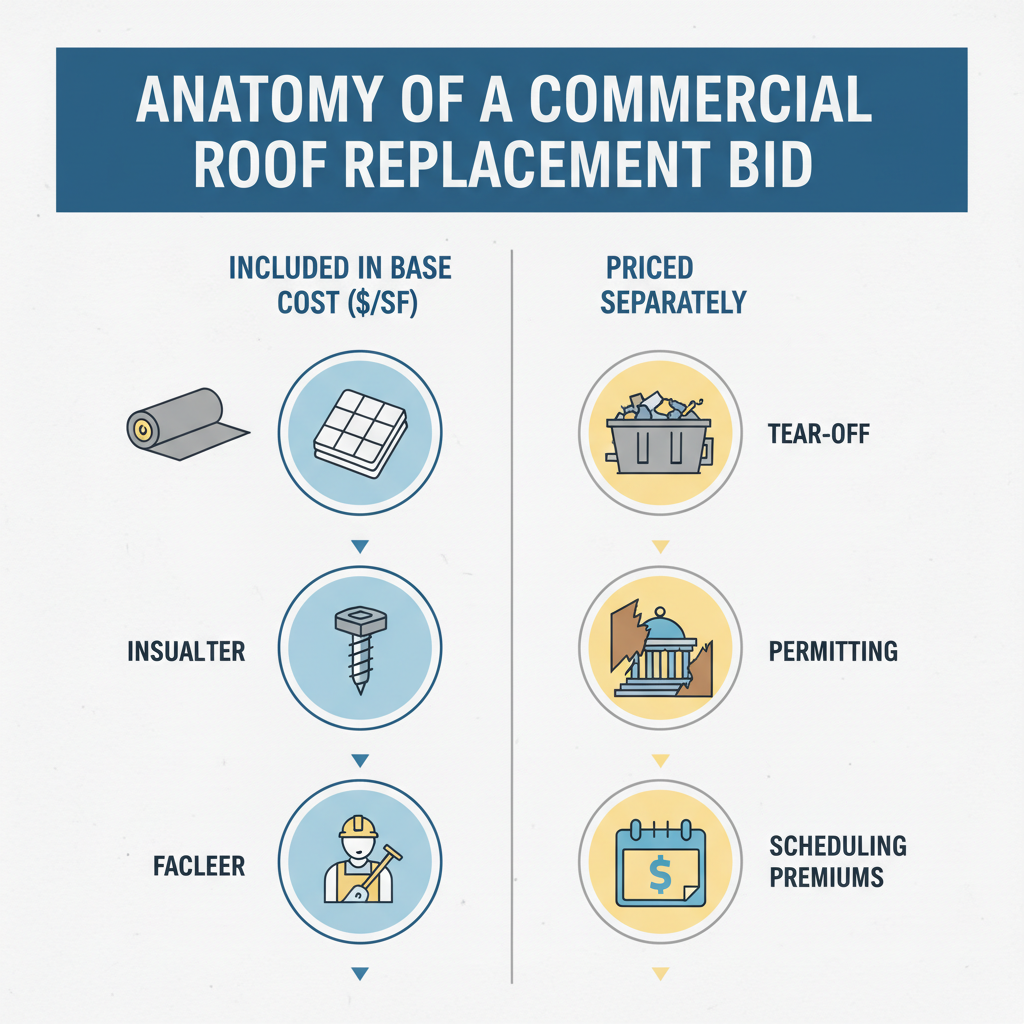
Typically Included in the Base Price:
- Roof Membrane: The primary waterproofing layer (TPO, PVC, EPDM, etc.).
- Insulation: Polyisocyanurate (Polyiso) rigid foam boards, typically to meet a minimum R-value of R-25 or R-30 per current Texas energy codes.
- Fasteners & Adhesives: The screws, plates, or glue used to secure the insulation and membrane to the roof deck.
- Standard Flashings: Material and labor to waterproof around common penetrations like pipes and vents, and at the perimeter of the roof.
- Labor: The cost for the trained and certified crew to install the system.
- Manufacturer Warranty Fee: The cost paid to the manufacturer (like GAF or Duro-Last) to issue a long-term No Dollar Limit (NDL) warranty.
Typically Excluded and Priced Separately:
- Tear-Off & Disposal: $1.50 – $3.50 per square foot. This covers the labor to remove the old roof system and the cost of transporting and disposing of the debris. The price varies based on the number of existing layers and the weight of the material (a gravel BUR roof is much more expensive to tear off than a single-ply membrane).
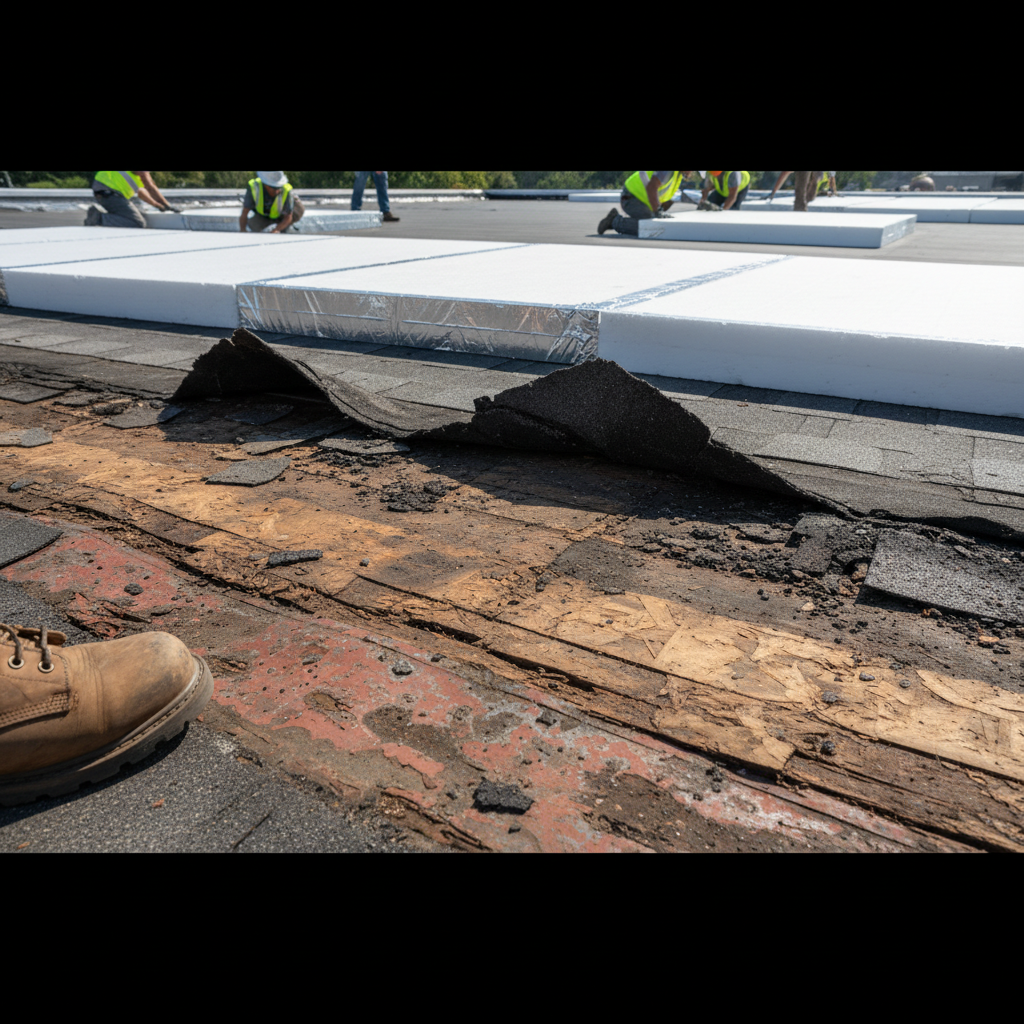
- Deck Repairs: (CONTINGENCY) If the tear-off reveals rotted wood, rusted metal decking, or crumbling lightweight concrete, it must be repaired or replaced before the new roof is installed. This is priced based on time and materials and is the biggest potential budget variable. A 20-30% contingency fund is critical.
- Edge Metal & Coping: While standard flashing is included, extensive replacement of custom metal coping caps on parapet walls or perimeter edge metal is often a separate line item based on linear footage.
- Permitting: $2,000 – $8,000+. The cost to file for and obtain a building permit from the local municipality. This varies wildly by jurisdiction, with cities like Austin and Dallas having more complex and expensive processes.
- Engineering/Structural Assessments: $3,000 – $10,000. Sometimes required by a city, especially if you are adding significant weight (like changing from a light single-ply to a heavy BUR) or if the building's structural integrity is in question.
- Asbestos Survey & Abatement: For buildings constructed before 1990, a survey ($2,500 - $5,000) may be legally required to test for asbestos-containing materials. If found, abatement can cost $3 to $8 per square foot of affected material and must be done by a licensed specialist.
- Occupied Building Premiums: 10% – 25% surcharge. If your facility must remain operational with minimal disruption, work may need to be done after hours, on weekends, or with special logistical considerations (fume management, noise control, limited site access). This adds a significant premium to labor costs.
How Texas & Oklahoma Market Variations Affect Your Price
Material and labor costs are not uniform across the region. A project in Amarillo will have a different cost structure than an identical project in Dallas. Understanding these regional dynamics is key to validating bids from local and non-local contractors.
DFW Metroplex (Dallas-Fort Worth)
The DFW market has the highest density of commercial roofing contractors in the state, which can lead to competitive pricing. However, it also has the highest demand, especially during storm season (spring and early summer). Expect to pay a premium of 15-20% for guaranteed scheduling during peak summer months compared to the fall or spring shoulder seasons.
Houston Metro
Pricing in Houston is broadly comparable to DFW. The key difference is the impact of high humidity. This often drives specifications for higher-performance vapor barriers and more complex insulation strategies to prevent condensation issues within the roof assembly, which can add to the material cost.
San Antonio & Austin
Labor rates in the Central Texas markets can run slightly below DFW, but this doesn't always translate to a lower total project cost. These markets have fewer large, certified commercial contractors, meaning less competition for major projects. The net effect is that pricing is often very close to DFW levels.
West Texas (Midland, Odessa, Lubbock, Amarillo)
Expect to pay a 10-20% premium for projects in West Texas. There are two primary reasons for this. First, material transportation costs are higher due to the distance from major distribution hubs in DFW or Houston. Second, contractor availability is more limited, reducing competitive pressure on pricing.
Oklahoma (Oklahoma City, Tulsa)
The Oklahoma City and Tulsa markets are very similar to DFW in terms of cost structure. However, projects here often face more stringent wind uplift design requirements due to the frequency of severe weather. This may require more robust fastening patterns or specific assemblies rated for higher wind speeds, which can add a small premium to the material and labor cost.
The Major Variables That Drive Costs Up or Down
Within any given market and for any chosen system, several factors can push your project from the low end of the cost range to the high end. Understanding these allows you to anticipate the true cost for your specific building.
- Complexity (15-30% increase): A simple, big-box rectangular roof is the cheapest to install. A roof with multiple levels, dozens of HVAC curbs, skylights, vents, pipes, and unusual geometric shapes is far more expensive. Each penetration requires meticulous, labor-intensive flashing work, driving up labor hours and material costs for flashing details.
- Occupied Building Constraints (10-25% increase): As mentioned earlier, working around tenants, employees, or sensitive operations costs more. The more restrictive your requirements for noise, fumes, and working hours, the higher the premium will be.
- Peak Season Scheduling (15-20% increase): In Texas, everyone wants their roof fixed in the summer. If you have the flexibility to schedule your replacement for the fall or early spring, you can often secure better pricing as contractors are not as overbooked.
- Deck Condition (The Great Unknown): The condition of the structural deck underneath your existing roof is the single biggest unknown in any replacement project. No contractor can know with 100% certainty what they will find until the old roof comes off. This is why a contingency fund is not just recommended; it is essential for responsible project management. A project with less than 5% deck damage will be on budget, while one with 25% rotted decking can see costs climb by $30,000 to $100,000 on a typical 30,000 sq. ft. project.
- Energy Code Compliance ($2-$4 per sq. ft. increase): When you replace more than 50% of your roof, Texas jurisdictions that have adopted the 2021 International Energy Conservation Code (IECC) require the new system to meet current insulation R-value minimums (typically R-25 or R-30). If your existing roof has inadequate insulation, you will be required to add more, which increases material and labor costs by $2 to $4 per square foot.
Putting It All Together: Sample Project Budgets
Let's apply this information to three realistic scenarios to see how these factors combine to create a total project budget.
Scenario A: 25,000 sq. ft. Warehouse in DFW
- Project: Standard TPO replacement, good deck condition, fall scheduling.
- Base Installation (TPO @ $9.50/sf): $237,500
- Tear-Off & Disposal (@ $2.00/sf): $50,000
- Edge Metal & Flashings (Allowance): $12,000
- Permitting (DFW): $3,500
- Contingency for Deck Repair (5%): $11,875
- Total Estimated Project Cost: $314,875
Scenario B: 40,000 sq. ft. Occupied Office Building in Houston
- Project: Fully adhered TPO, summer scheduling required, moderate penetrations.
- Base Installation (TPO @ $10.50/sf): $420,000
- Fully Adhered Premium (@ $1.00/sf): $40,000
- Occupied Building Premium (15%): $69,000
- Tear-Off & Disposal (@ $2.25/sf): $90,000
- Permitting (Houston): $6,000
- Contingency for Deck Repair (10%): $42,000
- Total Estimated Project Cost: $667,000
Scenario C: 15,000 sq. ft. Restaurant in San Antonio
- Project: PVC system required for grease/oil resistance from kitchen vents.
- Base Installation (PVC @ $11.50/sf): $172,500
- Specialized Grease-Proof Flashing (Allowance): $8,000
- Tear-Off & Disposal (@ $2.50/sf): $37,500
- Permitting (San Antonio): $3,000
- Contingency for Deck Repair (10%): $17,250
- Total Estimated Project Cost: $238,250
Final Guidance for Budget Planning
Armed with this data, you can create a much more accurate budget. Here are the key takeaways for your planning process:
- Always Budget a 25-30% Contingency. Use the square foot estimates to get a baseline, then add 25-30% to cover tear-off, potential deck repairs, and other variables. It is always better to have the funds and not need them than to have to go back to stakeholders for more money mid-project.
- Get Bids in the Right Quarter. The market is moving fast. Raw material inputs like asphalt and crude oil have seen dramatic price spikes. A budget you created in 2024 is likely 15-25% too low for a 2026 project. For maximum accuracy, solicit bids in the same calendar quarter you plan to execute the work.
- Demand Line-Item Proposals. Do not accept a single, all-in number. Require contractors to break out the base installation cost from tear-off, deck repairs (as a per-unit cost), edge metal, and other components. This is the only way to compare bids on an apples-to-apples basis and understand exactly what you are paying for.
A new commercial roof is a major capital investment designed to protect your assets for decades. Starting the process with a realistic understanding of the costs is the first and most important step. As a woman-owned business with over 24 years of experience in the Texas and Oklahoma hail corridor, TriVAN Roofing has built its reputation on transparency and education. A properly installed roof protects your building, and a well-planned budget protects your business. We also recommend protecting your new investment with a plan for proactive maintenance to ensure it reaches its maximum intended service life.
Tags: commercial roof replacement cost Texas, commercial roofing cost per square foot 2026, TPO roofing cost Texas, flat roof replacement cost DFW, commercial roof replacement cost guide, how much does commercial roof replacement cost, commercial roofing cost calculator Texas, PVC roofing cost commercial, standing seam metal roofing cost Texas commercial, commercial roofing price guide