Commercial Roof Replacement Cost in Texas: 2026 Budget Guide
| By TriVAN Roofing | 12 min read
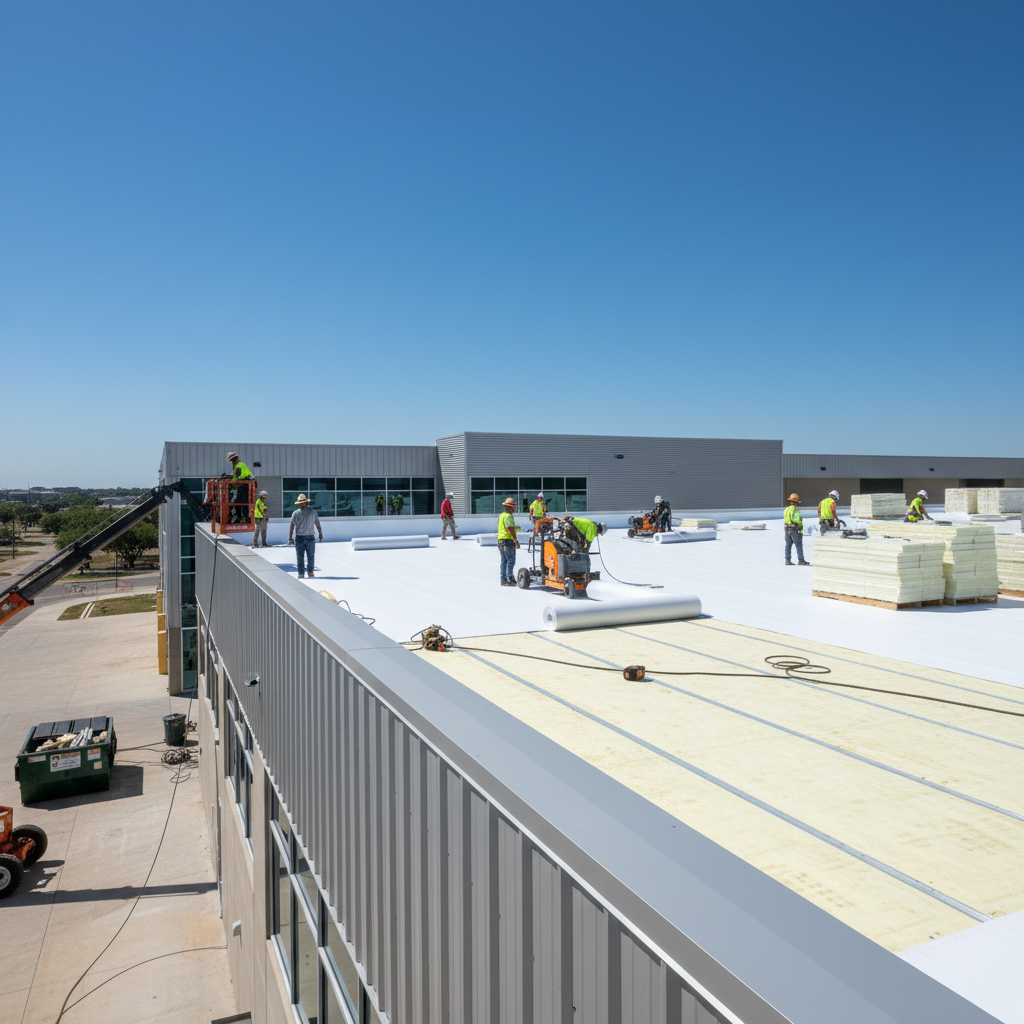
Plan your commercial roof replacement cost in Texas with verified 2026 benchmark data. Learn real per-square-foot costs for TPO, PVC, and metal, plus the hidden budget drivers that affect your final capital expenditure.
Categories: Industry Insights
The Commercial Roofing Budget Reality in Texas
Every commercial property owner and facility director eventually asks the same fundamental question: what will it cost to replace our roof? Finding a reliable, straightforward answer online often proves frustrating. Most published estimates skew heavily toward residential shingles, rely on figures published years ago, or offer broad ranges like "$3 to $20 per square foot" without clarifying the specific factors that position a property at the bottom or top of that spectrum.
A ballasted TPO overlay installed over an existing dry membrane on a clean warehouse in South Texas requires an entirely different capital commitment than a fully adhered 80-mil PVC replacement featuring structural deck remediation and mandatory energy code insulation upgrades in the Dallas-Fort Worth metroplex. Both projects qualify under the label of commercial roof replacement in Texas. Yet the actual investment required to execute them varies substantially.
Industry cost analyses provide a clearer picture of regional realities. According to roofobservations.com's Texas-specific 2026 cost guide, commercial roof replacement prices across Texas range from roughly $3.50 per square foot for a basic ballasted TPO overlay with no insulation added, up to $15 per square foot for a multi-ply modified bitumen system complete with continuous R-25 insulation designed to meet state energy codes. When full removal of the existing assembly is required, tear-off adds between $1.00 and $3.00 per square foot, with $1.50 serving as the typical midpoint for single-ply systems. For a standard 25,000 square foot facility, total project cost usually spans between $125,000 and $375,000 depending on the system selected and underlying conditions.
Recent contractor bid tabulations published by buildermuse.com, evaluating 14 commercial proposals within a single month in 2026, place Texas-specific TPO installation at $5.50 to $7.00 per square foot for materials and labor prior to tear-off. This data aligns with the lower boundary of complete re-roofing assemblies. To build an accurate capital expenditure forecast, property stakeholders must look closely at individual membrane types, code mandates, and the ancillary building conditions that transform an initial estimate into a final invoice.
Evaluating System Types: 2026 Benchmark Pricing in Texas
Material selection defines the operational performance of your roof and forms the foundation of your replacement budget. Different chemistries address specific architectural requirements, chemical exposures, and thermal loads.
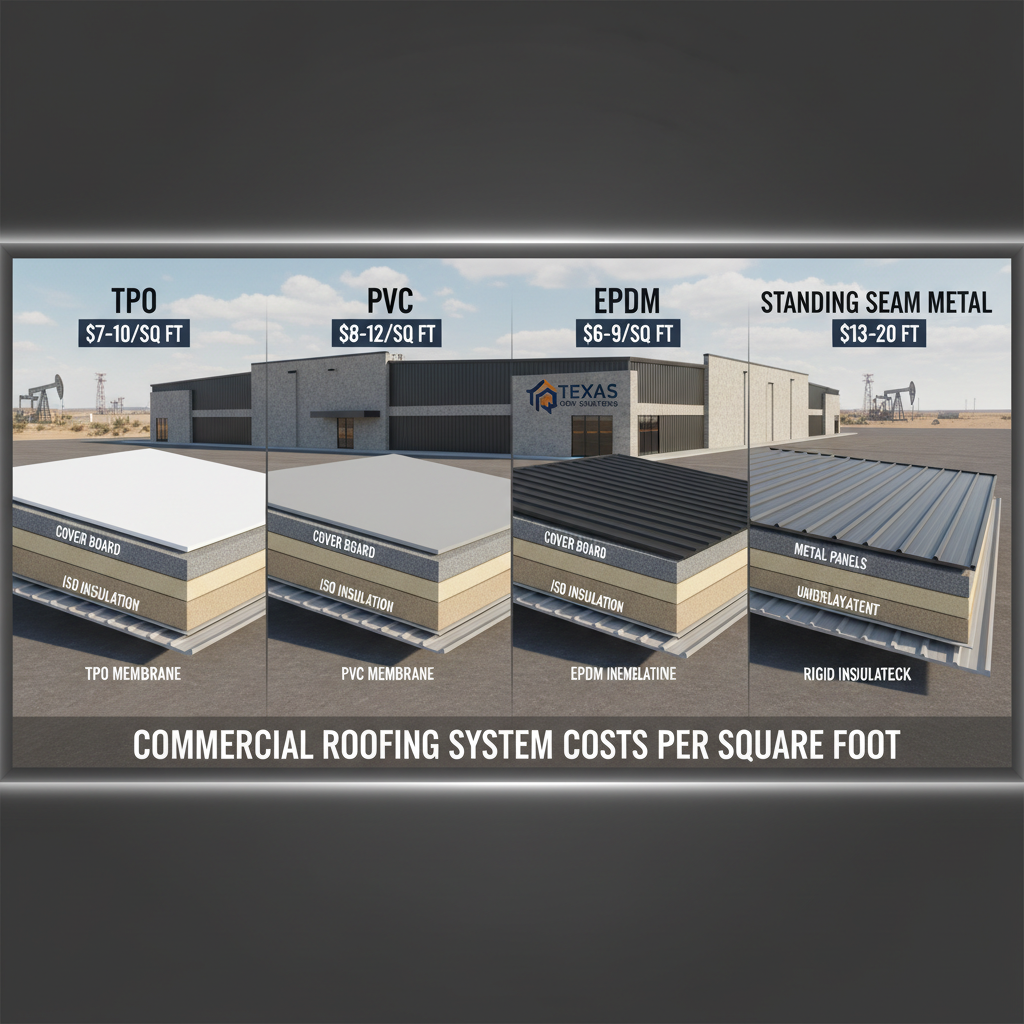
The following price brackets establish the baseline expectations for primary commercial membrane categories based on 2026 industry benchmark data across Texas and surrounding regions.
Thermoplastic Polyolefin (TPO)
TPO remains the dominant commercial roofing membrane specified across Texas, favored for its heat-welded seams and natural solar reflectivity that mitigates high summer cooling loads. Industry data from buildermuse.com places fully installed TPO systems at $6.00 to $10.00 per square foot all-in, including standard single-layer tear-off of the failed roof. For standard 45-mil or 60-mil mechanically attached installations over sound insulation, costs routinely sit toward the lower half of that range. Premium 80-mil assemblies installed in heavy hail zones or fully adhered configurations trend toward the higher end. For detailed specifications, review our comprehensive TPO roofing cost guide.
Ethylene Propylene Diene Monomer (EPDM)
EPDM rubber roofing delivers proven longevity and exceptional thermal shock resistance, but its dark surface poses distinct challenges in the Texas climate. Standard all-in replacement pricing for EPDM runs between $5.00 and $9.00 per square foot per buildermuse.com benchmarks. While the raw material and initial labor costs are slightly lower than TPO, black EPDM membranes absorb massive thermal radiation during Texas summers. Facilities choosing non-reflective EPDM frequently experience higher air conditioning demands unless paired with substantial polyisocyanurate insulation depths or an applied reflective topcoat, which offsets the upfront material savings.
Polyvinyl Chloride (PVC)
For buildings housing commercial kitchens, food processing plants, airports, or manufacturing processes that exhaust greases, oils, and industrial chemicals, PVC provides essential resistance that standard single-ply products cannot match. Benchmark data from risingsunartscentre.org indicates that standard mechanically attached PVC runs between $6.00 and $10.00 per square foot installed. When specifications demand heavy-duty, premium fully adhered PVC membranes, costs typically reach $10.50 to $16.00 per square foot. While PVC represents a larger initial investment, its chemical resilience prevents premature membrane deterioration on specialized facilities. Property managers can reference our detailed PVC roofing cost breakdown to examine how specific project conditions alter these figures.
Standing Seam Metal Roofing
Architectural and structural standing seam metal roofs deliver outstanding life cycles, frequently exceeding 40 to 50 years when properly engineered and maintained. Across Texas commercial projects, standing seam metal replacements range from $15.00 to $25.00 per square foot installed. Metal roofing requires higher initial capital than single-ply membranes, but it offers high wind uplift resistance, excellent thermal movement accommodation, and protection against severe storm events common along the Interstate 35 corridor.
Hidden Cost Components That Transform Estimates Into Realistic Budgets
A frequent mistake in commercial roof budgeting involves confusing a contractor's membrane installation estimate with the total project capital expenditure. A base re-roofing proposal typically includes removing one existing membrane layer, replacing incidental deteriorated fasteners, installing code-compliant insulation, laying the specified sheet, and terminating edge metal flashings. However, comprehensive facility budgets must account for critical secondary costs.
Substrate and Deck Remediation
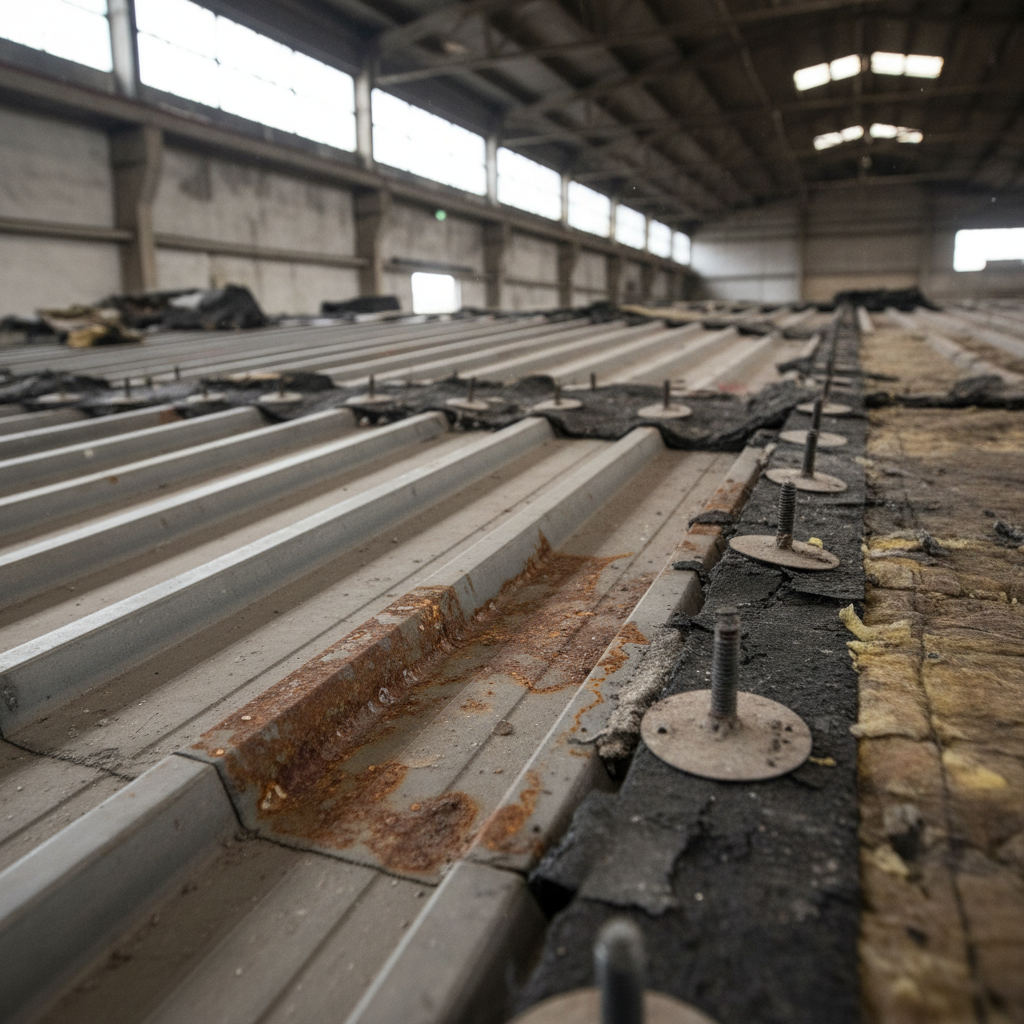
Structural deck repairs cannot be fully quantified until the existing roof assembly is removed, making this variable the primary driver of mid-project budget modifications. When long-term, undetected moisture leaks saturate the underlying layers, metal fluted decks rust through, wood decks rot, and gypsum or lightweight concrete decks lose their compressive strength. Facility teams should always hold a dedicated 20% to 30% contingency fund above base proposals specifically earmarked for unforeseen deck remediation. Encountering deteriorated metal decking on a mid-sized facility can easily introduce $30,000 to $100,000 in structural welding and panel replacement work.
Municipal Permitting and Regulatory Fees
Commercial building permits in Texas municipalities are calculated based on project valuation, square footage, and local inspection fees. Permitting fees for a mid-scale commercial re-roof typically add $2,000 to $8,000 to the total outlay. Municipalities across the Dallas-Fort Worth metroplex, Austin, and San Antonio actively enforce energy code verifications and wind uplift compliance documents prior to final sign-off.
Engineering Inspections and Wind Uplift Surveys
Depending on local building regulations and structural loading requirements, your jurisdiction may mandate third-party engineering verifications. Pull tests, structural deck load calculations, and wind uplift engineering assessments generally range from $3,000 to $10,000. These assessments guarantee that the chosen attachment pattern satisfies local building codes without compromising structural framing.
Asbestos Testing and Abatement
Commercial facilities constructed prior to 1990 present unique environmental considerations. Texas Department of State Health Services regulations mandate certified asbestos surveys before commercial demolition or tear-off work begins. Professional testing surveys typically run $2,500 to $5,000. Should hazardous materials be identified within legacy tar-and-gravel felt plies, flashing mastics, or transite decking, specialized abatement protocols add $3.00 to $8.00 per square foot in environmental remediation expenses.
Operational Continuity and Occupied Facility Scheduling
Industrial manufacturing plants, educational institutions, healthcare complexes, and corporate corporate centers rarely pause operations during construction. Restricting high-noise tasks, staging heavy cranes away from customer paths, managing interior dust mitigation, or running crews on evening and weekend shifts carries an operational labor premium. When projects demand non-standard execution hours to protect tenant continuity, facility managers should budget a 10% to 25% premium above baseline estimates.
Modeling a 25,000 Square Foot Facility Budget
To demonstrate how these variables interact in practice, consider a representative 25,000 square foot single-story light industrial building located in North Texas. This facility carries an aging, leak-prone original single-ply roof over a steel deck that requires total removal, insulation upgrades to satisfy local energy rules, and minor deck maintenance.
Base Scenario: Mechanically Attached 60-Mil TPO System
- Single-Layer Tear-Off and Disposal: $37,500 ($1.50/sq ft)
- Polyiso Insulation Upgrade (R-25 Continuous): $62,500 ($2.50/sq ft)
- 60-Mil TPO Membrane, Flashings, Edge Metal: $100,000 ($4.00/sq ft)
- Base Re-Roofing Subtotal: $200,000 ($8.00/sq ft)
- Municipal Permitting and Inspections: $4,500
- Pre-Construction Fastener Pull Testing & Engineering: $3,500
- Substrate Contingency Allowance (10% Steel Deck Patching): $25,000
- Realistic Total Capital Expenditure: $233,000 ($9.32/sq ft)
Specialized Scenario: Fully Adhered 60-Mil PVC System
- Single-Layer Tear-Off and Disposal: $37,500 ($1.50/sq ft)
- Insulation and High-Density Cover Board: $87,500 ($3.50/sq ft)
- Fully Adhered PVC Membrane, Chemical-Resistant Detailing: $162,500 ($6.50/sq ft)
- Base Re-Roofing Subtotal: $287,500 ($11.50/sq ft)
- Permitting, Engineering, and Environmental Surveys: $10,500
- Substrate Contingency Allowance: $30,000
- Occupied Facility Work Shift Accommodations (15% labor premium): $22,000
- Realistic Total Capital Expenditure: $350,000 ($14.00/sq ft)
This comparison shows why a basic quote providing only a membrane installation price leaves property owners vulnerable to mid-project financial adjustments. Structuring line-item budgets prevents capital shortfalls.
The Five Key Variables That Push Projects to the High End
When reviewing bids, property managers frequently notice wide cost spreads between competing structures. Five distinct project parameters govern whether your commercial facility sits at the economical or premium end of regional averages.
1. Architectural Complexity and Rooftop Penetrations
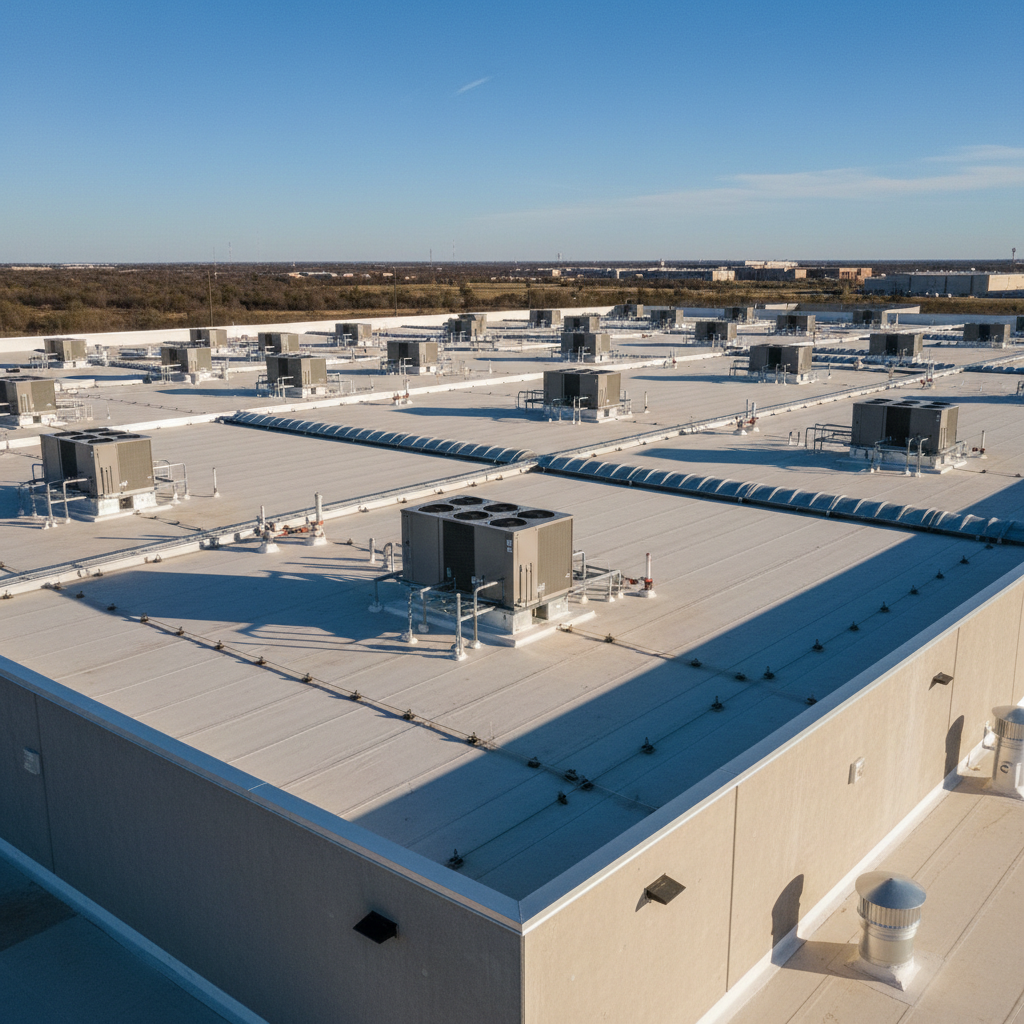
Roof complexity alters project labor requirements more directly than any other factor except deck failure. An expansive warehouse with flat spans, no parapets, and two drain basins allows crews to roll and mechanically weld broad single-ply sheets rapidly. Conversely, a retail strip or medical center featuring 40 separate HVAC package units, multiple soil stacks, structural skylights, complex conduit runs, and variable parapet wall elevations demands meticulous manual detailing. Hand-welding flashings around congested equipment curbs slows production rates, pushing base labor figures up by 15% to 30% per square foot.
2. Tenant Occupancy and Operational Constraints
The operational profile within your building dictates project workflow. Executing a tear-off over an active pharmaceutical production line, an aerospace cleanroom, or a retail store requires intensive interior protection, specialized air intake filtration, and strict vibration controls. Fastening mechanical screws into steel decking creates noise throughout structural beams. Shifting these activities to off-peak periods, such as nights or weekends, adds 10% to 25% to direct labor rates.
3. Seasonal Timing in the Texas Climate Corridor
Timing your project impacts labor availability and operational overhead. Commercial roofing activity in Texas reaches peak velocity during the summer months when commercial property managers hurry to repair hail damage before autumn rains arrive. However, sustained Texas heat, with surface temperatures on dark substrates exceeding 150 degrees, forces roofing contractors to alter shift schedules, provide heat-stress rotations, and manage shortened working windows. This seasonal rush drives up installation costs by 15% to 20% compared to scheduling re-roofs during stable spring or autumn windows.
4. Latent Substrate Conditions and Moisture Intrusion
Moisture often travels far from its point of entry. When water passes through compromised membrane seams, it saturates polyisocyanurate insulation boards, destroying their thermal properties and rusting the fasteners anchoring the system to the structural frame. If moisture surveys reveal that 40% of an existing insulation assembly is wet, contractors must remove and dispose of that heavy, saturated debris. On a mid-sized facility, extensive deck remediation and wet insulation disposal quickly introduce tens of thousands of dollars in unexpected costs.
5. Mandatory Energy Code Compliance
The State of Texas enforces modern commercial energy efficiency standards based on the International Energy Conservation Code (IECC). If an existing commercial roof is stripped down to the structural deck, local building codes mandate that the replacement assembly meet current continuous insulation thresholds, typically R-25 to R-30 depending on your Texas climate zone. If your legacy assembly contains only an inch of aged fiberboard yielding R-5, adding two staggered layers of two-inch polyisocyanurate to reach R-25 adds $2.00 to $4.00 per square foot in material and fastener expenses alone. Property owners can review the specific requirements outlined in our guide to Texas commercial building energy code compliance.
The 2026 Commercial Roofing Pricing Environment
Commercial roofing costs have seen significant movement over recent construction cycles. Understanding macro material trends prevents misunderstandings when recent proposals exceed older balance-sheet expectations.
Federal trade policies and global commodity swings have altered production inputs across the commercial construction sector. Section 232 steel tariffs set at 50% have pushed fabricated metal roofing panels, structural decking, and edge flashings up by approximately 60% relative to historic baselines. Single-ply polymers have felt parallel pressure: TPO and PVC single-ply membranes experienced 12% to 18% cost increases driven by higher petrochemical feedstock and stabilizer expenses.
Liquid asphalt and modified bitumen products have seen rapid shifts as well. Pricing data from BuildRefs in July 2026 documented that raw asphalt inputs climbed 35% in a single quarter, immediately affecting manufacturers of built-up roofing plies, modified bitumen rolls, and asphalt-based adhesives. For a deep examination of these global market movements, read our report on material tariff impacts on commercial roofing costs.
Because of these compounding pressures, any capital budget formulated before 2025 is likely underfunded by 15% to 25% today. Facility directors must recognize that elevated contractor bids do not necessarily indicate inflated margins. Instead, they reflect shifting supply costs across domestic manufacturing chains.
Capital Planning Strategy: How to Approach Your Next Replacement
Managing commercial roof expenditures successfully comes down to preparation, clear project scopes, and timing.
Incorporate Realistic Contingency Reserves
Never approve a commercial re-roofing budget based solely on the contractor's contract sum. Always carry a 25% to 30% financial contingency on full replacement projects, particularly when replacing an original roof that has operated past its engineered lifespan. This reserve provides the liquidity needed to address corroded decking, structural wood nailer rot, or drainage re-pitching without halting work.
Align Procurement With Target Installation Dates
Given the speed of raw material pricing shifts, material distributors and manufacturers rarely hold price locks beyond 30 to 60 days. Requesting contractor proposals nine months ahead of your expected start date produces estimates that may expire before work begins. Obtain bids within the same fiscal quarter in which work will commence. This ensures that the contractor's supplier pricing matches actual field costs.
Demand Transparent Line-Item Proposals
Avoid single-figure proposals that group mobilization, tear-off, insulation, membrane installation, and edge metal into a single lump sum. Insist on itemized bid structures separating membrane installation from tear-off, continuous insulation, cover boards, flashings, and hourly unit prices for deck replacement. This transparent format lets you make direct, accurate comparisons between competing bids. For more guidance on vetting proposals, consult our resource on evaluating commercial roofing contractor proposals.
Conclusion
Commercial roof replacement is a major capital investment, but it does not have to be an unpredictable one. By recognizing baseline material ranges, accounting for Texas energy code rules, and planning for unseen deck conditions, facility managers can establish capital budgets that protect both their buildings and their bottom lines. Work with an experienced, certified commercial roofing partner who prioritizes comprehensive upfront inspections, transparent project pricing, and proven warranty coverage.
Tags: commercial roof replacement cost, commercial roof replacement cost Texas, commercial roofing cost per square foot 2026, flat roof replacement cost Texas, TPO roofing cost Texas, commercial roof replacement budget, how much does commercial roof replacement cost, industrial roof replacement cost, commercial roof tear off cost, commercial roofing square foot pricing