Commercial Roof Repair Cost in Texas: When to Repair vs. When You Should Just Replace Your Roof
| By TriVAN Roofing | 10 min read
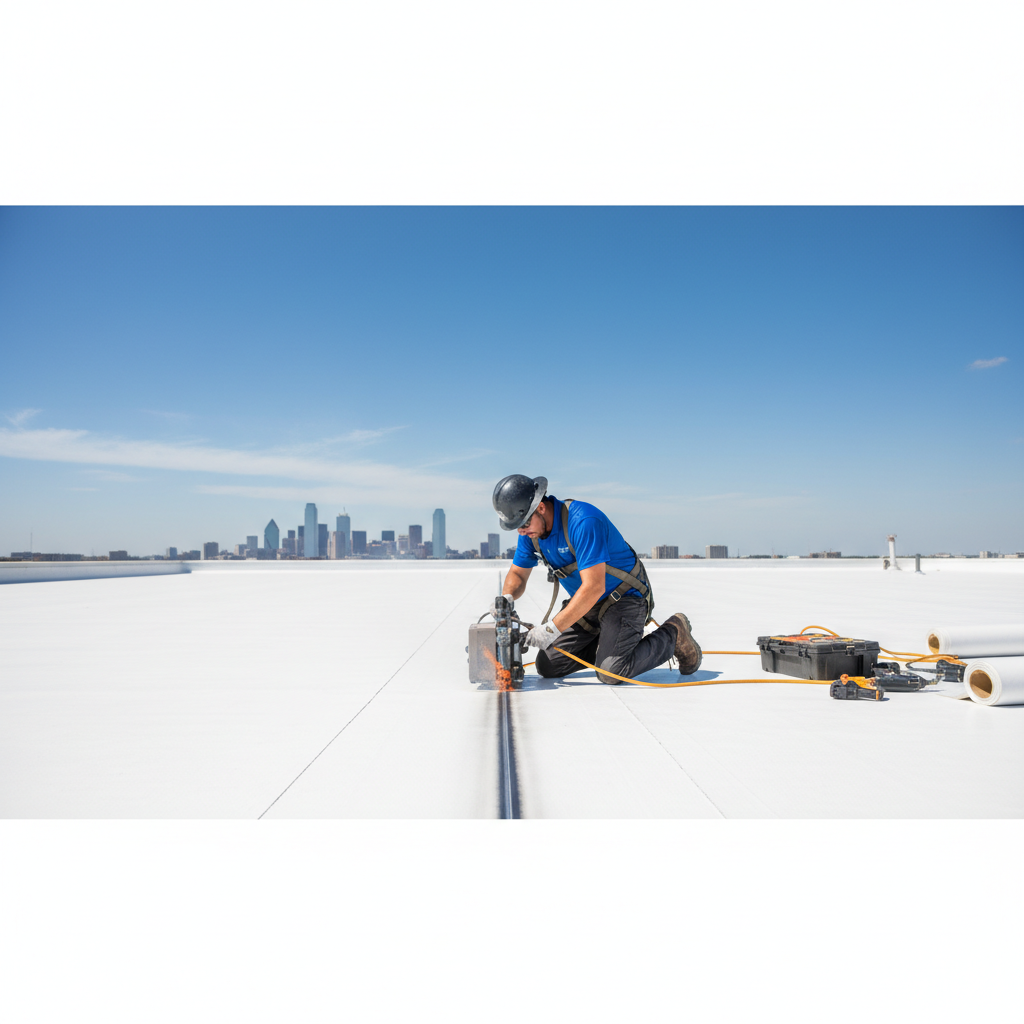
Facing a costly commercial roof repair in Texas? We break down typical costs for common issues like seam splits and leaks. Learn the financial framework to decide if a repair is smart or if a full roof replacement is the better long-term investment.
Categories: Roof Repairs & Restoration
The Big Question: Should I Approve a $12,000 Roof Repair?
You just received an estimate to fix your commercial roof. The number is not small. It might be $5,000, $12,000, or even more. Your immediate question is not just "Is this a fair price?" but something much more important: "Am I throwing good money after bad?" This is the core dilemma for facility managers, building owners, and property managers across Texas and Oklahoma. Spending a significant amount on a repair only for the roof to fail again in a different spot a year later is a frustrating and costly cycle. You need to know when a repair is a smart, strategic investment and when it’s a temporary patch on a problem that requires a full replacement.
This article is designed to answer that exact question. We will break down the typical costs for common commercial roof repairs, citing national benchmarks that provide a solid baseline. More importantly, we will provide a financial framework to help you make a thoughtful repair versus replacement analysis. The goal is to move beyond abstract pricing and give you the concrete information needed to decide whether to authorize that repair or start the conversation about a new roof.
The Cost of Common Commercial Roof Repairs
Before diving into the decision-making framework, it’s essential to understand the market rates for typical repair jobs. The figures below are based on national data and should be used as a baseline. Actual costs in Texas can fluctuate based on labor rates, material availability, and the current demand caused by storm seasons. For a deeper dive into the mechanics of these fixes, you can review our comprehensive Commercial Roof Repair Guide.
Disclosure: All cost data from external sources is noted for context. Material and labor pricing changes frequently. The most accurate cost information will always come from a detailed, current bid from a qualified local contractor.
Seam and Lap Repairs
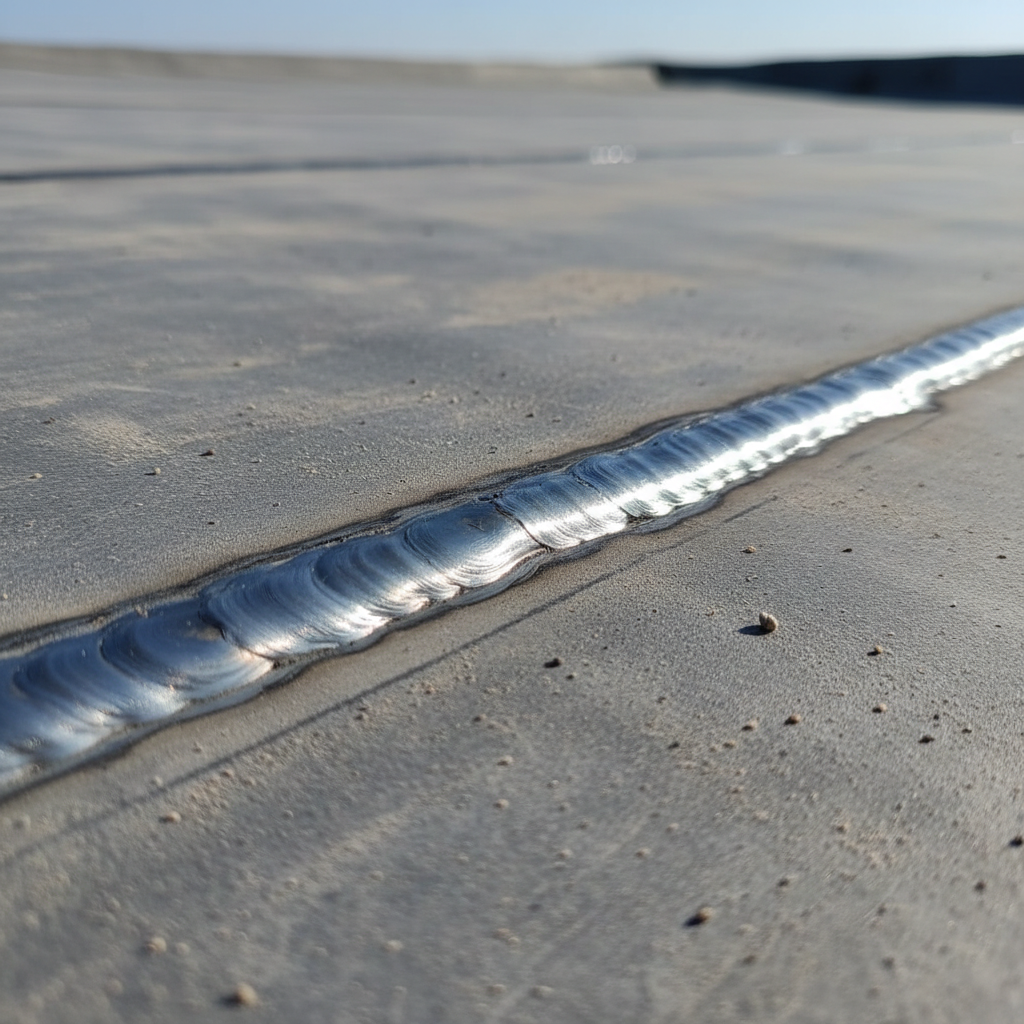
Seam failures are particularly common on single-ply systems like TPO and PVC, especially if the initial installation quality was subpar. Over time, exposure to UV radiation, thermal expansion, and contraction can weaken the bonds at the seams, creating entry points for water.
According to 2026 data from Lane Roofing, a single seam or lap repair can cost between $600 and $2,500. The price depends heavily on the linear footage of the damaged seam and the amount of cleaning and preparation required to get a solid weld. The real issue arises when a roof has systemic seam problems. If an inspection reveals 8 to 15 different areas with failing seams, you are no longer looking at a simple fix. The total repair cost could quickly escalate to a range of $5,000 to $37,500. At this point, the replacement conversation becomes unavoidable.
Penetration Flashing, Vents, and Curbs
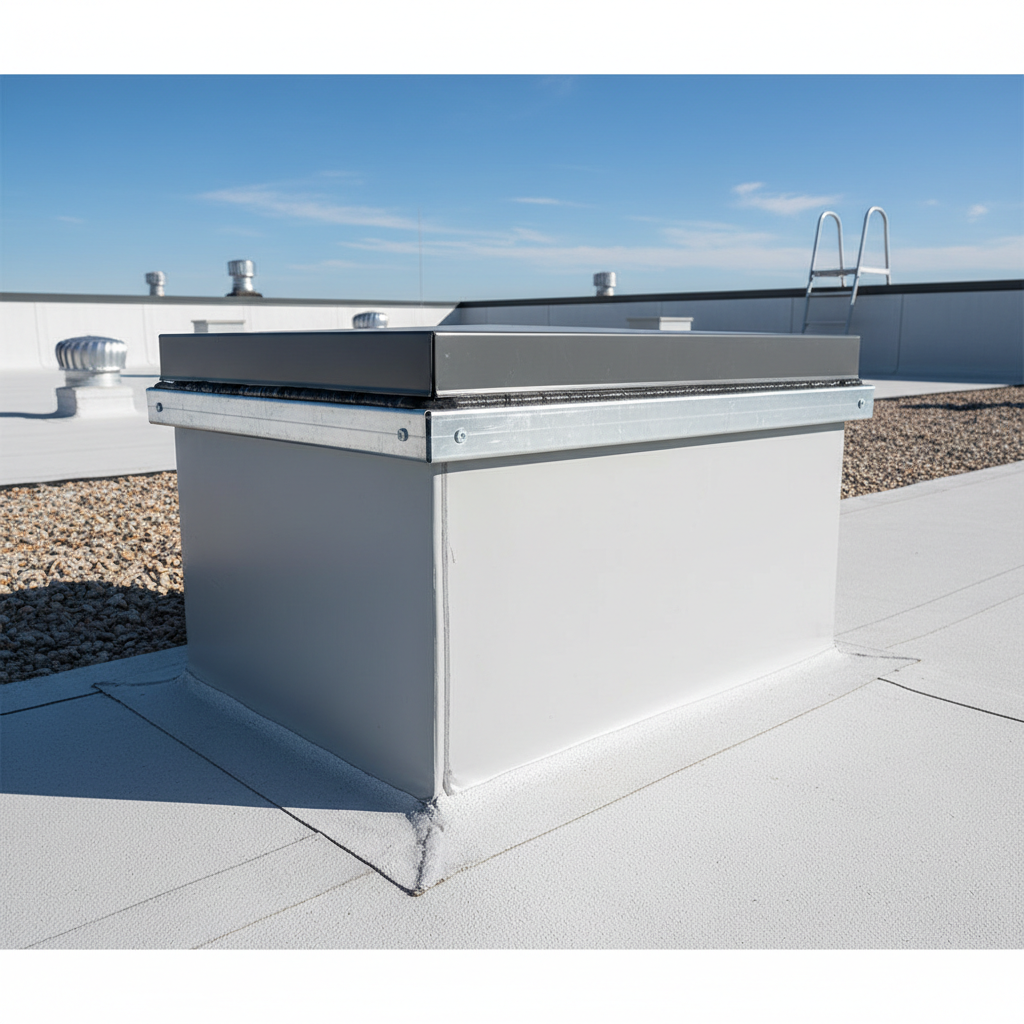
Anywhere something pokes through your roof—an HVAC unit, a plumbing vent, a drain, or electrical conduit—is a potential leak source. The flashing is the material that seals these transitions, and it is one of the most common failure points on any commercial roof.
For simple, small penetrations, the cost is relatively low. Data from Yutzy Roofing Service (2026) suggests a range of $200 to $500 per repair for a standard pipe boot or vent flashing. Simple repairs on small pipe boots or vents might be on the lower end, but flashing around large HVAC curbs, skylights, or complex ductwork is a different story. These require significantly more labor and materials to rebuild properly, pushing costs toward the $1,500 to $2,500 range per unit. If you have multiple aging HVAC units with failing curb flashing, the total repair bill can quickly approach five figures.
Membrane Punctures and Leaks
A straightforward puncture from a dropped tool or flying debris is often the most direct type of repair. For a standard, accessible roof area, resolving a single leak typically falls in the range of $350 to $1,500, as reported by Yutzy Roofing Service (2026). The cost variation depends on the size of the patch needed, the roof material, and the labor required to locate the entry point, which is not always directly above the interior drip. If the underlying insulation is saturated, the cost will increase as the wet material must be removed and replaced before the membrane can be patched.
Parapet Wall and Coping Cap Repairs
Parapet walls and the metal coping that caps them are critical components of your building's waterproofing envelope. Failed sealant joints, dislodged coping metal from wind events, or cracks in the wall itself can allow significant water intrusion. These repairs are usually priced per linear foot rather than per instance. Costs can vary widely based on the height of the wall, the type of metal coping, and whether underlying wood blocking or the wall substrate itself needs replacement. A simple resealing job might be minimal, but replacing sections of damaged coping can cost thousands.
Drain Repair and Ponding Water Correction
Many facility managers underestimate the complexity of drain repairs. A failing drain is not just a plumbing issue; it is a roofing issue. Properly replacing a commercial roof drain requires cutting back the existing membrane, setting the new drain body, and then integrating it flawlessly into the roofing system with new flashing. This is a skilled, multi-step process. A simple clog clearing is one thing, but a full drain replacement can be a significant expense.
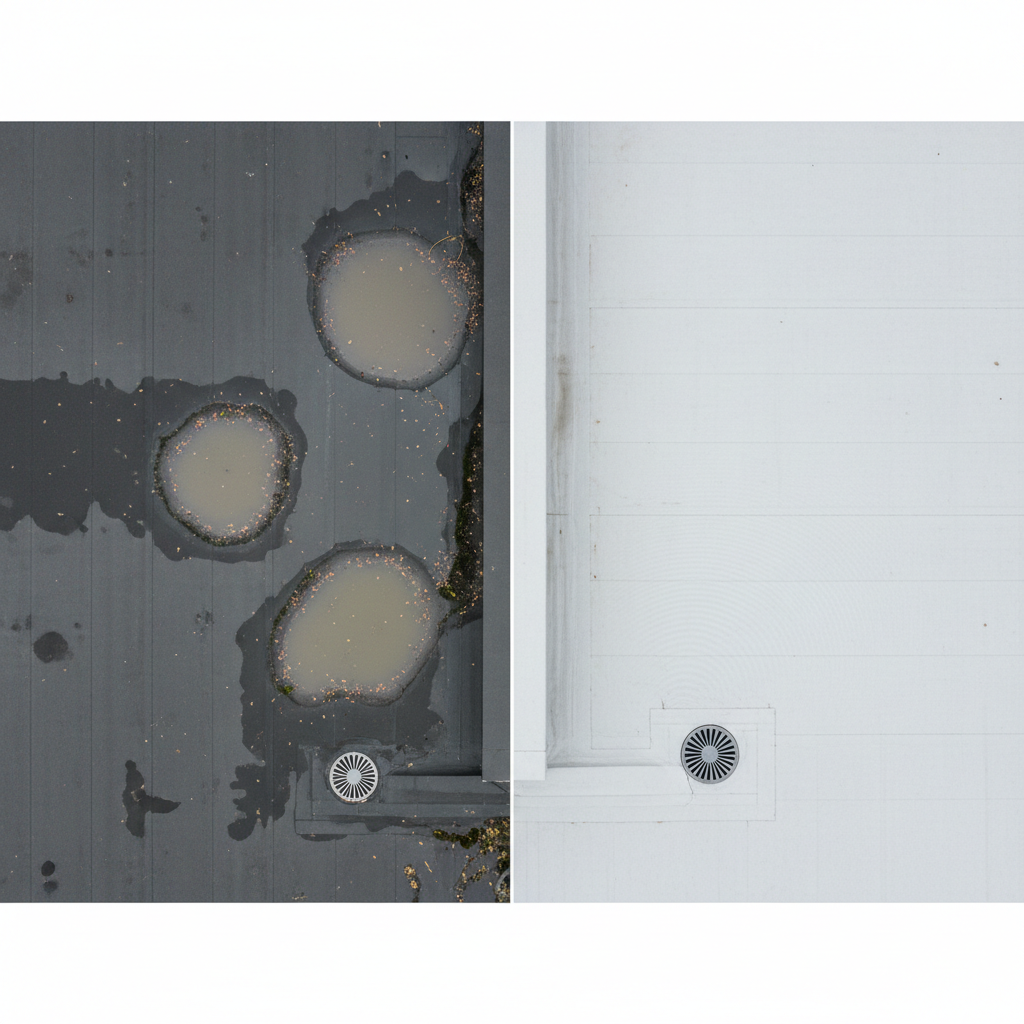
Even more costly is correcting the cause of ponding water. If your roof has low spots where water sits for more than 48 hours after rain, your membrane is deteriorating at an accelerated rate. This is often the largest single repair investment short of a full replacement. It involves adding custom-designed rigid insulation to create slope where none exists, directing water to drains. While effective, the material and design costs can be substantial, making it a primary trigger for the repair versus replace analysis.
Repair Quality: Is the Fix Going to Last?
The cost of a repair is irrelevant if it does not hold. A properly executed repair, completed by a certified technician using manufacturer-approved materials and methods, should last until the surrounding membrane reaches the end of its natural life. The key is in the preparation. Simply applying a tube of sealant over a gap is not a professional repair; it is a temporary stopgap that is almost guaranteed to fail.
A quality repair involves:
- Thorough Cleaning: The membrane surface must be completely clean, dry, and free of all contaminants.
- Proper Surface Preparation: This may involve primers or other treatments to ensure the new material will adhere or weld correctly to the old membrane. li>Manufacturer-Specified Materials: Using incompatible materials can cause a chemical reaction that damages the roof and voids any existing warranty.
- Correct Technique: For single-ply systems, this means proper heat-welding temperatures and speeds. For other systems, it means following precise application standards.
If you find yourself repairing the same spot every two years, it is a major red flag. This indicates one of three problems: the previous repairs were of poor quality, the surface preparation was inadequate, or there is a deeper, underlying issue that a surface patch cannot solve. A recurring leak demands a root cause assessment before you authorize another dollar for patchwork.
The Financial Framework: Repair vs. Replace
With an understanding of repair costs, you can now apply a logical framework to make your decision. This calculation balances the immediate cost of repair against the long-term value of a replacement. It considers two main factors: the percentage of the roof’s useful life remaining and the repair cost as a percentage of the total replacement cost.
The "25% Rule"
A widely accepted guideline in the industry is the "25% Rule." It states that if a roof has more than 25% of its expected service life remaining, it is generally worth repairing. If it has less, replacement becomes a more attractive option. For example, a 20-year TPO roof that is only 8 years old has 60% of its life left. A repair makes sense. A 15-year-old built-up roof with a 20-year life expectancy has only 25% of its life remaining, pushing it into the replacement consideration zone.
Financial Thresholds for Decision-Making
We can combine the 25% rule with repair cost thresholds to create a clear decision matrix. Let's assume a full replacement for your roof costs $100,000.
Scenario 1: Clear Case for Repair
- Condition: The proposed repair cost is less than 25% of the replacement cost (under $25,000 in our example).
- Roof Age: The roof has more than 40% of its useful life remaining (e.g., it is less than 12 years into a 20-year warranty).
- Decision: In this situation, repair is almost always the correct financial choice. The investment preserves a valuable asset that still has many years of service left.
Scenario 2: The Gray Area (Requires Full Assessment)
- Condition: The repair cost is between 25% and 35% of the replacement cost ($25,000 - $35,000).
- Roof Age: The roof is past the 60% mark of its expected life (12+ years old on a 20-year system).
- Decision: This is the tipping point. You need a complete condition assessment from a trusted contractor. The decision could go either way. If the rest of the roof is in excellent condition, the repair might buy you another 5-7 years. If there are signs of widespread aging, that $35,000 repair might only get you 2-3 years before another major issue arises, making replacement the smarter long-term play.
Scenario 3: Strong Case for Replacement
- Condition: The repair cost exceeds 35% of the replacement cost (over $35,000).
- Roof Age: The roof is well into the last third of its lifespan, or an inspection reveals multiple, distinct failure zones (e.g., widespread seam issues, failing flashing on most penetrations, and significant membrane degradation).
- Decision: At this level of investment, replacement is typically more economical over any horizon longer than two or three years. Spending $40,000 to "save" a roof that might only last another 24 months is poor asset management. The capital is better spent on a new system with a full 15 or 20-year warranty.
Texas and Oklahoma Market Context
The cost ranges provided are helpful national benchmarks, but it is important to understand the local market. Commercial roofing projects in the Dallas-Fort Worth area, for instance, are subject to a competitive labor market and frequent supply chain fluctuations. The same is true for the San Antonio market and for our clients in Tulsa and OKC. We operate in the heart of the hail corridor, and after a major storm event, demand for qualified labor and materials skyrockets, which can temporarily drive up repair costs.
An experienced regional contractor like TriVAN, with over 24 years of experience here, understands these dynamics. Our long-standing relationships with suppliers and deep bench of trained technicians allow us to provide stable, accurate pricing even in volatile market conditions. This regional expertise is critical when budgeting for repairs or planning for a large-scale replacement.
Conclusion: From Cost to Confidence
Ultimately, the numbers on a repair estimate are just the beginning of the story. Understanding the context—the type of repair, the condition of the rest of the roof, and where your roof is in its lifecycle—is what turns a cost into a confident decision. By using the financial framework of repair cost versus replacement cost and factoring in the age of your system, you can move from a reactive position to a strategic one.
A small, isolated repair on a young roof is a simple choice. A five-figure repair on an aging system requires careful thought. Before you approve that next big repair invoice, take a step back and run the numbers. A thorough diagnostic inspection may reveal that the smarter financial move is to channel that repair budget toward a full replacement, giving you two decades of peace of mind and predictable, low maintenance costs.
Tags: commercial roof repair cost, commercial roof repair cost Texas, flat roof repair cost, commercial roof seam repair cost, TPO roof repair cost, commercial roof leak repair cost, industrial roof repair cost, average cost of commercial roof repair, commercial roofing repair estimates, repair vs replace commercial roof