Asbestos in Roof Tear-Offs: A Guide for Texas Building Owners on Managing Hazardous Materials and Regulations
| By TriVAN Roofing | 10 min read
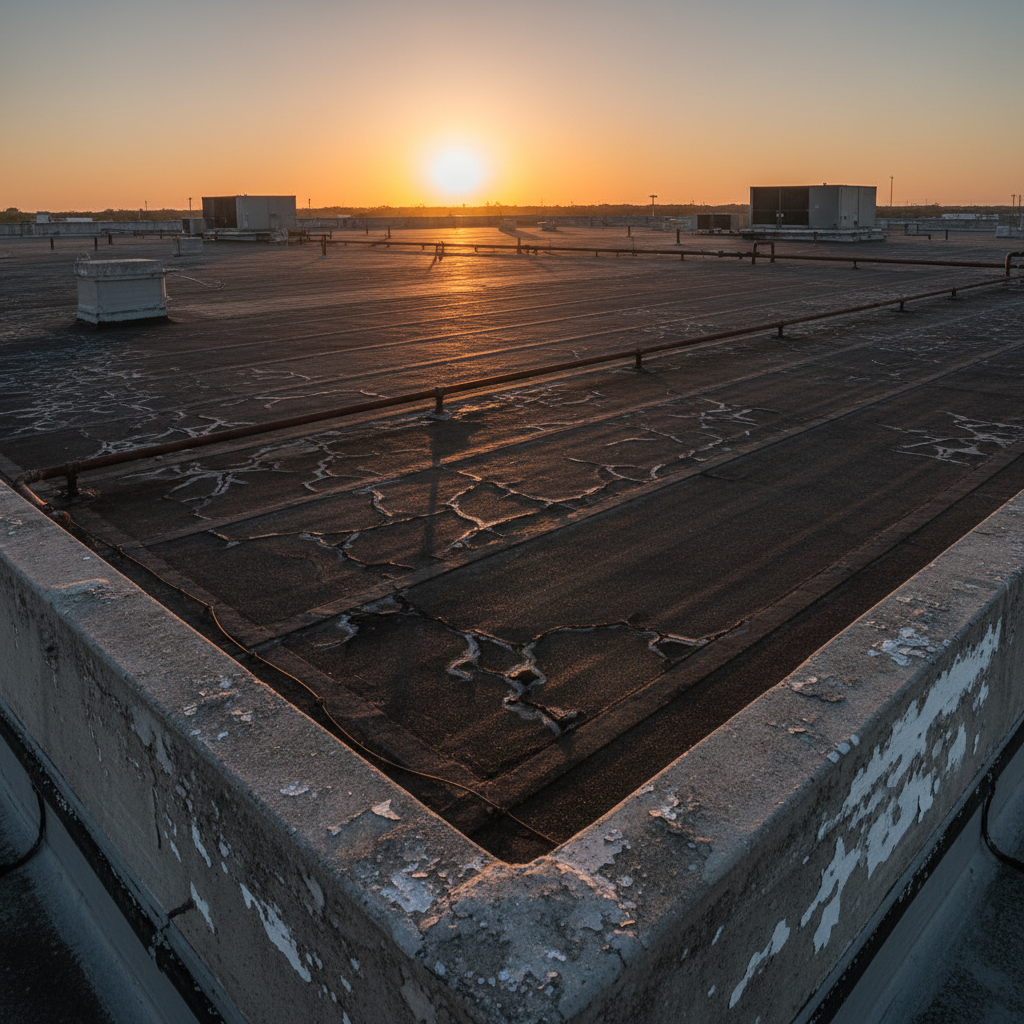
Before replacing a commercial roof on a pre-1990 Texas building, owners must address asbestos risks. This guide covers TCEQ rules, survey needs, abatement costs, and owner liability to prevent massive fines and project shutdowns before a tear-off.
Categories: Safety & Compliance
Asbestos in Commercial Roof Tear-Offs: A Guide for Texas Building Owners on Managing Hazardous Materials and Regulations
For facility managers and owners of aging commercial properties in Texas, planning a commercial roof replacement often focuses on budgets, timelines, and new material selection. Yet, a far more dangerous and costly issue lurks within the layers of any roof installed before 1990: asbestos. Ignoring this hidden hazard is not just a gamble; it’s a direct path toward regulatory violations, project shutdowns, massive cost overruns, and personal liability that can dwarf the original roofing budget. The assumption that your roof is "clean" until proven otherwise is one of the most consequential planning mistakes a building owner can make.
This is a topic many contractors are hesitant to raise proactively. The discovery of asbestos complicates bids and extends timelines, creating mixed incentives. Our goal here is different. As a trusted advisor, our priority is to equip you with the knowledge to manage this risk correctly from the outset. This guide provides a working knowledge of where asbestos hides, what Texas regulations demand, and how to navigate the process to protect your investment and your legal standing.
Where Asbestos Hides in Older Commercial Roofs
Before the Environmental Protection Agency (EPA) began heavily restricting its use in the late 1970s and 1980s, asbestos was a celebrated component in many building materials for its strength, durability, and fire resistance. In commercial roofing, it was a workhorse. Any building constructed before 1990 should be presumed to contain asbestos-containing materials (ACMs) until a proper laboratory analysis proves otherwise.
Here are the most common places asbestos is found in older commercial roofing systems:
- Built-Up Roofing (BUR) Felts: Many BUR systems installed before 1978 used roofing felts reinforced with chrysotile asbestos fibers. These fibers added tensile strength and fire-retardant properties to the asphalt-saturated layers.
- Mastics and Adhesives: The black, tar-like adhesives used to bond layers of insulation, flashing, and membrane often contained asbestos as a thickening and strengthening agent. These formulations were common well into the mid-1980s.
- Roof Coatings: Many silver or white reflective coatings applied over BUR systems to extend their life also contained asbestos. It served as a durable filler that improved the coating's weather resistance.
- Vermiculite Insulation: While not all vermiculite contains asbestos, a significant portion of the vermiculite sold in the U.S. for decades came from a mine in Libby, Montana, that was contaminated with tremolite asbestos. If your roof assembly includes loose-fill vermiculite insulation, it requires testing.
The complexity multiplies with layered systems. Consider a building with a BUR roof installed in 1972 and a new coating applied in 1981. It could easily have asbestos in the original felts *and* the top coating. A core sample that only analyzes the top layer will miss the hazardous material in the lower layers, which will inevitably be disturbed during a full tear-off. This is why a comprehensive, multi-layer analysis is essential.
The Regulatory Maze: NESHAP, TCEQ, and Building Owner Liability
The primary regulation governing asbestos during renovation and demolition is the EPA's National Emission Standards for Hazardous Air Pollutants (NESHAP). In Texas, NESHAP is enforced by the Texas Commission on Environmental Quality (TCEQ).
Here’s what every building owner needs to know:
- Notification is Mandatory: NESHAP requires the building owner or operator to notify the TCEQ at least 10 working days before starting any demolition or renovation activity that will disturb regulated asbestos-containing materials (RACM) above a certain threshold. This threshold is 160 square feet for surfaces or 260 linear feet for pipes. Nearly every full commercial roof tear-off will exceed this quantity if asbestos is present.
- TCEQ Has Teeth: The TCEQ has the authority to inspect job sites, issue immediate stop-work orders, and levy severe civil penalties for violations. Fines for non-compliance can reach $25,000 per day, per violation. A single project with multiple violations can quickly accrue six-figure penalties.
- The Owner is the Responsible Party: This is the most critical point. While a contractor may face penalties, the law identifies the owner of the building (the "regulated facility") as the primary responsible party. Hiring a contractor who promises to handle it "under the radar" does not absolve the owner of liability. If a violation occurs, the TCEQ will pursue the building owner. This personal liability makes proactive due diligence a necessity, not an option.
Friable vs. Non-Friable: A Critical Distinction That Changes Everything
The regulatory treatment of asbestos depends heavily on whether the material is "friable" or "non-friable."
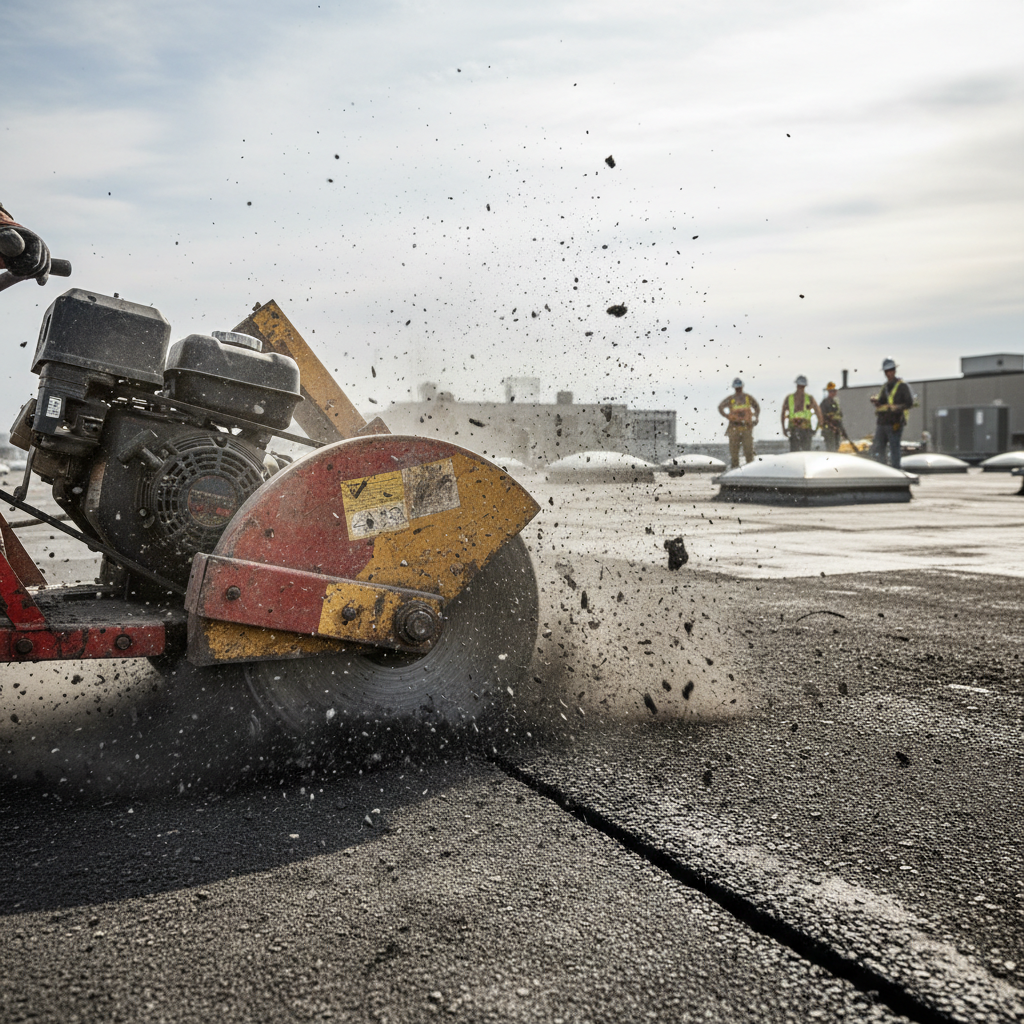
- Non-Friable ACM: This is material that cannot be crumbled, pulverized, or reduced to powder by hand pressure when dry. An intact sheet of asbestos-containing built-up roofing is typically classified as non-friable Category I material.
- Friable ACM: This is material that *can* be crumbled or reduced to powder by hand pressure. This is the most dangerous state, as fibers can easily become airborne and inhaled.
A common misconception is that because an old BUR roof is non-friable, it isn't regulated. This is false and dangerous. NESHAP regulations specifically state that if a non-friable material is subjected to sanding, grinding, cutting, or abrading, it must be treated as friable ACM.
This is where many projects run into trouble. The very act of mechanical removal changes the material's classification. Power tools like spud machines, saws, and grinders pulverize the non-friable matrix, releasing asbestos fibers into the air. At that moment, the material becomes regulated friable asbestos, and the project is immediately subject to the full force of NESHAP regulations.
The Mandatory Asbestos Survey: Your First Step, Not an Afterthought
To comply with NESHAP and avoid disaster, a thorough asbestos survey is required *before* any demolition or renovation activities begin. You cannot allow a contractor to begin tearing off the roof while survey results are pending. Doing so is a violation, regardless of what the contractor claims about the materials.
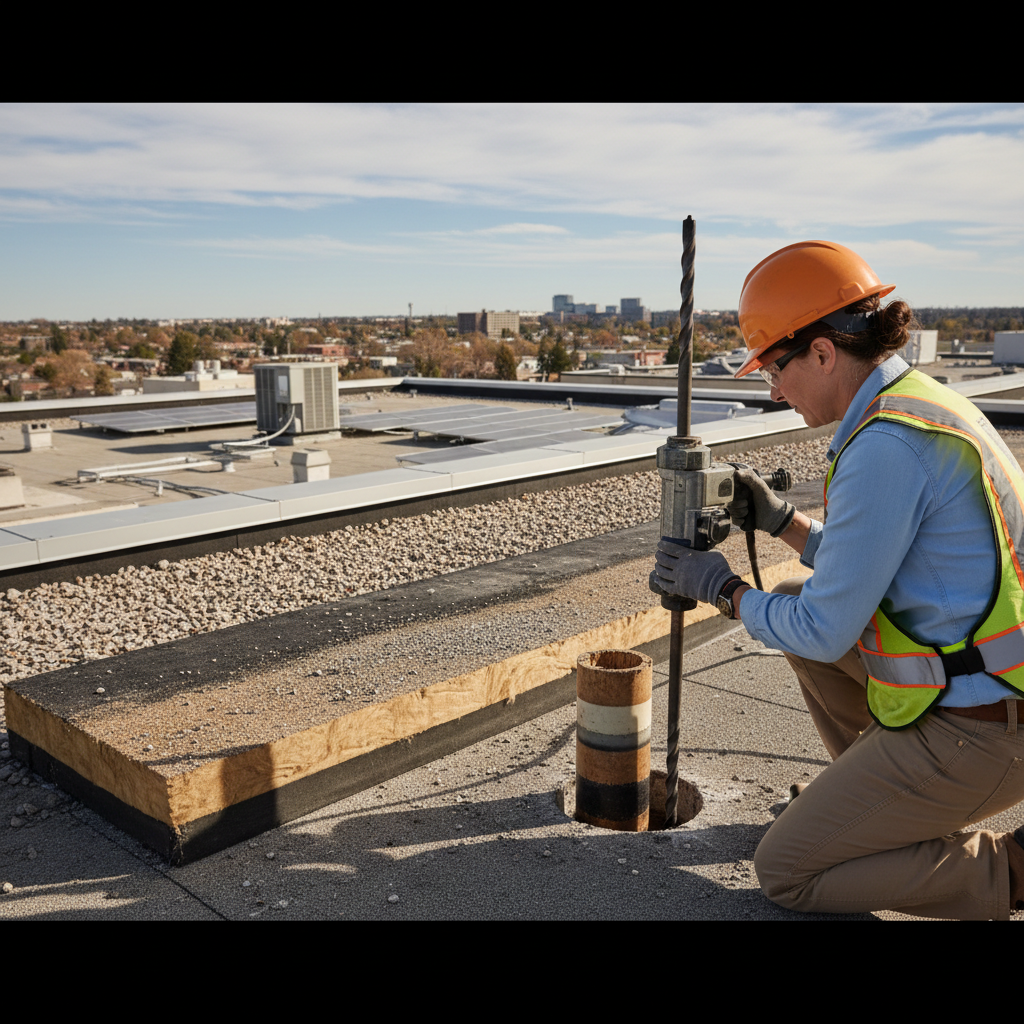
This survey is not a casual walkthrough. A Texas-licensed asbestos inspector must conduct a comprehensive assessment of all roofing materials and any associated components that will be disturbed during the replacement. The inspector will collect multiple bulk samples from different areas and layers of the roof assembly. These samples are then sent to an accredited laboratory for analysis using Polarized Light Microscopy (PLM). The final product is a formal written report that documents the findings, quantifies any ACM, and maps its location. This report is your legal proof of due diligence and the roadmap for the project.
The correct project sequence is:
- Commission an asbestos survey.
- Receive the formal report.
- Use the report to create an accurate scope of work for your roof replacement bid package. If abatement is needed, the bid must specify it.
The Financial and Timeline Fallout of an Asbestos Discovery
Discovering asbestos mid-project is a catastrophe. Discovering it beforehand is simply a planning factor. The financial and logistical impacts are significant but manageable when planned for.
Cost Implications: Asbestos abatement is a specialized trade that adds substantial cost to a project. On average, building owners can expect abatement to add $3 to $8 per square foot to the total project cost. The exact price depends on the material type, quantity, accessibility, and disposal fees. For a 50,000-square-foot roof, this could mean an unbudgeted expense of $150,000 to $400,000.
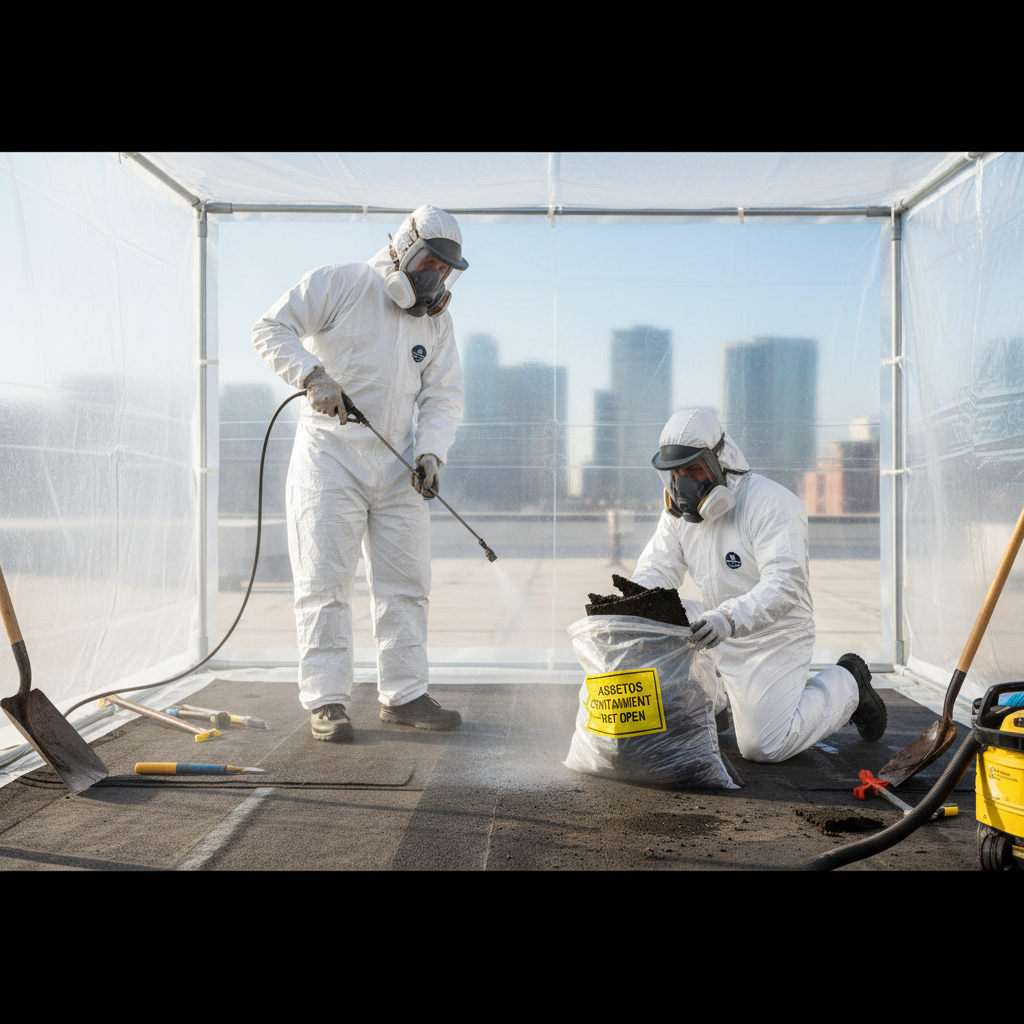
This cost is driven by the strict, legally mandated procedures for removal. The work must be performed by a Texas-licensed asbestos abatement contractor. The process involves establishing regulated work areas, using wet methods to suppress dust, employing HEPA-filtered vacuums, building negative air pressure containments, and ensuring all waste is properly sealed, labeled, and transported to a permitted landfill. After removal, a licensed industrial hygienist must conduct air monitoring to verify the area is clean before roofing contractors can begin their work.
Timeline Implications: Abatement can easily add 2 to 4 weeks or more to a project timeline. This delay can be devastating for time-sensitive projects. For example, a school district planning a roof replacement during the summer break could see its entire installation window consumed by abatement work. A mid-project discovery would force roofing work into the active school year, creating enormous logistical and safety challenges. For public entities like schools and municipalities, using pre-approved TIPS vendor contracts can help streamline the procurement of qualified contractors who understand these complex requirements.
Don't Forget Lead: A Parallel Hazard on Parapets and Metal
Asbestos isn't the only hazardous material to consider. For commercial buildings constructed before 1978, lead-based paint is another significant concern. During a roof replacement, work often involves disturbing painted surfaces like:
- Parapet walls
- Metal coping caps
- HVAC curbs and equipment stands
- Pipes and vents
If these surfaces are coated with lead-based paint, disturbing them through scraping, sanding, or demolition triggers the EPA's Renovation, Repair and Painting (RRP) Rule. This rule requires certified firms and renovators to follow specific lead-safe work practices to prevent lead contamination. Like asbestos, this requires testing before the project begins and can add cost and complexity if lead is present.
A Proactive Strategy for Texas Building Owners
Facing these regulations can feel overwhelming, but a simple, proactive strategy puts you in control and shields you from liability. As a woman-owned business with over two decades of experience helping clients navigate these challenges, we recommend the following approach for any pre-1990 building:
- Assume Nothing, Test Everything: Treat your building's age as the primary trigger. If it was built before 1990, engage a third-party, Texas-licensed asbestos inspector to perform a comprehensive survey of the roof and any associated components slated for disturbance. Also, test for lead on painted surfaces if the building is from before 1978.
- Build Your Plan on Facts: Use the survey report as the foundation of your project's scope. If hazardous materials are present, the bid documents you send to roofing contractors must include the survey and explicitly require that abatement be performed by a licensed specialist as part of the project.
- Hire a Partner, Not Just a Bidder: Select a roofing contractor with verifiable experience managing projects that involve abatement. They should understand the sequencing, the need for third-party air clearance, and how to coordinate their work with the abatement team. They act as your project partner, ensuring the transition from abatement to new roof installation is seamless.
By taking these steps, you transform a massive unknown risk into a known, manageable line item. You avoid the panic of a stop-work order, the shock of a six-figure change order, and the legal peril of a TCEQ violation. A properly planned and executed project not only complies with the law but also ensures you receive the full value of your investment, protected by comprehensive roof warranties that are only valid with proper substrate preparation. The long-term health of your facility depends on both the new roof and the diligence performed before it was ever installed. This includes scheduling regular roof inspections to maintain your asset for years to come. If you have questions about an older commercial roof, Contact TriVAN Roofing today.
All 14 deliverables complete.Tags: asbestos in commercial roof tear-off, hazardous materials commercial roofing, Texas asbestos regulations, TCEQ asbestos notification, NESHAP roofing requirements, commercial roof replacement Texas, asbestos survey for commercial building, cost of asbestos roof abatement, friable vs non-friable roofing materials, lead based paint commercial roofing